


Foliate Engraved Silver Case
These foliate engraved silver case pieces are pocket companions and desk accessories worked with scrolling leaf patterns.
Foliate Engraved Silver Case
When you search for a foliate engraved silver case, you are looking at small personal containers decorated with leaf and scroll motifs. These items span the Victorian and Edwardian eras, emerging in forms such as vesta cases, card cases, and cigarette cases.
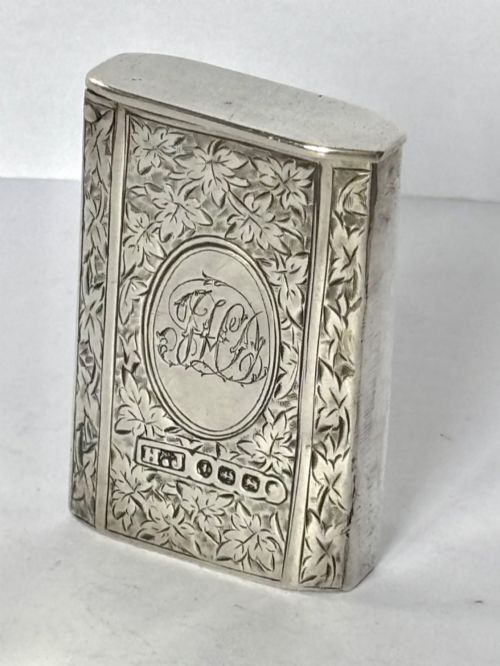
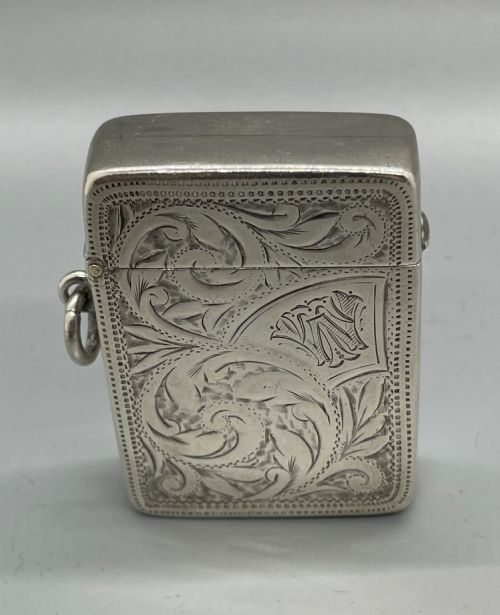
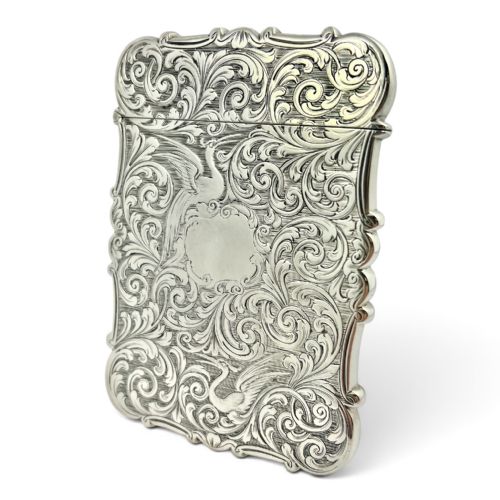
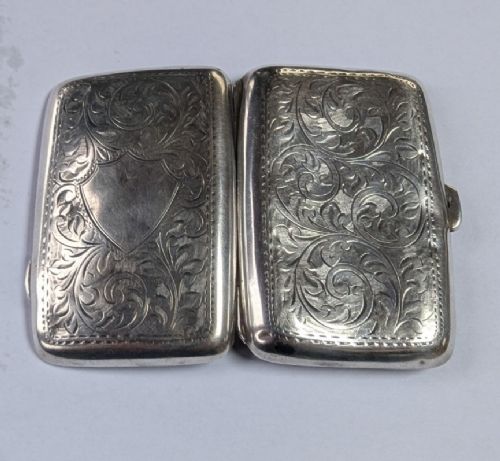
The versions you meet most frequently on this page are vesta cases and card cases made from sterling silver. They carry surface decoration cut by hand, showing scrolling foliage that covers the front and reverse.
Makers produced these pieces across provincial workshops and major centres like Birmingham. They served daily social and domestic needs, holding matches, calling cards, or cigarettes in a waistcoat pocket or handbag.
How they were made
Silversmiths formed these objects from sterling silver sheet, pressing or hammering the metal to shape before adding hinged lids or flip tops. Internal linings in pieces like card cases or boxed sets often incorporated silk, velvet, or leatherette.
The characteristic foliate decoration was applied using hand gravers to cut scrolling leaves and floral patterns directly into the silver. Punch work and stippling frequently filled the background spaces to make the bright-cut engraving stand out.
Some nineteenth-century match containers were built to stand upright on a desk, ready to save fingers from charcoal.
What varies in quality
Quality rests in the crispness of the hand engraving and the depth of the metal work. Pieces with deep, clear foliate carving retain their visual impact better than those with worn surface decoration.
Construction details also separate standard examples from finer items. Well-fitted hinges, snug lids, and clear hallmarks show the care taken by the original maker.
Howard James·Nathaniel Mills·Sampson Mordan·Robert Pringle
The Foliate Engraved Silver Case Glossary
- Sterling silver
- A silver alloy containing 92.5 percent pure silver and 7.5 percent other metals, usually copper, used for durability in tableware and small personal items. This standard was marked with the lion passant on British pieces.
- Vesta case
- A small pocket container designed to hold matches, usually fitted with a striker on the base. Victorian and Edwardian examples were often decorated with foliate engraving.
- Card case
- A flat protective container used for carrying visiting cards during the nineteenth and early twentieth centuries. These were frequently fashioned from silver and ornamented with chased or engraved designs.
- Bright-cut engraving
- A surface decoration technique using faceted cuts made with a graver to reflect light. It creates a sparkling effect across the scrolling leaf patterns.
- Hallmark
- A series of official marks stamped on precious metals to show the standard of purity, the assay office, and the year of making. These stamps help date items accurately.
Foliate Engraved Silver Case: Frequently Asked Questions
What is a vesta case?
A vesta case is a small pocket container made to hold matches safely. They feature a striking surface on the bottom.
Victorian examples often show detailed foliate engraving across the silver body.
How do I date a silver case?
Dating relies upon the hallmarks stamped into the silver. These marks reveal the assay office and the year letter.
Style and construction methods also help identify whether a piece belongs to the Victorian or Edwardian period.
Were these cases used daily?
These items were everyday accessories carried in pockets or handbags. Card cases held visiting cards for social calls, while vesta cases kept matches dry.
Their sturdy sterling silver construction suited this constant handling.