

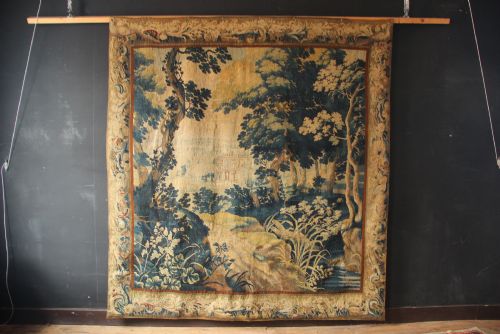
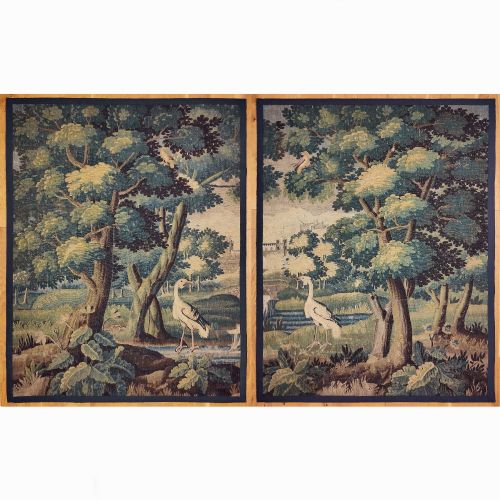


Foliage Landscape Tapestry
A foliage landscape tapestry brings ancient woodland straight onto your drawing room wall, rich with leafy glades and distant trees.
Foliage Landscape Tapestry
A foliage landscape tapestry represents woven scenes dominated by dense woodland foliage, often termed verdure tapestries in the trade. These hangings transform plain walls into atmospheric forest views filled with leaves, trees, and occasional glimpses of distant architecture or wildlife.
Most examples encountered on this page originate from seventeenth and eighteenth century Flemish workshops or Aubusson in France. Buyers frequently meet formats ranging from expansive wall panels to narrow vertical lengths and paired compositions designed to flank a doorway or fireplace.
The aesthetic centres on deep greens, blues, and earthy tones that have mellowed over centuries into softer olive and brown hues. Every piece reflects the historic European fascination with bringing untamed nature indoors through textile art.
Materials and Construction
Weavers constructed these panels primarily using wool, silk, and linen yarns on large looms. Wool provided the heavy structural weight and durable body of the textile, while silk highlights added subtle luminosity to foliage and highlights.
Linen often served as a robust warp thread or backing support to bear the considerable tension of the loom. Artisans dyed these animal and plant fibres by hand, building up the rich palette necessary to render layered leaves and shadowy undergrowths.
Foliage Landscape Tapestry Retail Price Guide 2026
Typical asking prices for foliage landscape tapestry among the pieces listed under this phrase on Sellingantiques today, from the lower quarter to the upper quarter. They describe what is for sale here now, not the wider market.
The current selection spans the seventeenth, eighteenth, and late nineteenth centuries, featuring works originating from Flemish and French workshops.
Assessing Quality
The distinction between standard and superior pieces rests on the complexity of the botanical detailing and the depth of the perspective. Finer examples display meticulous variation in leaf shapes and naturalistic colour shading that creates a convincing sense of a deep forest.
Weaving density and the skilful integration of silk threads dictate how vividly the landscape catches the light. Greater density allows for intricate rendering of tree bark, overlapping foliage, and subtle atmospheric distance.
The Foliage Landscape Tapestry Glossary
- Verdure
- A type of tapestry featuring plant motifs, foliage, and landscapes as the primary subject matter rather than human figures or historical narratives. These scenes focus entirely on stylized trees, shrubs, and grassy banks.
- Aubusson
- A town in central France renowned for its historic tapestry weaving industry, particularly celebrated for floral and verdure designs produced from the seventeenth century onwards. Aubusson pieces often exhibit a lighter, more decorative palette than their Flemish counterparts.
- Flemish Baroque
- An artistic style prevalent in seventeenth century Flanders that heavily influenced contemporary weavers to create dynamic, dramatic compositions with rich textures. This aesthetic translates into swirling foliage and dramatic contrasts of light and shadow within the textile.
- Warp
- The vertical set of stationary threads held under tension on a loom before the colouredweft yarns are passed through horizontally. In these historic textiles, warp threads typically consist of sturdy linen or wool.
Foliage Landscape Tapestry: Frequently Asked Questions
How do I hang a heavy tapestry safely?
Hanging a large textile requires distributing the weight evenly across the entire top edge rather than suspending it from a few isolated points. Conservation framing or stitching a strong linen sleeve to the reverse to accommodate a padded wooden batten ensures the weight rests safely without distorting the weave.
Keep the hanging away from direct sunlight and damp walls to protect the natural wool and silk fibres from fading or deterioration over the years.
What is a verdure tapestry?
A verdure tapestry is a specific genre of wall hanging dedicated entirely to botanical subjects, foliage, and landscape views rather than battle scenes or mythological stories. These pieces were historically commissioned to create the illusion of an indoor garden or forest.
The imagery typically showcases dense clusters of leaves, ferns, and towering trees, sometimes accompanied by birds or distant chateaux nestled in the greenery.
How do I tell Flemish and Aubusson pieces apart?
Flemish tapestries from the seventeenth century generally feature heavier, darker tones with intense greens and browns, reflecting a dense, dramatic baroque sensibility. Their composition tends to feel wilder and more enclosed by thick forest canopies.
Aubusson pieces often display a slightly brighter, more orderly French aesthetic with refined borders and lighter blue and green hues that mirror eighteenth century decorative tastes.