
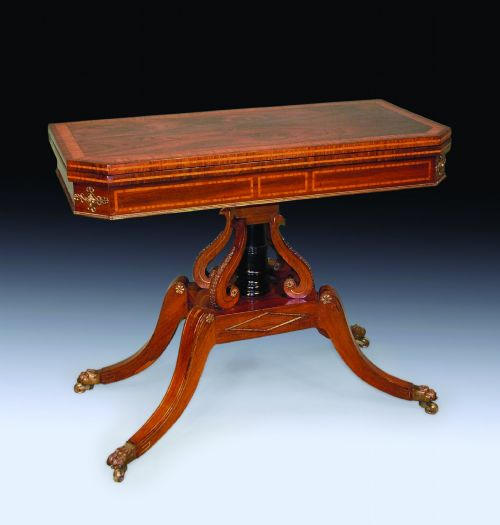
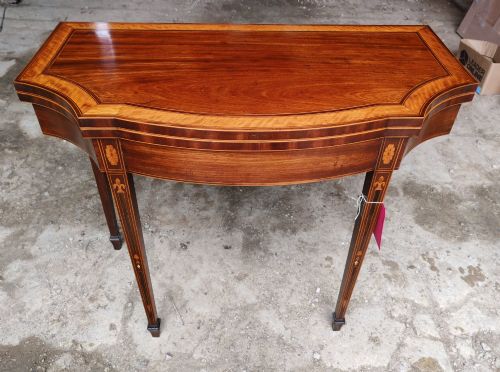
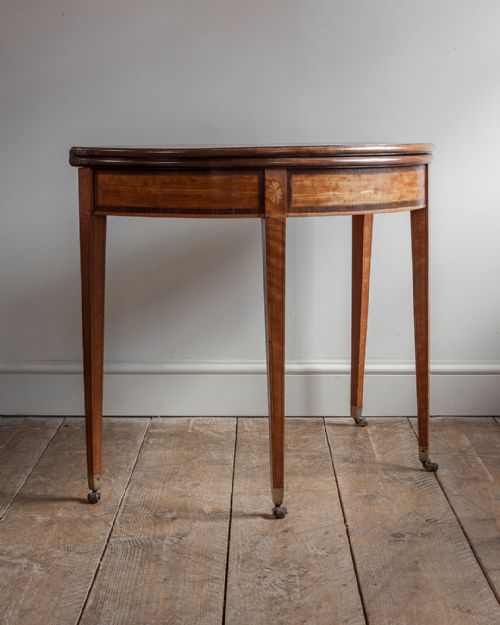
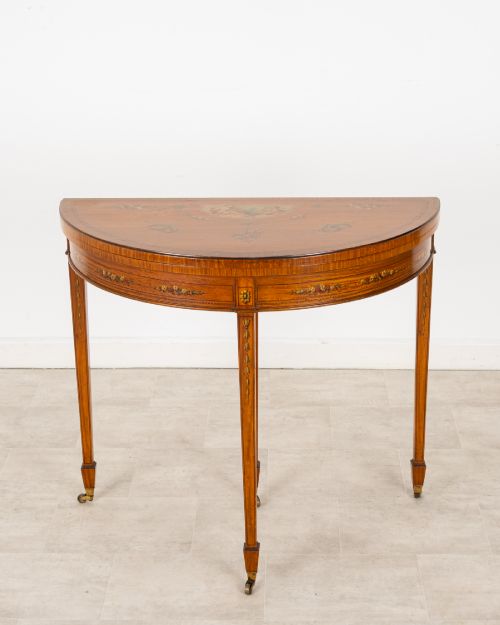


Folding Satinwood Games Table
A folding satinwood games table is a clever piece of adaptable furniture designed for card playing and social evenings.
Folding Satinwood Games Table
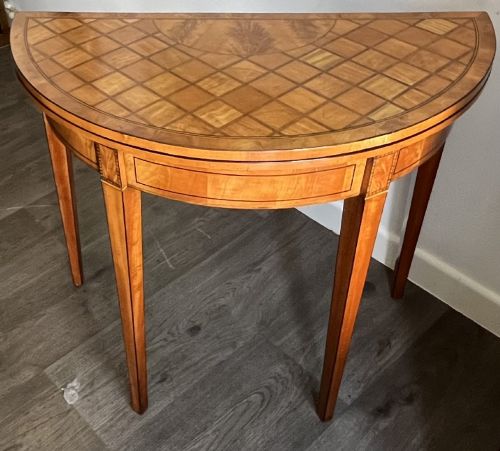
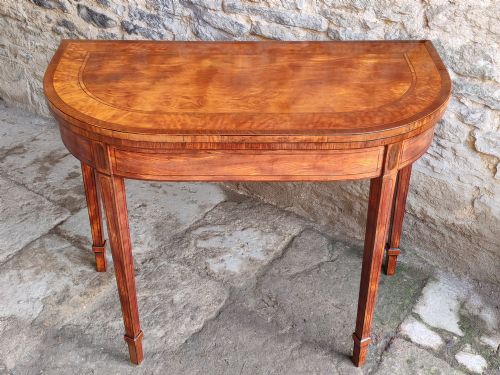
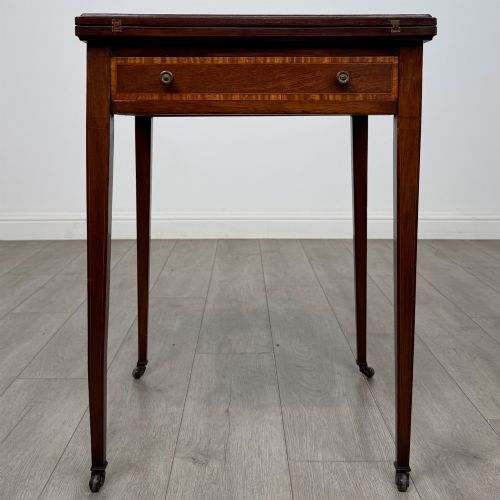
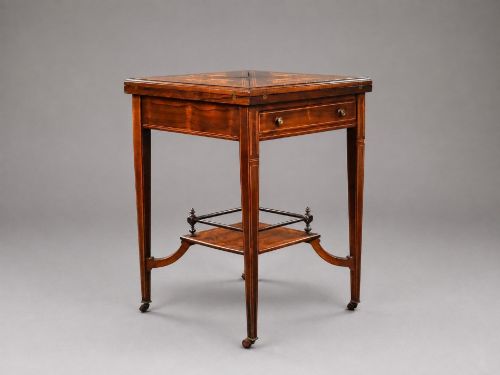
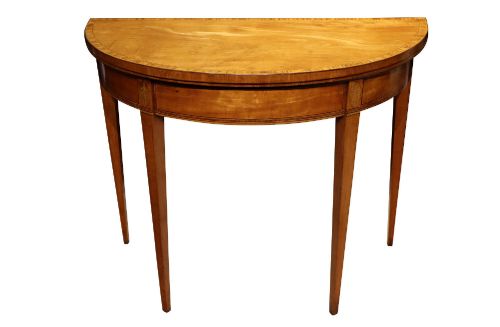
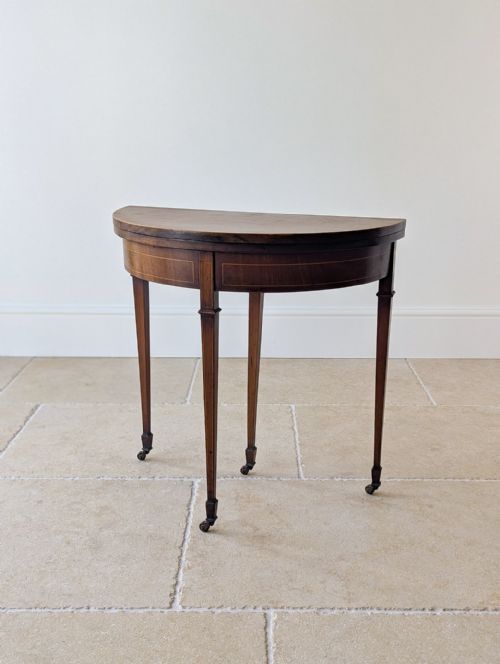
A folding satinwood games table is a versatile surface engineered to transform from a compact console or side piece into a full table for cards and social pastimes. These pieces appear in forms such as demi-lune, envelope designs, and fold-over configurations from the Georgian and Edwardian eras.
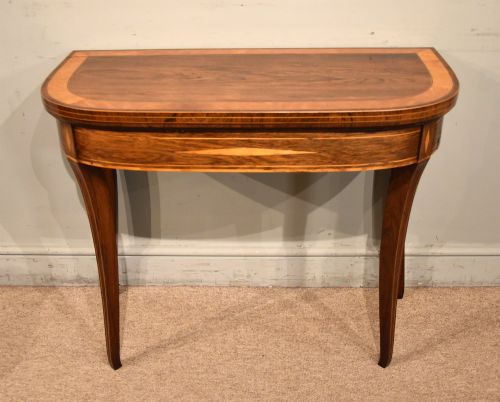
The materials seen on this page combine golden timbers with contrasting veneers and inlays. Makers often paired satinwood with mahogany, rosewood, kingwood, and ebony to create geometric borders and painted motifs.
Originating largely in the 18th and 19th centuries, these items reflect changing domestic habits where furniture needed to adapt quickly for guests. The selection ranges from George III neoclassical pieces to later Sheraton revival iterations.
Materials and construction
Cabinet makers utilised satinwood veneers applied over secondary timbers like mahogany to achieve a bright, reflective surface. Crossbanding in kingwood or rosewood provides a crisp border around the primary top.
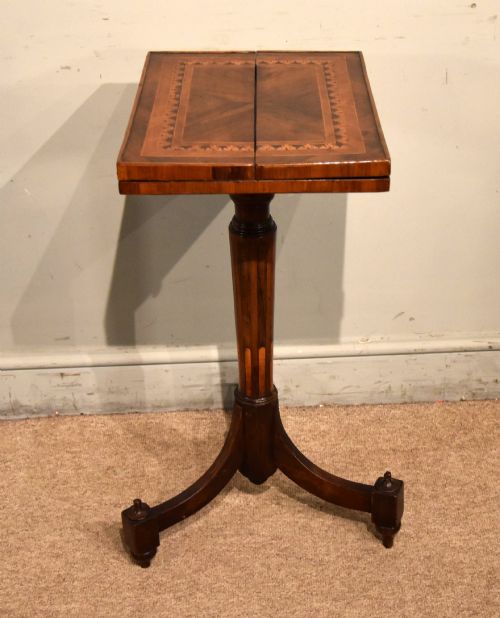
Inlay work relied on contrasting woods such as boxwood and ebony, carefully cut and fitted into precise channels. Painted decoration also appears on certain surfaces, adding delicate floral or classical motifs directly onto the wood.
Some tables include hidden wells beneath the folding top specifically designed to store stray dice, counters, and stray playing cards out of sight.
Evaluating the craftsmanship
The precision of the inlay work separates standard examples from exceptional ones. Sharp mitres in the crossbanding and tight joints where different wood species meet indicate a skilled hand at the workbench.
The smoothness of the folding or rotating mechanism dictates how well the piece functions in daily use. Superior examples maintain stability and alignment when opened, without sagging at the hinge or pivot points.
Howard & Son's·Maples of London
The Folding Satinwood Games Table Glossary
- Satinwood
- A tropical hardwood known for its golden-yellow colour and lustrous, reflective grain. It serves as the primary decorative veneer on many 18th and 19th-century tables.
- Demi-lune
- A half-moon shape characteristic of tables designed to sit flat against a wall when folded. These pieces open up into a full circle for play.
- Crossbanding
- A strip of veneer applied to the border of a table top with the grain running perpendicular to the centre. This technique frames the primary wood.
- Envelope table
- A square card table with four triangular flaps that fold inward to cover the top like an envelope. Rotating the top reveals the folding leaves.
- Parquetry
- Geometric patterns formed by fitting small pieces of contrasting wood together. It frequently decorates the tops of formal gaming surfaces.
Folding Satinwood Games Table: Frequently Asked Questions
How do these tables open?
Most examples feature a fold-over leaf supported by a swinging rear leg or a rotating mechanism. When closed, they function as side or console tables against a wall.
Opening the top reveals a baize-lined or polished wooden surface intended for cards or board games.
What periods do they come from?
The pieces span the Georgian, Regency, and Edwardian eras, with many dating from the late 18th century through to the early 20th century.
Revival styles from the Victorian period also replicate earlier neoclassical designs.
Where were they placed in a home?
These items typically stood in drawing rooms, parlours, or reception spaces where guests gathered for entertainment. Their compact closed footprint allowed them to save space until needed.
They often doubled as tea tables or writing surfaces between gaming sessions.
What is satinwood?
Satinwood is a dense hardwood valued for its shimmering, light-reflecting grain and warm yellow tone. It provides an ideal canvas for contrasting stringing and crossbanding.
Cabinet makers used it extensively during the neoclassical period for high-status formal furniture.