

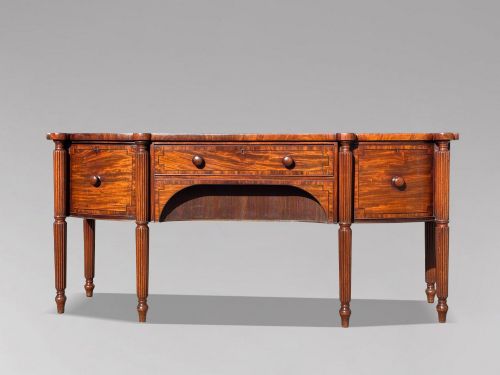
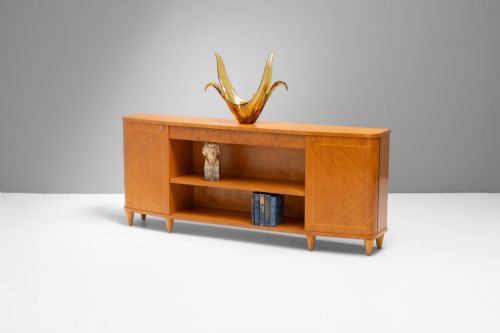
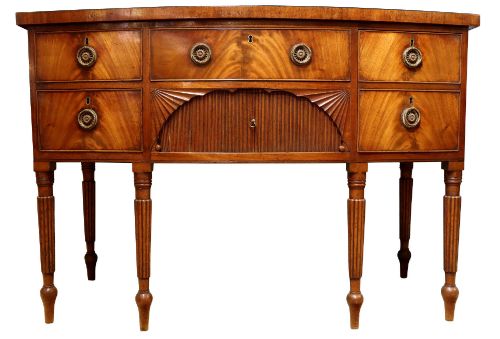
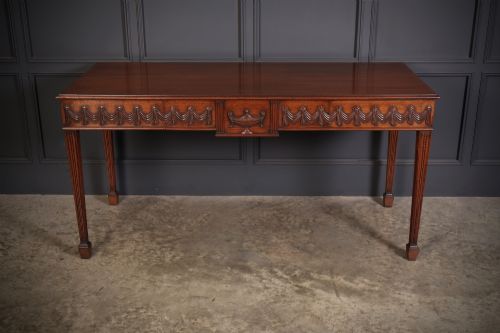


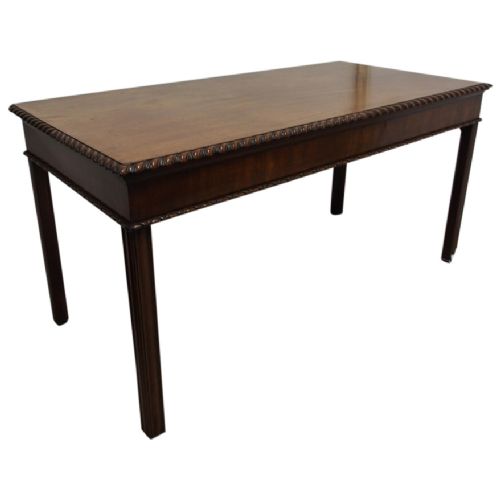

Fluted Leg Sideboard
A fluted leg sideboard brings architectural line and warmth to a room, offering practical storage disguised by classical detail.
Fluted Leg Sideboard
A fluted leg sideboard encompasses serving tables, servers, and console tables rooted primarily in the Georgian and Regency periods, alongside later revivals. These forms span straight fronts, bow fronts, and serpentine profiles designed for dining rooms and grand halls.
Buyers searching for a fluted leg sideboard will frequently encounter mahogany timbers, often enhanced by flame veneers or satinwood inlay, supported by legs carved with vertical grooves. Origins stretch from English workshops to Irish commissions and French commodes sharing similar classical proportions.
The selection ranges from eighteenth-century George III originals to nineteenth-century interpretations and later revival pieces from eighteen eighty. Each version provides surface area and storage while displaying the characteristic linear carving that defines the style.
Materials and Construction
Makers built these pieces primarily using solid mahogany and walnut, frequently applying flame mahogany or burr walnut veneers to larger surfaces to create striking grain patterns. Satinwood provided contrast through delicate inlay work, while gesso and gilt details highlighted specific decorative elements on select tables.
Carpenters formed the characteristic flutes by cutting parallel hollow grooves directly into the solid wood of the legs, imparting a slender, column-like appearance. Brass fixtures such as handles and gallery rails completed the construction, combining structural timber with refined hardware.
Fluted Leg Sideboard Retail Price Guide 2026
Typical asking prices for fluted leg sideboard among the pieces listed under this phrase on Sellingantiques today, from the lower quarter to the upper quarter. They describe what is for sale here now, not the wider market.
Listings feature mahogany, walnut, and satinwood across eighteenth and nineteenth-century periods, including George III and Regency styles.
Distinguishing Quality
Quality reveals itself in the crispness of the carved fluting and the selection of timber, where matched flame veneers or figured walnut demonstrate superior craftsmanship. The integration of secondary woods and the precision of dovetail joints in the drawers indicate the standard of workshop execution.
Proportion and scale separate standard examples from exceptional pieces, particularly where serpentine or bow fronts demand complex bending of timber. Original brass hardware and untouched patination further elevate the standing of a piece.
Gillows
The Fluted Leg Sideboard Glossary
- Fluting
- Vertical parallel grooves carved into a column or leg for decorative effect. This classical detail draws the eye downward and lightens the visual weight of the support.
- Serpentine
- A front profile that curves outward in the centre and inward at the sides, or vice versa. This complex shape requires considerable skill from the carpenter.
- Bow front
- A convex, outward-curving front common on eighteenth and nineteenth-century case furniture. It softens the corners of the room and increases internal capacity.
- Veneer
- A thin layer of figured wood applied over a secondary timber base. Flame mahogany and burr walnut veneers create decorative surface patterns.
- Gesso
- A plaster-based mixture applied to wood and carved or gilded. It provides a smooth base for rich surface decoration on revival pieces.
Fluted Leg Sideboard: Frequently Asked Questions
What is a fluted leg sideboard?
A fluted leg sideboard is a serving table, server or sideboard featuring vertical grooved carving on the legs, drawing on classical architectural styles.
These pieces typically date from the Georgian and Regency eras, as well as later nineteenth-century revival periods, combining storage with refined carving.
How do I date a sideboard?
Dating relies on timber choice, construction methods, hardware, and stylistic details such as leg profiles and inlay patterns.
Earlier pieces from the eighteenth century often feature hand-cut dovetails and native timbers, while nineteenth-century revivals adopt specific stylistic revivals from earlier reigns.
Where should I place a serving table?
These tables suit dining rooms for serving food and storing linens, or hallways as console tables to anchor a large mirror or artwork.
Their shallow depth allows them to sit comfortably against walls without obstructing walkways in living spaces.
How do I care for antique mahogany?
Maintain mahogany surfaces by keeping them away from direct sunlight and sudden temperature changes that can dry out the timber.
Regular dusting with a soft cloth and occasional application of appropriate wax preserves the natural lustre and grain.