




Fluted Leg Dining Sideboard
A fluted leg dining sideboard brings neoclassical discipline to the dining room, offering stately proportions and disciplined linear ornament.
Fluted Leg Dining Sideboard
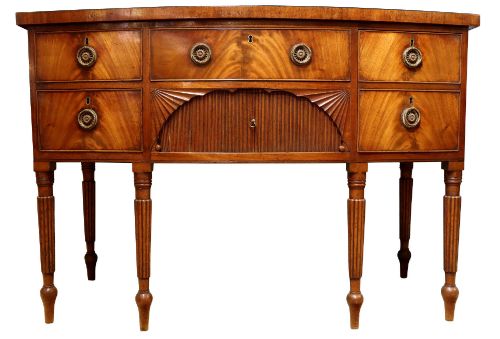
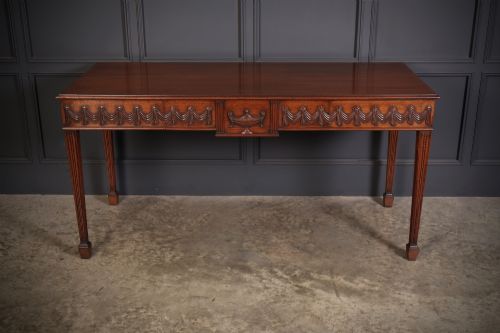
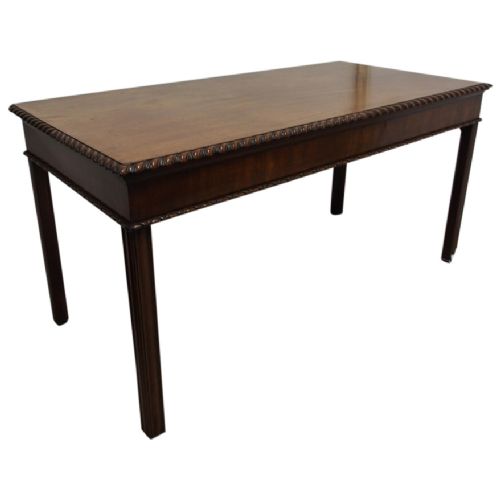
A fluted leg dining sideboard combines generous serving surfaces with disciplined classical detailing drawn from the Georgian and Regency periods. The listings here present servers, side tables, and bowfront sideboards shaped from rich timbers.
The version most commonly met on this page is the mahogany serving table or sideboard displaying neoclassical influence, often carrying the characteristic carved vertical fluting along the supports. These forms date from the eighteenth and nineteenth centuries, alongside later revival interpretations.
Makers drew on George III, Regency, and Adam design vocabularies to structure these pieces, balancing utility with refined proportions. Buyers encounter both straight-fronted serving tables and curved bowfront configurations designed for formal dining rooms.
How they were made
Cabinetmakers constructed these sideboards using solid mahogany and flame mahogany veneer, augmented by contrasting stringing in satinwood and ebony. The application of veneer created rich, figured surfaces across drawer fronts and tabletops.
Hardware typically included cast brass handles and mounts which accented the dark timber tones. Joinery relied on traditional techniques to house drawers and support heavy serving vessels during formal meals.
Fluted Leg Dining Sideboard Retail Price Guide 2026
Typical asking prices for fluted leg dining sideboard among the pieces listed under this phrase on Sellingantiques today, from the lower quarter to the upper quarter. They describe what is for sale here now, not the wider market.
Listings span the Georgian and Regency eras alongside nineteenth-century revival periods, featuring mahogany, satinwood, ebony, and brass.
What varies in quality
Quality reveals itself in the crispness of the carved fluting and the selection of the timber grain across the front. Finer examples display carefully matched flame mahogany veneers and balanced proportions that reflect disciplined proportioning.
The integrity of the construction and the refinement of the brass mounts distinguish the exceptional examples from standard revival pieces. Attention to interior drawer construction and subtle inlay work marks the upper tier of these dining room pieces.
The Fluted Leg Dining Sideboard Glossary
- Fluting
- Vertical parallel grooves carved into the surface of a leg or column. This classical detail derives from ancient architectural columns.
- Bowfront
- A convex curved front that swells outward toward the centre. This shape softens the room's geometry while adding interior capacity.
- Serpentine
- A gently undulating front line that curves inward and outward in a continuous sweep. It demands precise cabinetmaking to execute successfully.
- Stringing
- Thin inlaid lines of contrasting wood used to outline panels and drawer fronts. Satinwood and ebony frequently provide this sharp linear contrast.
Fluted Leg Dining Sideboard: Frequently Asked Questions
Where did these sideboards stand in the dining room?
These pieces traditionally stood against the perimeter wall of the dining room during meals. Servants placed dishes, cutlery, and wine decanters upon the surface ready for service.
Their substantial length and shallow depth allowed them to sit comfortably in large rooms without obstructing movement around the dining table.
How do I distinguish an original Georgian piece from a revival?
Examination of the secondary woods inside the drawers and the tool marks left by cabinetmakers provides initial clues to the date. Older pieces often show hand-cut dovetails and timber shrinkage consistent with age.
Revival pieces from the later nineteenth century display machine-sawn elements and standardised construction methods while still utilising traditional mahogany and inlay.
What is the difference between a sideboard and a serving table?
A serving table typically presents an open base beneath the tabletop, often featuring four or more legs without enclosed drawer banks. It functioned primarily for placing dishes during a meal.
Sideboards incorporate built-in drawers and sometimes cupboards beneath the main surface, offering enclosed storage for silver, linen, and dining accessories.
How do I care for flame mahogany veneer?
Mahogany responds best to stable room temperatures and protection from direct sunlight, which can fade the rich reddish-brown tones over time. Regular dusting with a soft cloth maintains the finish.
Applying a traditional beeswax polish occasionally nourishes the timber and preserves the depth of the grain without building up heavy chemical layers.