
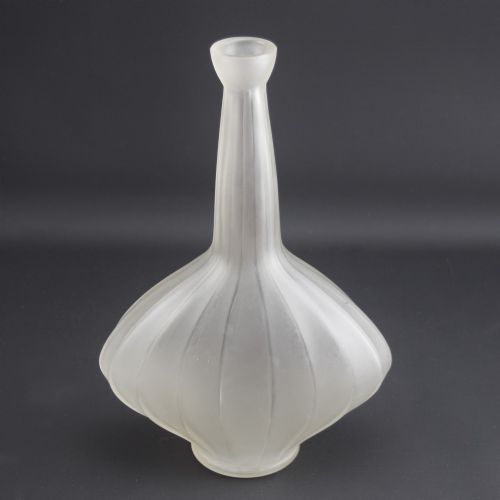


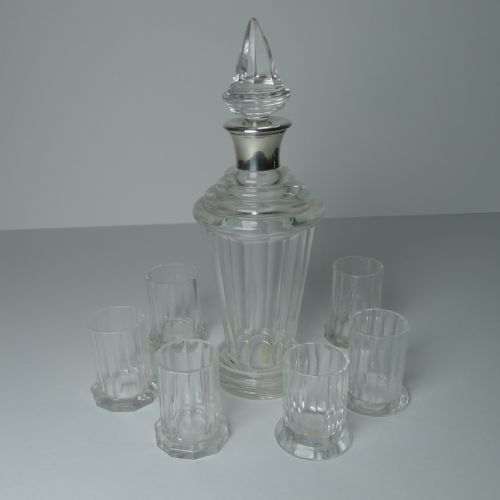
Fluted Glass Carafe
A fluted glass carafe brings bright refraction and a crisp line to the table, handling everything from claret to water.
Fluted Glass Carafe
When you search for a fluted glass carafe, you are looking at serving bottles and decanters shaped by vertical channels cut or moulded into the body. The examples you meet on this page span the Georgian, Regency, and Victorian eras through to the Edwardian period and Art Deco designs.
The most common forms on this page include Victorian cut glass decanters, Edwardian serving bottles, and pairs from the late nineteenth century. These vessels range from simple blown glass with subtle facets to heavy lead crystal pieces finished with silver plate mounts.
Makers such as René Lalique and Moser appear alongside unlabelled English and Continental works, showing a wide spread of origins from simple tavern pieces to high-end luxury glassware. Each period brings its own weight, handle treatment, and stopper style to the table.
Materials and construction
These vessels rely on blown glass, lead crystal, and frosted glass shaped into ribbed or fluted profiles. Workshops used both free-blowing and mould-blowing techniques before finishing the surfaces with hand-cutting.
Cut glass and cut crystal variants receive their facets through wheel-cutting, where artisans grind away material to create sharp, light-catching ridges. Some pieces integrate silver plated collars, handles, and mounts fixed directly to the glass neck.
A surprising number of Victorian table bottles survived simply because their heavy glass bottoms made them nearly impossible to tip over during lively dinner parties.
Judging quality and execution
The standard of a fluted glass carafe rests on the crispness of the wheel-cut facets and the optical clarity of the metal. Finer pieces show deep, mathematically precise fluting that catches the light cleanly, while simpler vessels display softer, wider moulding lines.
Weight and balance dictate the upper tier, where heavy lead crystal provides a solid hand-feel and substantial stability. Secondary examples often use lighter blown glass with thinner walls and simpler stoppers that lack the precise ground fit of better workshops.
Rene Lalique·Hukin & Heath·Moser Glass
The Fluted Glass Carafe Glossary
- Cut Glass
- Glass shaped and patterned by holding it against a rotating abrasive wheel. This technique creates sharp recesses and brilliant polished facets.
- Lead Crystal
- Glass containing a high proportion of lead oxide, which increases weight, brilliance, and softness for easier cutting. It gives these vessels a distinct ring when struck.
- Claret Jug
- A specialised serving vessel designed for red wine, frequently fitted with a metal handle, spout, and hinged lid. Many examples combine blown glass bodies with silver plate mounts.
- Frosted Glass
- Glass treated to achieve a matte, opaque surface finish rather than a transparent one. This technique highlights carved or moulded low-relief decoration.
Fluted Glass Carafe: Frequently Asked Questions
How do I date a fluted glass carafe?
Dating relies on combining the silhouette, the depth of the cutting, and any accompanying metal mounts. Georgian and Regency pieces often feature distinct neck rings and heavy pontil marks, while Victorian examples lean toward deeper, more elaborate facet cutting.
Later Edwardian and Art Deco items show cleaner, more geometric moulding or frosted surfaces. Maker signatures or hallmarks on attached silver mounts provide the most secure chronological anchor.
Can I use these carafes for daily dining?
These vessels were originally built for functional service on the dining table, handling wine, spirits, and water. Their sturdy lead crystal and thick blown glass construction suits modern service just as well as historical display.
Hand washing remains essential to protect older glass and any delicate silver plated mounts from harsh dishwasher detergents.
What is the difference between a carafe and a decanter?
A carafe generally serves water, juice, or everyday wine at the table without a stopper, though many antique examples include one. A decanter is typically heavier, featuring a tightly ground glass stopper designed to seal spirits or fine wine for longer storage.
On this market page, the terms often overlap depending on whether the vessel has a narrow pouring neck or an integrated handle.
Why do some carafes have three rings on the neck?
Those raised horizontal bands are neck rings, commonly found on Regency and early nineteenth-century decanters. They were applied hot to the neck during manufacture to provide a secure grip for pouring when condensation or wine made the glass slippery.
Over time, the number and profile of these rings shifted, offering a helpful clue for identifying the manufacturing period.