

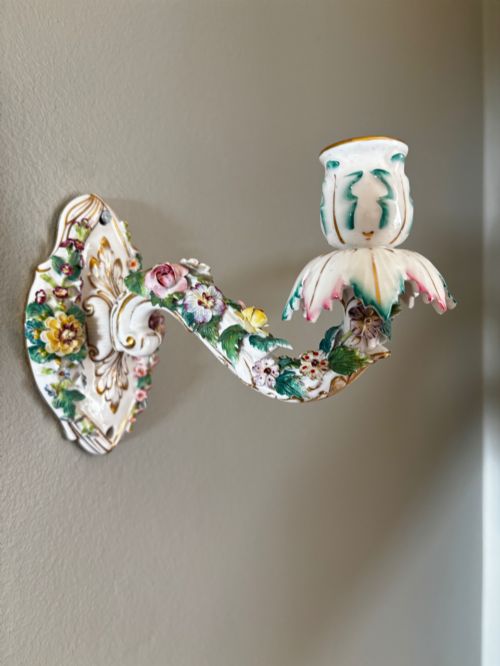


Floral Encrusted Candlesticks
Floral encrusted candlesticks bring intense modelled colour and relief decoration to a table, combining sculptural figures with intricate applied petal work.
Floral Encrusted Candlesticks
Floral encrusted candlesticks appear here primarily as 19th Century German porcelain pieces, taking the form of pairs or single items designed for illumination. The listings show candelabra, wall sconces and traditional candlesticks spanning the decades from 1880 to 1900, alongside an earlier example from 1835.
The dominant aesthetic draws heavily on the Rococo Revival style, integrating elaborate figural elements with structural candle holders. Makers such as Meissen, Sitzendorf, Minton and Dresden represent the core origin of these pieces on this page.
Forms range from single candle wall sconces to substantial four-arm figural candelabra. Collectors encounter blanc de chine variations as well as richly decorated polychrome surfaces throughout the current selection.
How they were made
Hard-paste porcelain forms the structural body of these items, shaped through intricate moulding and hand-modelling. Individual ceramic petals and leaves are applied by hand to create the signature encrusted effect.
Enamel colours and glaze are fused to the porcelain surface during kiln firing, often accented with gold leaf and gilding to highlight the relief decoration. This combination of techniques yields both high-gloss glaze and matte painted details.
Floral Encrusted Candlesticks Retail Price Guide 2026
Typical asking prices for floral encrusted candlesticks among the pieces listed under this phrase on Sellingantiques today, from the lower quarter to the upper quarter. They describe what is for sale here now, not the wider market.
Every single applied petal was individually pinched and glued by hand, ensuring no two flowers in the encrustation are identical.
What varies in quality
The precision of the modelling separates superior examples from simpler production, particularly in the crispness of the applied petals and the detailing of figural elements. Finer pieces demonstrate greater depth and undercut work in the floral clusters.
The application of gilding and enamel painting dictates the visual richness of the object. Master factories achieve superior tonal variation and meticulous brushwork across the porcelain surface.
Meissen·Sitzendorf·Minton·Dresden
The Floral Encrusted Candlesticks Glossary
- Hard-paste porcelain
- A dense, durable ceramic composed of kaolin and petuntse, fired at high temperatures. It provides the smooth, impervious base characteristic of fine European tablewares and figures.
- Rococo Revival
- A design movement of the 19th century reviving 18th-century motifs like asymmetrical scrolls, C-scrolls, and naturalistic flora. This style dominates the ornamentation of the candlesticks listed here.
- Candelabra
- A branched candlestick designed to hold multiple candles simultaneously. The examples on this page include impressive four-arm configurations.
- Blanc de chine
- A French term for white Chinese porcelain, later adopted to describe European white-glazed wares without polychrome enamel. It allows the sculptural form and relief work to stand out entirely in monochrome.
- Gilding
- The application of gold leaf or gold powder to the porcelain surface. It accentuates raised mouldings and architectural details.
Floral Encrusted Candlesticks: Frequently Asked Questions
What are floral encrusted candlesticks?
These are 19th-century ceramic lighting pieces adorned with applied porcelain flowers and leaves, frequently incorporating human figures.
Originating largely from German factories, they combine structural candle holders with elaborate sculptural decoration.
How were multi-arm candelabra used?
Multi-arm candelabra served to provide ambient illumination in reception rooms and dining spaces during the evening hours.
Placed on mantelpieces or side tables, they maximised light output while functioning as decorative centrepieces.
How do I date these porcelain pieces?
Dating relies on stylistic indicators such as the Rococo Revival aesthetic, factory marks, and the manufacturing techniques visible in the paste and glaze.
The current selection concentrates on the late 19th century, specifically between 1880 and 1900.
How should I care for antique porcelain?
Antique porcelain requires gentle dusting with a soft, dry brush to protect delicate applied floral elements from breakage.
Harsh cleaning agents and immersion in water should be avoided, particularly where gilding and enamel paints are present.