


Floral Carved Tilt Table
These floral carved tilt table examples combine pivoting surfaces with elaborate botanical woodwork, offering flexible display spaces for Victorian parlours.
Floral Carved Tilt Table
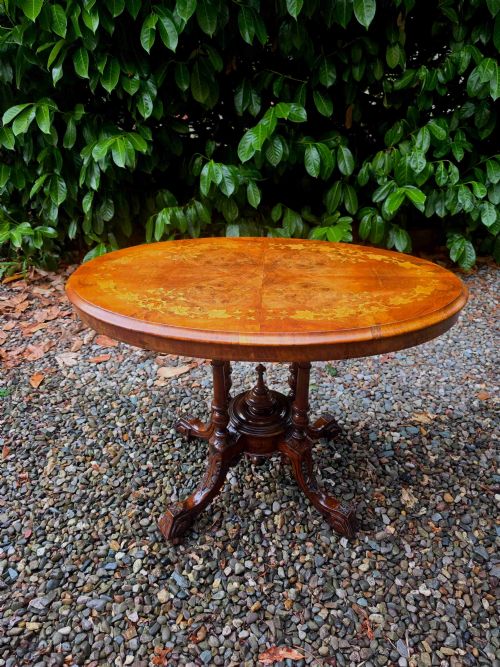
When you search for a floral carved tilt table, you encounter nineteenth-century pieces designed to save space when not in dining or display use. The version most common on this page is the Victorian centre or breakfast table, often featuring a circular top that tilts vertically on a pillar support.
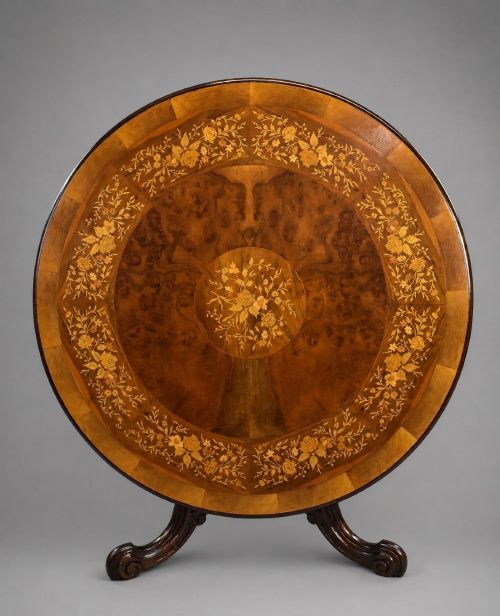
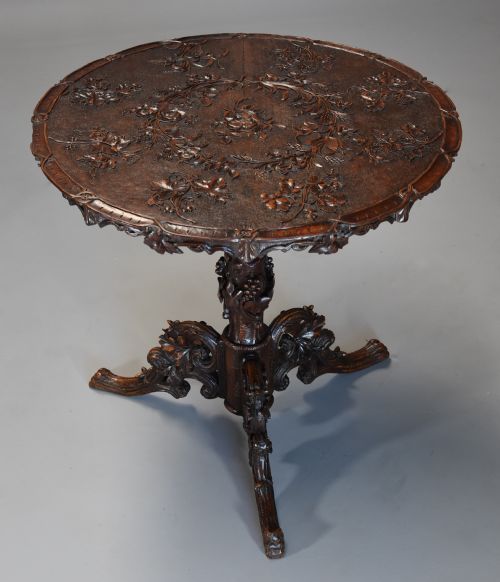
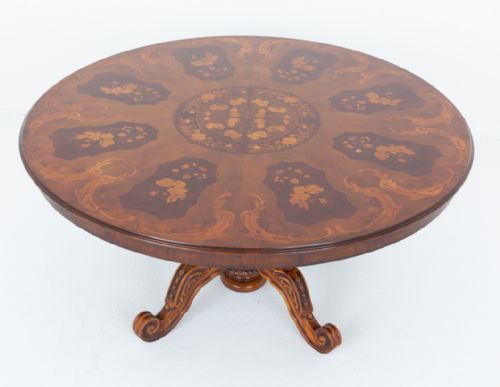
The styles span standard Victorian production, Oriental export work, and Black Forest carving traditions. Many examples incorporate marquetry inlays alongside carved floral motifs on the pedestals and borders.
How they were made
Cabinetmakers utilised dense timbers such as burr walnut, mahogany, and rosewood for the primary surfaces and structural pedestals. Linden wood and olive wood also appear, lending themselves to deep relief carving.
Marquetry and wood inlay techniques created intricate botanical patterns across the tabletops using contrasting veneers. Brass mechanisms frequently secure the pivoting mechanism beneath the surface.
The documented pieces span the Victorian era, from the eighteen-fifties through the late nineteenth century.
What varies in quality
The depth and crispness of the floral carving define the upper tier of these pieces, separating mechanical output from skilled artisan work. Timber selection plays a major role, with choice burr walnut veneers commanding greater visual richness than plain stock.
The stability and smoothness of the tilt mechanism indicate the original engineering standard of the table. Integrated marquetry work executed with precise veneer matching also elevates the stature of the piece.
John Kendal
The Floral Carved Tilt Table Glossary
- Tilt top
- A tabletop mounted on a pivoting hinge that allows the surface to stand vertically against the pedestal when stored. This mechanism saved valuable floor space in nineteenth-century interiors.
- Marquetry
- A decorative technique applying fitted wood veneers to form pictorial or floral patterns on a surface. Craftsmen used various tinted woods to achieve tonal depth.
- Burr walnut
- A prized timber harvested from walnut tree growths, notable for its swirling, highly figured grain patterns. It provided a luxurious surface for Victorian table tops.
- Centre table
- A freestanding table designed to be viewed from all sides rather than pushed against a wall. These frequently served as the focal point of a Victorian parlour.
Floral Carved Tilt Table: Frequently Asked Questions
How do you tilt the top?
A brass catch or release mechanism beneath the surface unlocks the pivoting joint to let the top swing upright.
Once vertical, the table occupies minimal depth, allowing it to rest against a wall or fit into a corner.
Were these used for dining?
Larger breakfast and dining versions served everyday meals in Victorian households before being cleared away.
Smaller examples functioned primarily as occasional or centre tables for lamps and decorative objects.
How do I identify a Victorian piece?
Victorian tables typically display dense burr walnut veneers, elaborate marquetry, and heavily turned or carved central pedestals.
Construction methods involve solid secondary timbers and traditional joinery consistent with nineteenth-century workshops.