
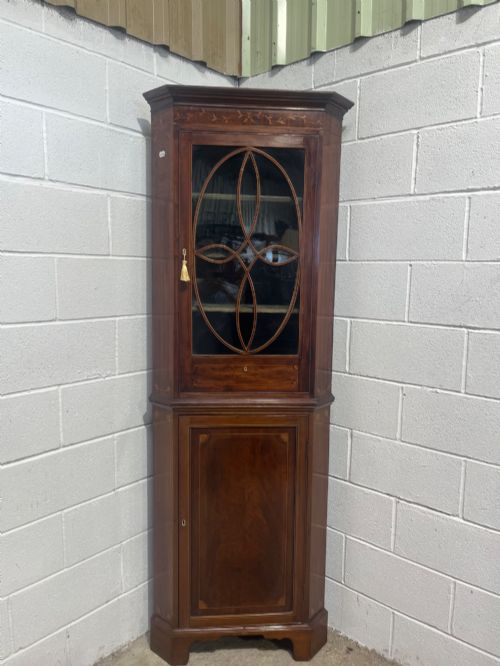
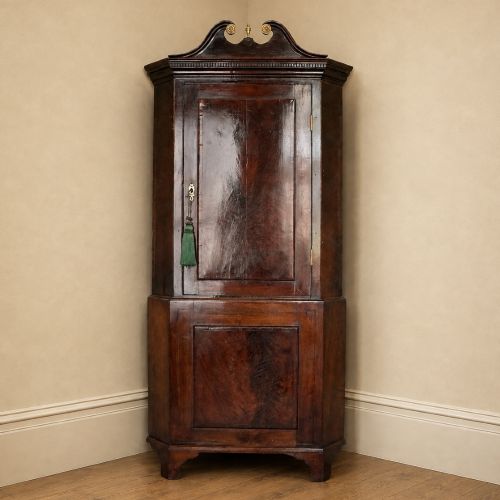
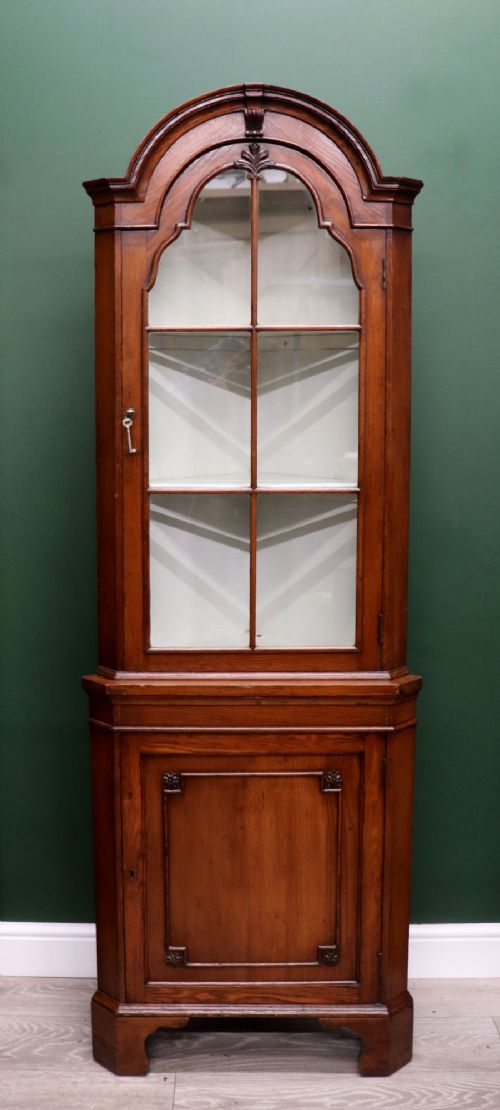


Floor Standing Corner Unit
A floor standing corner unit makes clever use of awkward angles, offering substantial display and storage space without dominating a room.
Floor Standing Corner Unit
A floor standing corner unit is a tall piece of furniture designed to fit neatly into the right angle of a room, bridging the gap between practical storage and elegant display. When exploring this selection, buyers encounter pieces primarily shaped as corner cupboards and corner cabinets.
The examples available range from formal Georgian and 18th-century designs to later Victorian, Edwardian, and 1930 interpretations. These tall architectural pieces utilise otherwise neglected wall junctions, often standing directly on the floor or raised on a distinct stand.
Most items on this page adhere to traditional British and continental cabinet-making traditions, appearing in various heights and configurations. The core function remains consistent: housing objects behind panelled or glazed doors while anchoring the room's corner space.
How they were made
Cabinet-makers relied on robust timber framing to construct these corner pieces, frequently employing dense hardwoods such as mahogany and oak as the primary structural materials. Many of the finer specimens incorporate secondary woods like walnut, fruitwood, and satinwood, sometimes arranged in two distinct parts to facilitate transport.
Surface decoration often involves fine inlay and marquetry work, contrasting lighter timbers like boxwood against darker grain patterns. Glazed panels and brass hardware appear regularly, adding functional detail and visual lightness to the substantial timber frames.
Several cupboards divide neatly into two stacked halves, proving that even grand 18th-century cabinet-makers understood the dread of tight staircases.
What varies in quality
Quality in these standing units rests principally upon the selection of timber and the precision of the cabinet-making. Rich grain figures in the mahogany or oak, combined with crisp execution of inlaid stringing and marquetry, distinguish the more ambitious pieces from simpler vernacular items.
Proportion and scale also dictate distinction, particularly in two-part constructions where the upper and lower sections must align harmoniously. The integration of brass fittings and the clever handling of curved bow fronts demonstrate the maker's skill level.
The Floor Standing Corner Unit Glossary
- Bow front
- A convex, curved front section that projects outward from the corner angles. This shape softens the geometric lines of the room.
- Marquetry
- Decorative veneer work arranged in pictorial or geometric patterns using various coloured woods. It requires considerable skill to assemble across angled surfaces.
- Inlay
- Contrasting pieces of wood set into a recessed surface to form a flat decoration. Boxwood and satinwood are frequently utilised for this purpose.
- Two parts
- Construction where the cabinet separates horizontally into an upper and lower section. This facilitates moving the tall structure into position.
- Welsh corner cupboard
- A regional vernacular form, often executed in sturdy oak. These pieces typically display robust construction suited to country interiors.
Floor Standing Corner Unit: Frequently Asked Questions
How do I place a floor standing corner unit?
These cabinets slide directly into an empty room corner, requiring no wall hanging or special brackets. They anchor the junction of two walls and make efficient use of otherwise dead space.
Ensure your chosen corner has sufficient height clearance and unobstructed floor space, as many examples stand quite tall and feature projecting plinths or cornices.
Can these hold heavy items?
Most pieces feature fixed or adjustable internal timber shelving designed to bear the weight of books, ceramics, or glassware. The solid timber carcase provides inherent strength.
Distribution of weight matters greatly, so heavier decorative objects or collections of china should rest on the lower shelves to maintain overall stability.
How do I distinguish Georgian from Victorian pieces?
Georgian and 18th-century examples tend to display restrained classical proportions, fine mahogany or oak grain, and subtle string inlay. They often utilise two-part construction.
Later Victorian and Edwardian iterations frequently show heavier mouldings, differing brassware styles, or revivals of earlier decorative techniques such as Dutch baroque influences.
What is a corner cupboard on stand?
This variant elevates the main storage cabinet upon a separate supporting base or legs rather than extending straight down to the floor. It creates a lighter visual silhouette.
The raised design exposes more floor area beneath the piece, altering the proportions and offering a distinct alternative to standard full-length standing units.