






Flame Mahogany Toilet Mirror
A flame mahogany toilet mirror brings deep figured grain and rich warmth to a chest of drawers or dressing table.
Flame Mahogany Toilet Mirror
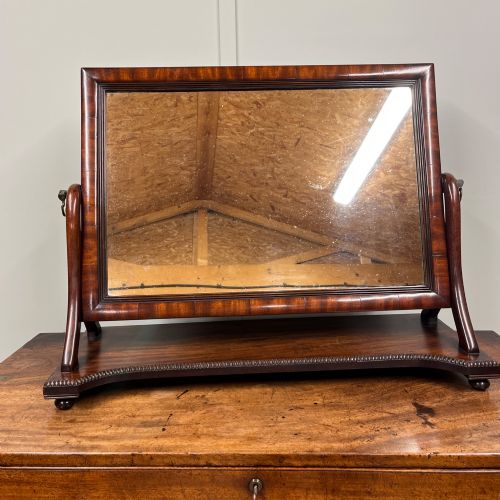
A flame mahogany toilet mirror sits on a tabletop or forms part of a larger dressing table, offering a pivoting glass plate framed by solid wood and veneer. These pieces appear across the Georgian, Regency, William IV and Victorian periods, taking various forms from serpentine and bow-fronted designs to simple swing mirrors on upright supports.
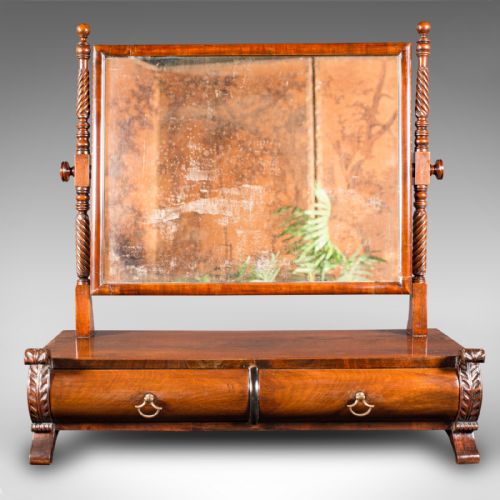
The most common examples on this page date from the Victorian era and the Regency period, often featuring three-drawer box bases and shaped side arms. Smaller tabletop versions sit alongside larger dressing mirrors, while related pieces span French Empire tables and Scottish barrel-fronted variants.
Judging the quality
Quality rests upon the selection and matching of the flame mahogany veneer, where dramatic, symmetrical grain figures elevate an ordinary piece into a striking focal point. Finer mirrors display crisp carving on the scroll supports, well-fitted miniature drawers with tidy dovetails, and substantial brass hardware.
Proportion and stability separate standard utility pieces from exceptional examples. A well-balanced frame stays firmly in position when adjusted, while heavier mouldings and substantial box bases indicate superior craftsmanship from master workshops.
Flame Mahogany Toilet Mirror Retail Price Guide 2026
Typical asking prices for flame mahogany toilet mirror among the pieces listed under this phrase on Sellingantiques today, from the lower quarter to the upper quarter. They describe what is for sale here now, not the wider market.
Listings feature flame mahogany, solid mahogany, brass, ormolu, leather and mirror glass across Georgian, Regency, William IV and Victorian periods.
The Flame Mahogany Toilet Mirror Glossary
- Flame mahogany
- A veneer cut from the branch junction of the mahogany tree, producing a distinctive, fiery feather pattern. Cabinet makers reserved this striking timber for the most visible surfaces of fine furniture.
- Toilet mirror
- A smaller mirror designed to stand on a dressing chest or table rather than hang on a wall. These pieces frequently incorporate small drawers in the base for personal items.
- Swing mirror
- A glass plate mounted on pivots between two upright arms, allowing the user to tilt the angle. The mechanism relies on brass screws or wooden pegs.
- Serpentine front
- A furniture front curving outward at the centre and inward at the sides in a gentle 'S' shape. This profile demands high skill from the woodworker.
- Ormolu
- Gilded bronze mounts applied to furniture, seen particularly on French Empire pieces. The metal adds a bright, contrasting metallic sheen to the dark wood.
Flame Mahogany Toilet Mirror: Frequently Asked Questions
Where should I place a toilet mirror?
These mirrors suit dressing tables, chests of drawers or sideboards in a bedroom or hallway. They need a stable surface deep enough to support the box base without overhang.
Position the piece near natural light to make the most of the pivoting glass plate. Ensure the surrounding furniture height allows comfortable use when seated or standing.
How do I date a mahogany mirror?
Examine the construction details of the base and the timber framing to determine the period. Georgian and Regency pieces often show lighter proportions and delicate inlay, while Victorian examples tend to be heavier with deeper mouldings and bun feet.
Look at the backboards, fixings and drawer construction for clues about age. Hand-cut dovetails and original brass mirror screws point firmly to nineteenth-century workshop practices.
Did these mirrors always have drawers?
Many toilet mirrors sit upon a box base containing one, two or three small drawers. These compartments held jewellery, cosmetics and small personal items.
Simpler tabletop versions omit the drawer base entirely, relying instead on curved or turned upright supports attached directly to feet. Both styles remained popular across the Georgian and Victorian eras.
How do I maintain the glass and wood?
Keep the wood nourished with appropriate wax polishes applied sparingly with a soft cloth. Avoid placing the mirror in direct sunlight or near heat sources to protect the delicate veneer.
Clean the mirror glass gently using a cloth slightly dampened with water or glass cleaner, taking care not to let moisture seep behind the plate edge where the silvering might be affected.