
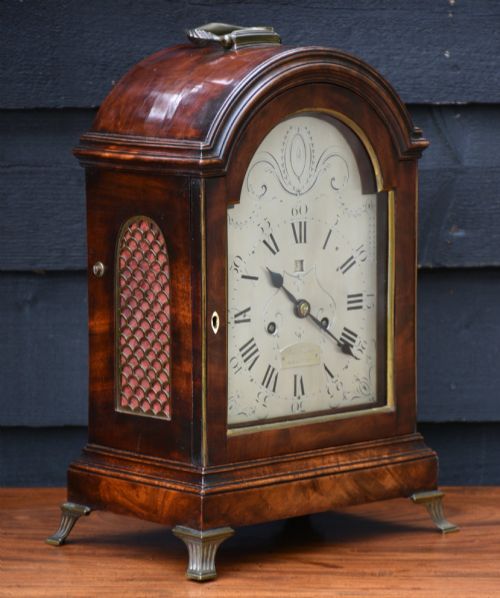
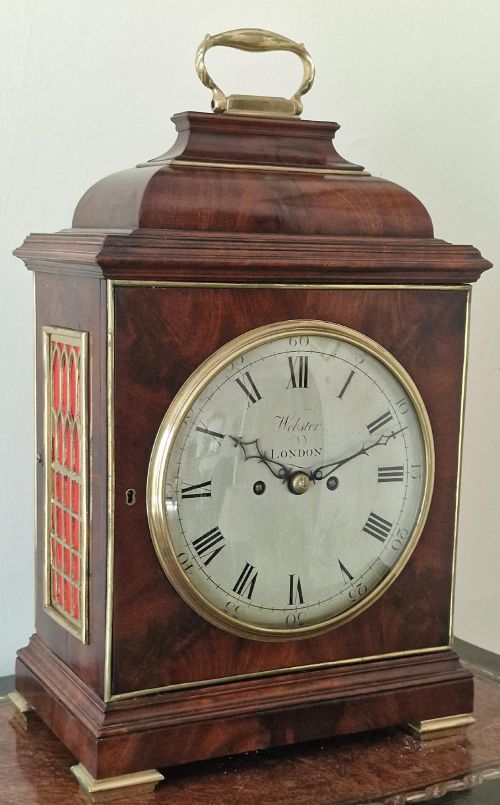


Flame Mahogany Mantel Clock
A flame mahogany mantel clock brings rich timber grain and precision movement to a desk or shelf, offering a distinct focal point for any room.
Flame Mahogany Mantel Clock
A flame mahogany mantel clock encompasses table and bracket clocks fashioned from figured timber across the Georgian, Regency, and nineteenth century periods. These timepieces display rich grain patterns on mahogany cases, frequently paired with brass mounts and glass panels.
Buyers frequently encounter bracket clocks and table clocks featuring architectural forms such as bell tops, chamfer tops, and lancet tops. Originating primarily from British workshops, these examples span provincial makers and notable London horologists.
Materials and construction methods
Cases combine solid mahogany and figured flame mahogany veneers over secondary timbers, constructed to house mechanical movements. Brass details such as bracket feet, side handles, and bezels accent the timber structures.
Dials employ silvered metal, enamel, or painted surfaces to display the time, protected behind glazed doors. Movements utilise fusee-driven mechanisms to maintain even tension across the eight-day running duration.
Listings feature mahogany, brass, glass, enamel, and silvered metal across Georgian, Regency, and nineteenth-century periods.
Distinctions in craftsmanship and design
Superior examples demonstrate meticulous selection of flame mahogany veneer, matched symmetrically across the architectural case. The crispness of brass mounts and the refinement of engraved silvered dials separate finer pieces from simpler provincial work.
Movement quality is evident in the execution of the signed dial and the complexity of the striking train. Maker reputation and case proportion heavily influence the overall stature of each clock.
Webster London·Hyde of Salisbury·Hampson and Son·Watson London·Ganthony of London·John Ellicott·Barraud and Lund·Vulliamy
The Flame Mahogany Mantel Clock Glossary
- Fusee
- A conical pulley used in mechanical clocks to maintain an even pull on the gear train as the mainspring unwinds. This mechanism ensures consistent timekeeping.
- Bracket clock
- A portable table clock originally designed to sit upon a matching wall bracket. These pieces often feature brass carrying handles.
- Silvered metal
- A brass dial plate treated with a silver compound to create a matte finish for engraved numerals. This technique provides clear contrast.
- Bell top
- A case roof design shaped like a dome or bell, characteristic of eighteenth-century bracket clocks. It adds height and architectural presence.
- Chamfer top
- A case style featuring bevelled edges along the upper corners. This treatment softens the strict rectangular silhouette.
Flame Mahogany Mantel Clock: Frequently Asked Questions
What is a fusee movement?
A fusee movement uses a conical drum and cord to regulate the power delivered from the mainspring to the gear train. This clever device compensates for the dropping tension as the spring unwinds.
Clocks with fusee movements generally offer more reliable timekeeping across their running cycle. It represents a hallmark of traditional British clockmaking quality.
How do I wind the clock?
Winding requires a dedicated key inserted into the winding holes on the dial face to tension the mainspring gently. Care must be taken not to overwind the mechanism.
Most surviving examples run for eight days per wind. Keeping a consistent schedule helps maintain the health of the internal gear train.
Where should I place a mantel clock?
These clocks sit best on stable, level surfaces such as mantelpieces, sideboards, or dedicated tables away from direct sunlight and drafts. A sturdy foundation ensures the pendulum or balance swings evenly.
Because many examples feature delicate wood veneers and glass panels, a secure location prevents accidental knocks. Proper placement also allows the bell strike to resonate clearly.
How do I date a bracket clock?
Dating relies on examining the case silhouette, dial materials, and architectural details like bell tops or lancet arches. Georgian and Regency pieces display specific proportions and joinery methods.
Signatures on the dial or movement backplate often point to active working dates of the maker. Comparing these stylistic cues provides a reliable chronological window.