
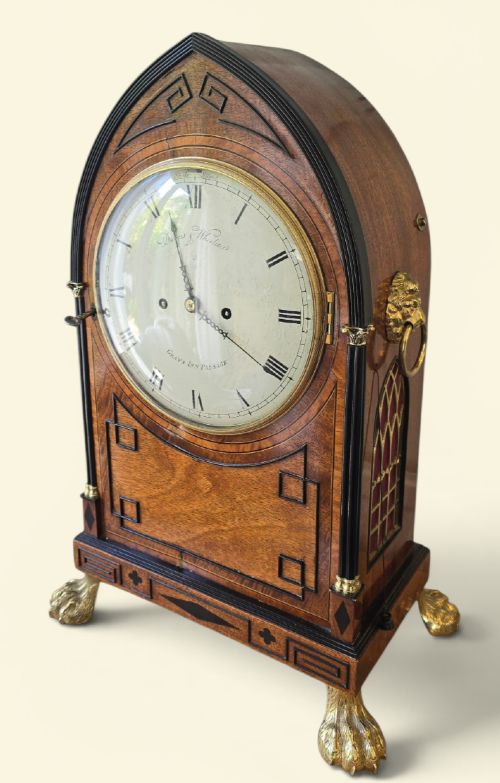


Antique Lancet Mantel Clock
These antique lancet mantel clocks combine architectural pointed arches with reliable domestic timekeeping, offering a striking centrepiece for any room.
Antique Lancet Mantel Clock
An antique lancet mantel clock takes its name from its distinctive pointed Gothic arch silhouette, echoing the lancet windows of medieval architecture. These decorative horological pieces sit on tabletops, shelves and mantelpieces, serving both a practical function and a decorative purpose in period interiors.
Most examples found here date from the Georgian, Regency, Victorian and Edwardian eras, spanning the nineteenth century and into nineteen hundred. Mahogany forms the predominant case material across these periods, often accented by satinwood inlay, boxwood stringing or brass details.
Makers and workshops range from notable London horologists to provincial English and continental makers, producing both striking mechanisms and simple timepieces. Forms include bracket clocks with carrying handles and dedicated mantel clocks designed to anchor a room's decorative scheme.
What varies in quality
Quality reveals itself in the crispness of the cabinetwork, the precision of the wood veneers and the subtlety of any satinwood or boxwood inlay. Superior examples display balanced proportions in their lancet arches and tight joints where the timber meets the brass bezel and glass door.
The sophistication of the internal movement further separates standard timepieces from finer bracket clocks by noted London makers. A well-executed dial, clean enamel work and legible signature lettering reflect the higher tiers of period production.
The listings span multiple design movements, including Georgian, Regency, Victorian, Edwardian, Gothic Revival and Belle Epoque styles.
Desbois & Wheeler·Cording of London·W. Burton·W&H·Wilkinson Leicester·Ganthony of London·James McCabe
The Antique Lancet Mantel Clock Glossary
- Lancet top
- A case design featuring a sharply pointed Gothic arch silhouette resembling a medieval church window. This architectural form defines the entire category.
- Fusee
- A conical pulley mechanism within the clock movement that ensures even tension on the driving chain or cord as the mainspring unwinds. This device improves timekeeping accuracy across the power reserve.
- Bracket clock
- A portable timekeeper originally designed to sit on a wall bracket or table, frequently fitted with a brass carrying handle on top. Many early examples feature this traditional designation.
- Ting tang
- A striking mechanism that uses two hammers and two bells to sound the quarters or half hours with a distinctive two-tone chime. It offers an audible marker for the passing time.
- Single fusee
- A single-train movement driven by a fusee mechanism designed solely to keep time rather than strike the hours. These simpler movements focus on accuracy and reliability.
Antique Lancet Mantel Clock: Frequently Asked Questions
What is a lancet mantel clock?
A lancet mantel clock is a portable timepiece housed in a wooden case shaped with a pointed Gothic arch at the top. The design draws inspiration from medieval lancet windows.
These clocks became popular during the Georgian and Regency periods and continued through the Victorian and Edwardian eras. They were built to display on mantelpieces and tables while keeping domestic time.
How do I wind my clock?
Winding involves inserting a matching key into the winding hole on the dial and turning it gently until resistance is felt. Care must be taken not to overwind the mainspring.
Different movements require different intervals, ranging from daily timepieces to eight-day striking clocks. Consulting the specific movement type helps determine the correct winding routine.
Where should I place it?
These clocks belong on stable, level surfaces such as mantelpieces, chests of drawers or sturdy tables away from direct heat sources. A level foundation ensures the pendulum or balance wheel swings evenly.
Placing the clock out of reach of heavy drafts and direct sunlight preserves the mahogany case and the delicate enamel dial over time.
How do I date a clock?
Dating relies on stylistic clues such as case timber, inlay materials, dial construction and the signature of the maker. Regency models often feature bold brass inlay, while Edwardian versions lean towards refined mahogany proportions.
Internal movement signatures and historical provenance records also provide firm clues regarding the decade of manufacture. Comparing these elements against known maker periods narrows the timeline.