
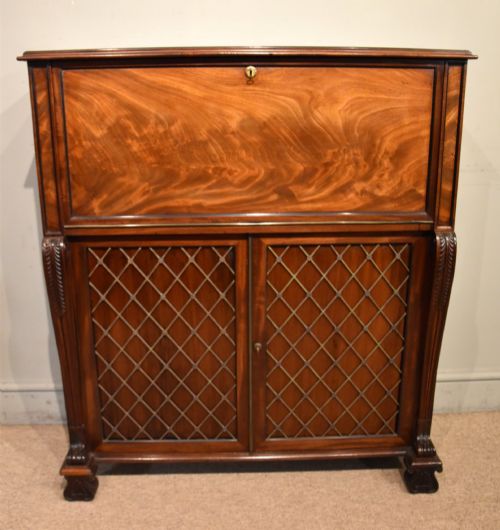


Flame Mahogany Cupboard Desk
A flame mahogany cupboard desk brings rich, figured grain and concealed writing surfaces into a room.
Flame Mahogany Cupboard Desk
A flame mahogany cupboard desk combines practical storage with a fitted writing drawer, appearing across Georgian, 18th Century, and Victorian periods. Buyers exploring this flame mahogany cupboard desk search often encounter secretaire bookcases, linen presses, and kneehole desks with enclosed cabinets.
The forms span tall bookcases with secretaire drawers, housekeeper's cupboards, and compact side cabinets. Cabinet makers of the Georgian, George III, Regency, and Victorian eras built these pieces to conceal writing compartments behind drop-front drawers or panelled doors.
Mahogany and flame mahogany veneer provide the primary exterior presence, frequently accented by satinwood inlay and brass hardware. These hybrid pieces served domestic and estate administration needs, offering both visible display and secure storage.
How they were made
Cabinet makers applied highly figured flame mahogany veneers onto solid mahogany carcases, exploiting the striking grain patterns of the wood. Satinwood inlay added contrast and linear detail to drawer fronts and door panels.
Functional metal elements such as brass handles and locks secured drawers and doors, whilst internal writing surfaces utilised inset leather. Glass panes appeared in the upper bookcase sections of taller secretaire cabinets to display books and porcelain.
Object forms recorded in the inventory include secretaire bookcases, linen presses, kneehole desks, housekeeper's cupboards, and side cabinets.
What varies in quality
The visual impact depends largely on the choice and matching of the flame mahogany veneer across the facade. Skilled selection creates symmetrical grain patterns that draw the eye across the doors and fall-front writing drawers.
Interior execution distinguishes superior examples, particularly the complexity of the pigeonholes, small drawers, and central cupboards hidden within the secretaire section. Refinement in secondary timbers and inlay work similarly marks out the finer workshops.
Gillows
The Flame Mahogany Cupboard Desk Glossary
- Flame mahogany
- A veneer cut from the branch forks of the mahogany tree, producing a distinctive flickering flame-like pattern. It was prized for decorative drawer fronts and cabinet doors during the Georgian and Victorian periods.
- Secretaire
- A desk or drawer fitted with a drop-front that conceals a writing surface and small compartments. This form allowed a tall cabinet or bookcase to double as a writing desk.
- Linen press
- A tall wardrobe or cupboard traditionally used for storing folded linens on sliding trays. Many examples incorporated a secretaire drawer into the lower section.
- Satinwood inlay
- Contrasting light-coloured wood inserted into the mahogany surface in geometric or floral patterns. This decorative technique became prominent in late 18th and early 19th Century cabinet work.
- Kneehole desk
- A compact desk featuring a central recess for the sitter's knees, flanked by pedestals of small drawers. Georgian and Victorian makers often incorporated a top drawer that pulled down for writing.
Flame Mahogany Cupboard Desk: Frequently Asked Questions
What is a secretaire drawer?
A secretaire drawer looks like a standard deep drawer from the outside but pulls down on hinges to reveal a writing surface and small pigeonholes.
This clever design allows a cupboard, bookcase, or linen press to function as a desk without taking up extra floor space.
How do I date these pieces?
Dating relies on observing construction methods, timber choices, and stylistic details associated with Georgian, George III, Regency, and Victorian periods. Cabinet proportions and the presence of satinwood inlay often point towards specific decades.
Earlier 18th Century pieces tend to feature heavier proportions and solid mahogany construction, whilst later Victorian versions frequently employ extensive veneering.
Where were they used?
These hybrid cabinets suited private studies, libraries, and bedrooms where space efficiency mattered. Housekeepers and estate managers utilised them for organising household accounts and correspondence.
The combination of upper display shelving or linen storage with a concealed writing desk made them versatile additions to polite domestic interiors.
What is flame mahogany?
Flame mahogany is a decorative wood veneer derived from the wood grain found where branches meet the main trunk. The resulting figure resembles flickering flames or feathers.
Cabinet makers used this figured veneer on prominent surfaces like drawer fronts and cabinet doors to catch the light and demonstrate fine craftsmanship.