
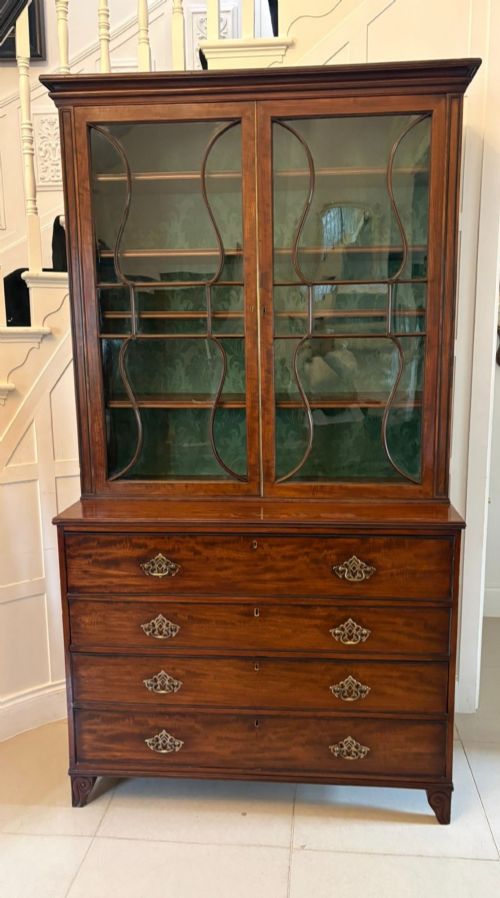
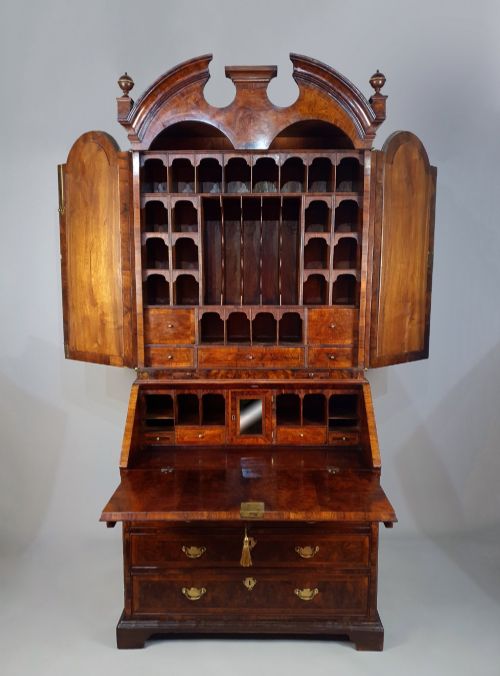
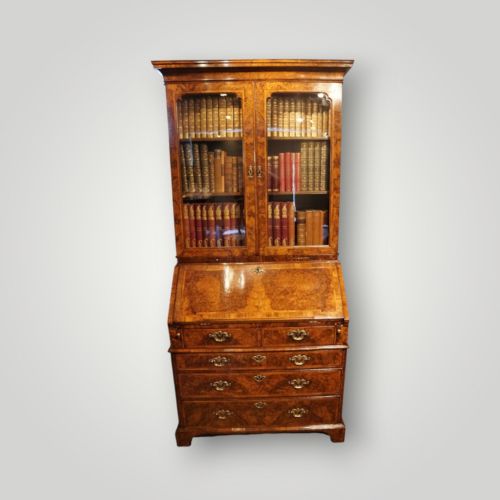
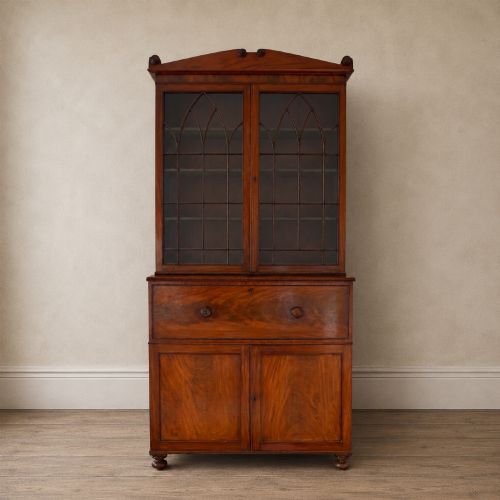
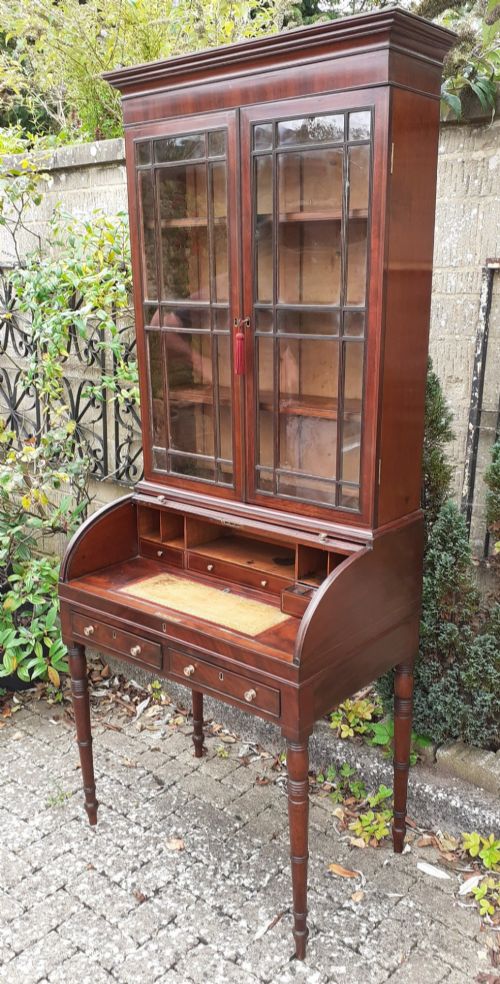
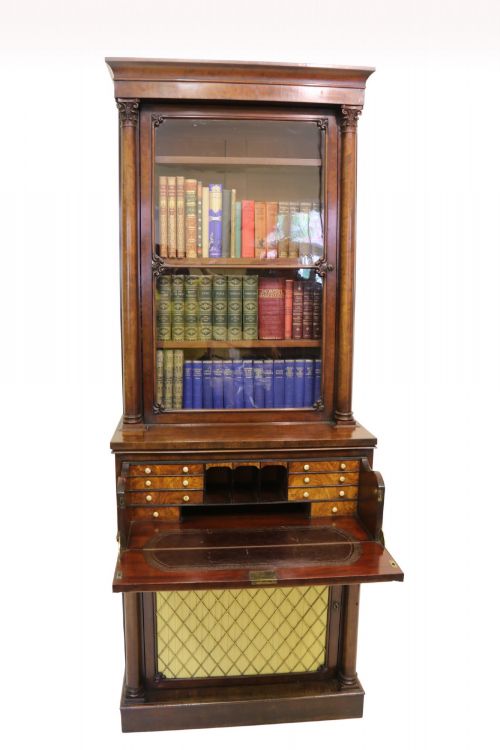


Fitted Interior Bureau Bookcase
A fitted interior bureau bookcase combines a writing slope and a shelved cabinet, offering a handsome workstation and library space in one piece of furniture.
Fitted Interior Bureau Bookcase
When you search for a fitted interior bureau bookcase, you encounter large dual-purpose storage units designed for writing and displaying or storing books. These pieces bridge the gap between a cabinetmaker's desk and a bookcase.
The versions most commonly met on this page span the eighteenth and nineteenth centuries, taking forms such as George I walnut pieces, Georgian mahogany designs, and later Victorian or Edwardian interpretations.
Makers divided these forms into distinct sections, pairing glazed, mirrored, or solid wooden upper doors with a lower bureau containing a fall-front or secretaire drawer that conceals pigeonholes and small drawers.
How they were made
Cabinetmakers built these pieces using solid timbers and decorative veneers such as mahogany, walnut, burr walnut, mulberry, oak, and satinwood over sturdy framing. These woods were chosen for both durability and striking grain patterns.
Hardware such as brass handles, escutcheons, and hinges secured doors and drawers, completing constructions that frequently separated into upper and lower sections for transport.
Periods represented span from Queen Anne and George I through Georgian, Regency, and Victorian up to Edwardian times.
What varies in quality
The distinction between standard and exceptional pieces rests on the choice of timber, such as highly figured mahogany or intricate burr walnut veneers, and the sophistication of the internal arrangement.
Superior examples display meticulous joinery within the concealed compartments of the fitted interior, alongside original glass, well-proportioned cornices, and harmonious hardware rather than later replacements.
Tudor & Burrey·Gillows of Lancaster
The Fitted Interior Bureau Bookcase Glossary
- Bureau bookcase
- A dual-purpose piece featuring a shelved upper cabinet and a lower section with a sloping desk or pull-out secretaire drawer.
- Secretaire
- A drawer disguised as a drawer front that pulls down to reveal a fitted writing surface and internal compartments.
- Candle slide
- A pull-out wooden board positioned beneath the upper doors to hold a candle for illumination while writing.
- Burr walnut
- A decorative timber veneer taken from the warted growths of walnut trees, prized for its swirling grain patterns.
- Pigeonhole
- A small, open compartment within the fitted interior used for sorting letters and papers.
Fitted Interior Bureau Bookcase: Frequently Asked Questions
What is inside the fitted interior?
The fitted interior typically contains an arrangement of small drawers, pigeonholes, and central compartments concealed behind a fall-front flap or a pull-out secretaire drawer.
These internal spaces were designed for storing letters, documents, and writing implements securely.
How do I tell an 18th-century piece from a later one?
Early pieces from the eighteenth century frequently utilise walnut, burr walnut, or early mahogany, often constructed in multiple sections with candle slides and mirrored or paneled doors.
Later Victorian and Edwardian examples tend to use heavier proportions, different secondary woods, and varied grain patterns characteristic of nineteenth-century manufacturing methods.
Do these pieces separate for moving?
Many examples are built in multiple sections, usually separating into a heavy upper bookcase and a lower bureau base to facilitate transport.
This modular construction was standard practice for large case furniture during the Georgian and Regency periods.
How do I care for the timber and veneer?
Protect the wood and veneer by placing the piece away from direct sunlight and maintaining stable room humidity to prevent splitting or warping.
Apply traditional wax polish occasionally to nourish the surface and preserve the natural sheen of the mahogany, walnut, or oak.