


Figural Satsuma Ware
Figural satsuma ware pieces are richly decorated earthenware ceramics adorned with gold leaf and enamel figures, prized for their intricate Meiji period craftsmanship.
Figural Satsuma Ware
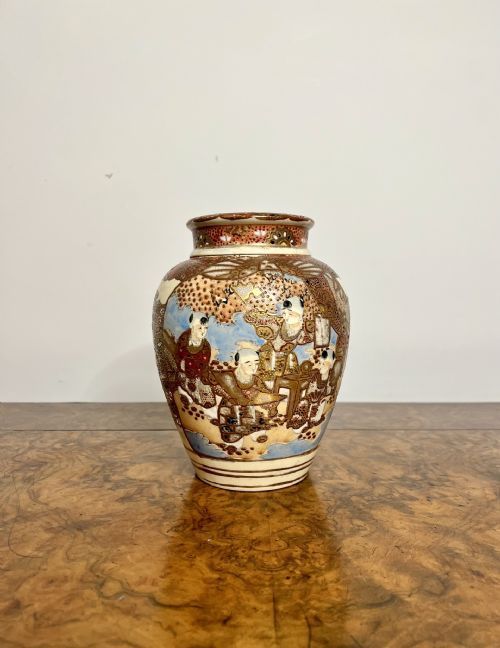
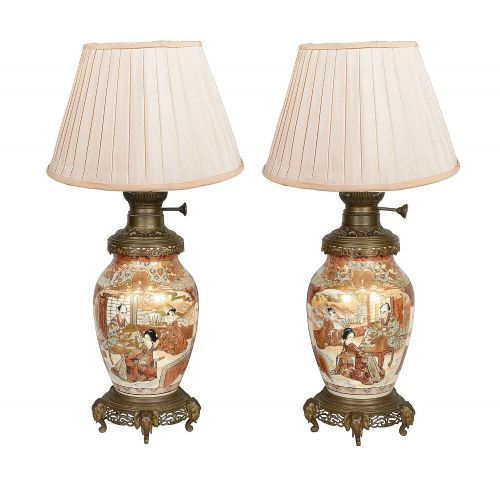
Figural satsuma ware comprises earthenware vessels decorated with detailed enamel and gold leaf illustrations of figures, spanning periods from the late nineteenth century into the early twentieth century. These objects appear as vases, ginger jars, incense burners, and table lamps originating from Japanese workshops.
The pieces on this page are predominantly Meiji period works, including miniature vases, globular vases, and large koro covers. Collectors encounter various forms such as bottle vases and decorative bowls bearing figural processions and traditional scenes.
Makers from the Meiji era created these ceramic items using earthenware bodies painted with polychrome enamels and gilt highlights. The resulting forms range from compact miniature vessels to substantial lidded jars and pair lamps.
How figural satsuma ware was made
The foundation of figural satsuma ware is earthenware pottery, shaped into vases, bowls, and koro before receiving its primary glaze. Artisans then applied detailed enamel paintings and gold leaf highlights over the glazed surface to build up the figural processions and decorative motifs.
Firing techniques allowed makers to fuse polychrome enamels and gilt bronze or gold leaf onto the ceramic body. Many items also incorporated silk and brass elements in later adaptations, particularly when converted into table lamps.
Listings feature earthenware vessels decorated with enamel and gold leaf, spanning the nineteenth century and the early twentieth century.
What varies in quality
Quality in figural satsuma ware rests on the precision and fineness of the enamel painting and gold leaf application. Pieces signed by notable workshops demonstrate superior control over minute figural details and compositional balance.
The complexity of the form and the preservation of the delicate gilt work distinguish standard production items from exceptional artist-signed pieces. The crispness of the earthenware potting further separates the finest examples from simpler output.
Kinkozan·Shizan
The Figural Satsuma Ware Glossary
- Satsuma ware
- Earthenware pottery originating from Satsuma province in Japan, characterised by a fine crackle glaze and ornate enamel and gilt decoration. It became widely exported during the Meiji period.
- Meiji Period
- The era in Japanese history spanning from 1868 to 1912, marked by extensive international trade and the production of highly detailed decorative arts. Pieces from this time often feature elaborate figural processions.
- Koro
- A traditional Japanese incense burner, typically featuring a body, handles, and a pierced cover. These ceramic vessels often stand on small feet and display intricate painted scenes.
- Gilt
- A thin layer of gold or gold leaf applied to the surface of ceramics or metal mounts. In satsuma ware, it accentuates borders, robes, and backgrounds.
- Enamel
- Vitrified glass paste applied to pottery and fired to produce durable coloured decoration. Satsuma pieces utilise multiple enamel colours alongside gold to depict figures.
Figural Satsuma Ware: Frequently Asked Questions
What is figural satsuma ware?
Figural satsuma ware is Japanese earthenware decorated with enamel and gold leaf depicting human figures, typically produced during the late nineteenth and early twentieth centuries.
These ceramics include vases, ginger jars, bowls, and incense burners created for both domestic use and export markets.
How do I date satsuma ware?
Dating relies on stylistic markers, periods such as the Meiji era, and specific artist signatures recorded on the base of the ceramics.
Nineteenth-century examples often exhibit finer hand-painted detail and distinctive crackle glazes compared to later commercial output.
How should I clean satsuma ware?
Cleaning requires gentle dusting with a soft, dry cloth to protect the delicate enamel and gold leaf details from abrasion.
Water and chemical cleaners must be avoided, as moisture can damage old earthenware and vulnerable gilt surfaces.