


Featherbanded Walnut Desk
A featherbanded walnut desk brings the figured grain and linear stringing of the eighteenth century directly into a modern room.
What a featherbanded walnut desk is
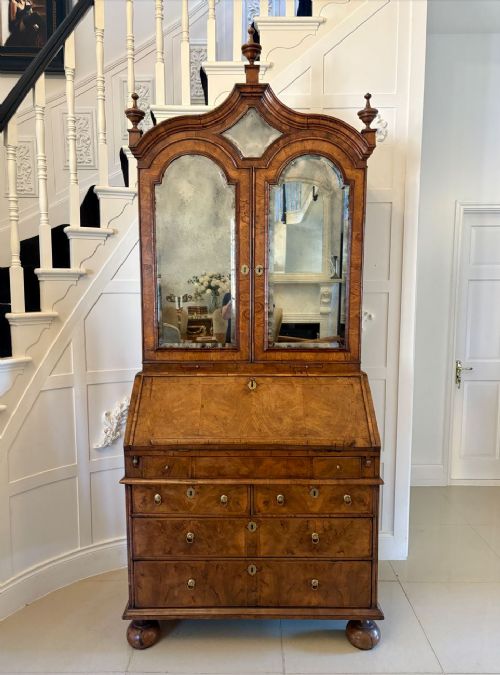
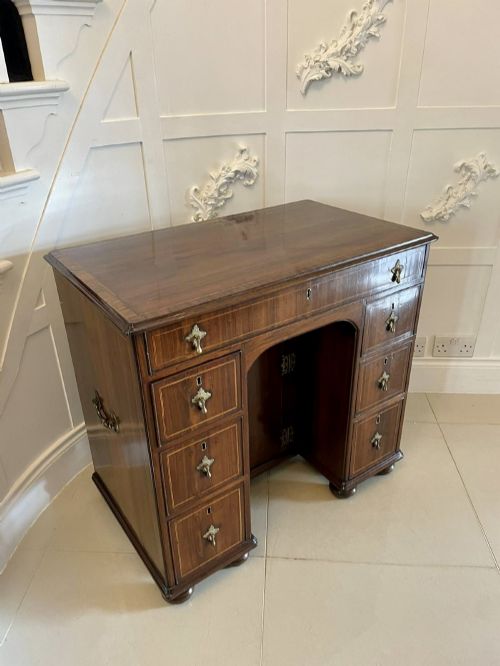
A featherbanded walnut desk is a writing piece originating in the eighteenth century, encompassing bureau bookcases, kneehole desks, and lowboys. These forms showcase the cabinetmaker's skill in arranging rich timber surfaces for domestic use.
The versions met on this page date exclusively to the eighteenth century, spanning the Queen Anne, George I, George III, and early Georgian periods. Bureau bookcases and kneehole desks dominate the offerings, often complemented by lowboys serving as writing or dressing tables.
How they were made
Cabinetmakers constructed these pieces using walnut, burr walnut, and oak, frequently incorporating glass panes in upper bookcase doors. Timber selection focused on dramatic grain patterns, notably in burr walnut veneers laid across primary surfaces.
Decoration relied on precision banded inlay framing the drawer fronts and tops, while brass hardware provided functional pulls and escutcheons. Quarter veneered tops matched grain directions symmetrically to create complex geometric patterns.
Retail Price Guide 2026
Typical UK retail prices for featherbanded walnut desk, calculated from the Sellingantiques database of over a million retail prices indexed since 2003. This retail price guide relies exclusively on Sellingantiques data; no external sources or auction records are used, so the figures do not describe the wider market.
The timber chosen for these desks often came from trees planted during the reign of earlier monarchs, maturing just in time for Georgian cabinetmakers.
What varies in quality
Quality rests upon the ambition of the veneering and the crispness of the featherbanding. Bureau bookcases with intricate upper cabinet glazing and balanced burr walnut figures stand apart from simpler writing tables.
The harmony of the timber selection dictates the visual success of each piece. Desks exhibiting carefully matched quarter veneered tops and intact brass fittings represent the finer tier of eighteenth-century craftsmanship.
The Featherbanded Walnut Desk Glossary
- Featherbanding
- A form of inlay consisting of two strips of veneer laid diagonally to meet at a central axis, creating a herringbone effect. It frames drawer fronts and tabletops on eighteenth-century furniture.
- Burr walnut
- Timber taken from walnut tree growths or burls, prized for its swirling, highly figured grain patterns. It provides decorative surfaces on high-status desks.
- Kneehole desk
- A compact writing desk featuring a central recessed cupboard flanked by small drawers. This form became popular during the early Georgian period.
- Lowboy
- A small table with drawers, standing on four legs, used in the eighteenth century for writing or as a dressing table. Some examples share the kneehole configuration.
- Quarter veneered
- A technique where four matching slices of veneer, cut consecutively from the same log, are arranged symmetrically. This creates a mirrored pattern across the top of a desk.
Frequently Asked Questions
How were these desks used?
They served as private writing surfaces for correspondence, account management, and reading in the home.
Bureau bookcases added enclosed shelving for books and papers above the main writing flap, while kneehole desks offered concealed drawers for portable writing equipment.
How do I date an eighteenth-century desk?
Dating relies on stylistic shifts across the Queen Anne, George I, and George III periods, observed through leg forms and hardware.
Early Georgian and Queen Anne pieces often feature walnut and burr walnut veneers, while later George III examples show evolving proportions and construction methods.
Where should I place a walnut desk?
Position the desk away from direct sunlight and heat sources to protect the fragile walnut veneers and timber.
These pieces function well in studies or living rooms where their figured grain and featherbanding can be appreciated from multiple angles.