


Farm Landscape Artwork
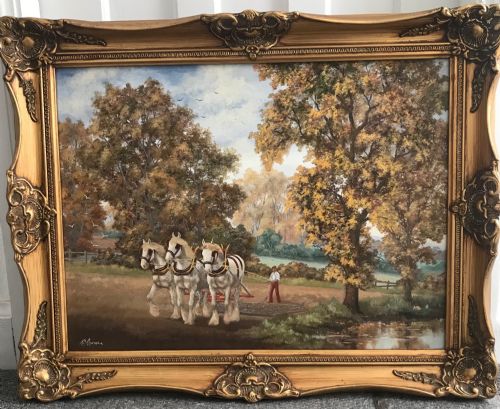
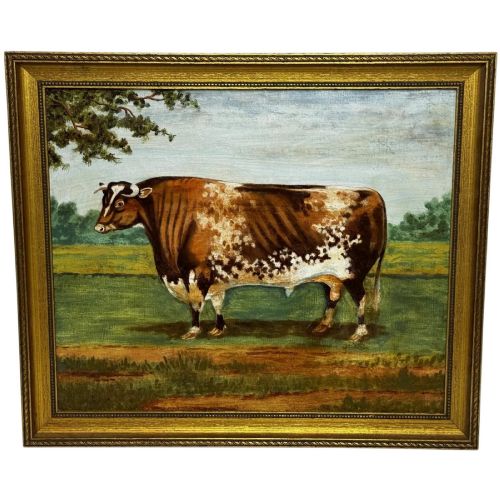
Farm landscape artwork captures the working countryside through rural scenes of ploughing horses, livestock, and harvest yards.
Farm Landscape Artwork
Farm landscape artwork encompasses traditional depictions of rural life, agricultural labour, and pastoral scenes created across the nineteenth and twentieth centuries. These pieces record the everyday rhythms of farming through depictions of shire horses, cattle, farmsteads, and harvested fields.
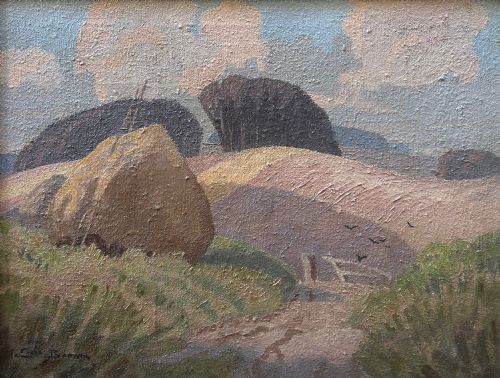
Buyers will most frequently encounter nineteenth-century and early twentieth-century oil paintings on canvas and board, alongside watercolours and original etchings. These works range from detailed Victorian animal studies to broader British and French impressionist views of the countryside.
How they were made
Artists worked primarily in oil paint on prepared canvas or wood panels, building rich textures to describe agricultural fields, livestock, and animal coats. Watercolours on paper offered a lighter medium for capturing atmospheric skies and open farmyards.
Framing typically involved ebonised or moulded wood frames that suited the traditional palettes of the period, while original etchings relied on inked metal plates pressed onto fine paper.
Ducks and chickens frequently supervise heavy farm labour from the edges of the canvas.
What varies in quality
Quality rests upon the artist's command of anatomical drawing, particularly in the rendering of working horses and farm livestock within a convincing spatial landscape. Stronger works display confident brushwork and a balanced composition that unites the human labour, animals, and surrounding fields.
Condition plays a part in separating examples, with original stable surfaces and untouched periods of preservation holding more integrity than heavily restored canvases.
Herbert Dicksee·Raimond Louis Lecourt·Franz van Severdonck·John Frederick Herring Jnr·Ernest Pile Bucknall·Samuel Joseph Clark·Eugene Verboeckhoven·Charles Vickers·John Linnell·Claude Cardon
The Farm Landscape Artwork Glossary
- Etching
- A printmaking technique where lines are bitten into a metal plate with acid before being inked and pressed onto paper. This method allowed artists to produce detailed linear works of rural subjects.
- Oil on Canvas
- Pigment mixed with drying oils applied to a woven fabric stretched across a wooden frame. It remains the principal medium for durable landscape painting.
- Watercolour
- A paint consisting of pigment suspended in a water-soluble vehicle, traditionally applied to paper. It yields transparent washes ideal for light-filled rural watercolours.
- Board
- A rigid wooden or fibrous support used instead of canvas for painting. It provides a firm surface often seen in smaller regional landscape works.
Farm Landscape Artwork: Frequently Asked Questions
What subjects appear in farm landscape artwork?
These works feature working shire horses, ploughing scenes, cattle by streams, and harvest yards with poultry.
They record the routine activities of rural life and specific farmsteads across Britain and France.
How do I date a farm landscape painting?
Dating relies on stylistic clues, framing, artist signatures, and recorded working periods found in the title details.
Victorian and Edwardian pieces often display specific aesthetic traits and clothing styles distinct from mid-century works.
Where should I hang a rural oil painting?
These works suit traditional living spaces, studies, or dining rooms where natural light complements oil and watercolour surfaces.
Direct sunlight should be avoided to protect pigment stability on both canvas and paper over time.
What is the difference between an oil and a watercolour?
Oils use pigment bound in oil on canvas or board, offering rich texture and deep colour layering.
Watercolours use water-soluble pigments on paper, producing a luminous and lighter effect.