


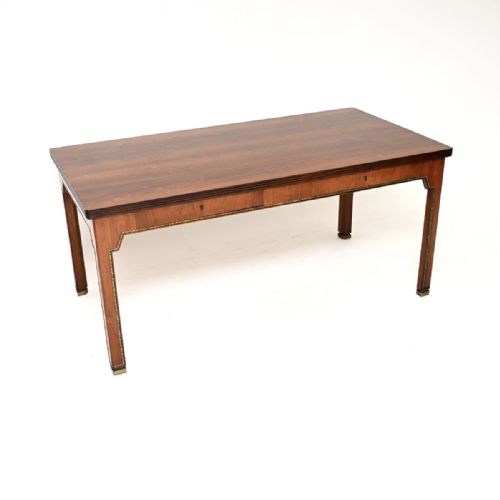
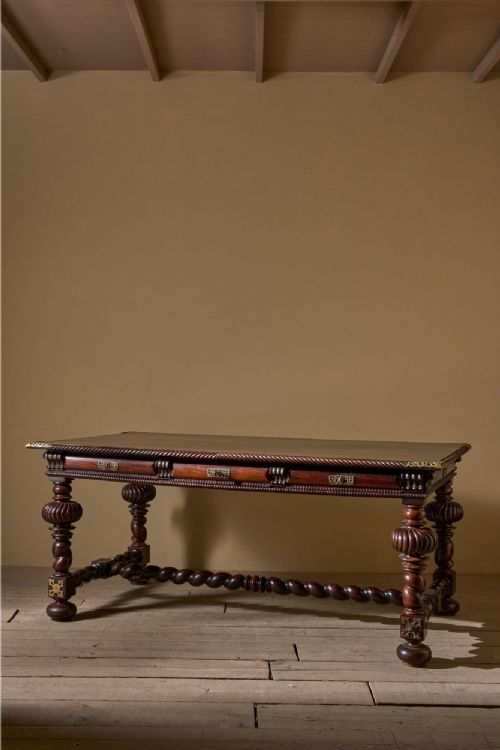
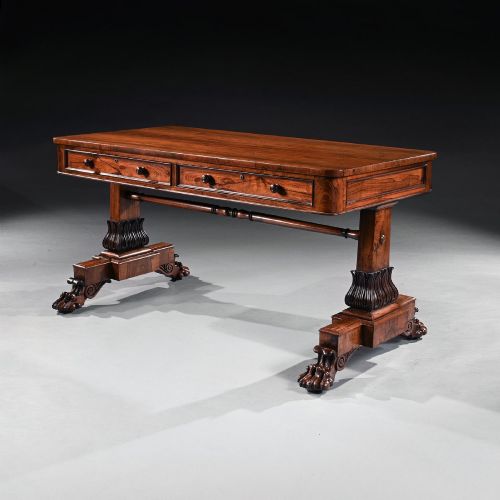
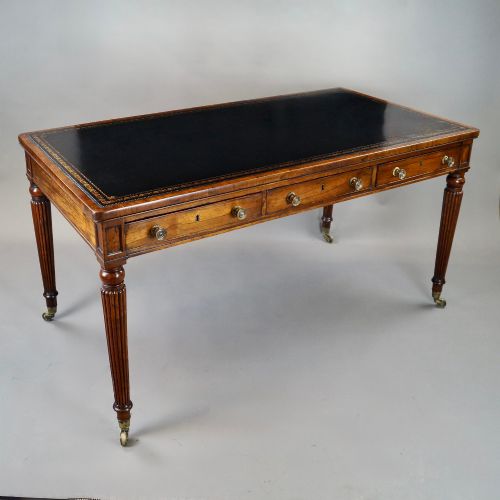
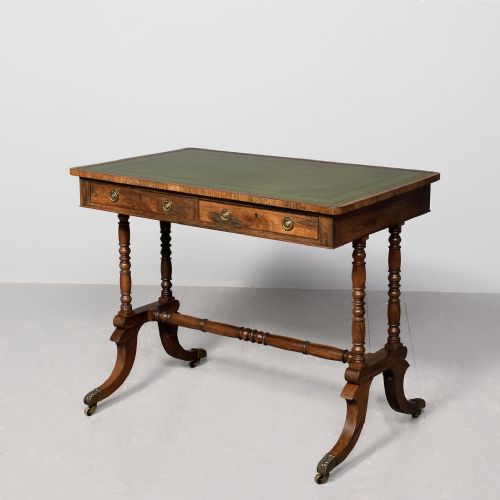


Executive Rosewood Table
An executive rosewood table brings warm grain and steady purpose to a study, with Regency library tables and Art Deco desks forming the core of the selection.
Executive Rosewood Table
An executive rosewood table serves as a substantial surface for correspondence and study, typically taking the form of a library table, pedestal desk, or bureau plat. These pieces are designed to stand free in a room rather than push against a wall, displaying finished timber on every side.
The version most commonly encountered on this page originates from the nineteenth century, spanning the Regency, William IV, and Victorian periods. Alongside these nineteenth-century examples appear French Art Deco and Danish Modern creations from the twentieth century.
Library tables and writing desks predominate in the inventory, often featuring freestanding pedestals or pillar supports. Buyers select these tables to anchor a workspace with deep brown and reddish timber tones.
Materials and construction methods
Makers utilised solid rosewood and veneers applied over secondary timbers, often incorporating contrasting woods such as tulipwood, satinwood, kingwood, and birds-eye maple for marquetry and parquetry details. Leather inserts frequently form the writing surface, providing a smooth plane for daily correspondence.
Metal mounts in brass, ormolu, and gilt bronze accent the corners, handles, and feet, while carved wooden details like lions paw feet anchor the heavier library tables. Joinery relies on traditional cabinetmaking techniques suited to heavy hardwoods.
Several tables feature carved lions paw feet that stand ready to hold your ground while you draft correspondence.
Distinctions in craftsmanship
The distinction between standard execution and finer work rests on the selection of timber figures and the precision of the parquetry or marquetry inlay. Superior examples display symmetrical grain patterns across expansive surfaces and meticulous attention to hidden secondary woods.
Hardware quality also separates grades of production, where heavy cast ormolu mounts and finely tooled leather writing surfaces indicate high workshop standards. Attribution to known makers or documented cabinetmakers further elevates the standing of a piece.
Gillows·Donald Ross·Maurice Dufrene·William Trotter
The Executive Rosewood Table Glossary
- Rosewood
- A dense, heavily figured timber prized for its dark grain and reddish-brown coloration. It takes a high polish and forms the primary surface material for these desks.
- Bureau Plat
- A French freestanding writing table fitted with drawers across the frieze. This form usually stands on slender cabriole or tapered legs.
- Ormolu
- Gilded bronze used for decorative mounts and decorative feet on French and English desks. It adds metallic contrast to the dark timber.
- Parquetry
- Geometric wood inlay patterns arranged to form decorative surfaces on tabletops and drawers. Craftsmen use contrasting timbers to create visual depth.
- Goncalo Alves
- A dense exotic hardwood with striking dark brown and amber figuring. Cabinetmakers employed this timber as an alternative to rosewood on nineteenth-century tables.
Executive Rosewood Table: Frequently Asked Questions
Where should an executive rosewood table go?
These pieces function best when placed in the centre of a room rather than pushed against a wall. Because the back and sides receive identical finishing, a freestanding setup displays the timber grain from every angle.
Positioning the table away from direct sunlight and heat sources protects the rosewood polish and prevents the leather writing surface from drying out over time.
How do I care for rosewood furniture?
Dust the timber regularly with a soft, dry cloth to prevent particle accumulation. Avoid silicone-based polishes, which dull the finish and build up a residue over years of application.
Maintain a stable room humidity to keep the solid timber and veneers from expanding or contracting, which protects the structural joins and inlay work.
What is the difference between a library table and a desk?
Library tables generally feature open friezes with one or two shallow drawers, designed primarily for reading and central room placement. Desks often incorporate banks of drawers in pedestals beneath the top surface for active storage.
Both forms utilise rosewood and similar construction methods, but pedestal desks provide significantly more enclosed storage capacity for papers and supplies.
How do I identify a Regency rosewood table?
Regency examples often display classical restraint, clean lines, and architectural supports such as pillar pedestals or sabre legs. Brass inlay and restrained ormolu mounts frequently accent the dark rosewood surfaces.
Proportions tend to remain balanced and formal, reflecting the design vocabulary of the early nineteenth century before the heavier Victorian styles developed.