





French Rosewood Bureau Plat
A french rosewood bureau plat brings a refined writing surface to a room, combining rich cabinet woods with gilt bronze mounts.
French Rosewood Bureau Plat
When you search for a french rosewood bureau plat, you are looking at a freestanding writing table designed to sit centrally in a room rather than against a wall. The pieces appearing here span the eighteenth century through to the mid-twentieth century, with nineteenth-century revivals making up the largest share. These desks take several related forms, including centre tables and ladies' desks, alongside traditional bureau plat writing tables.
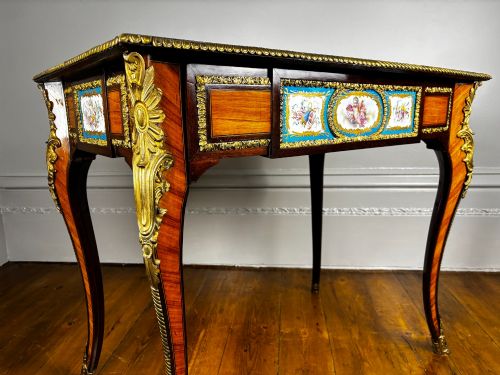
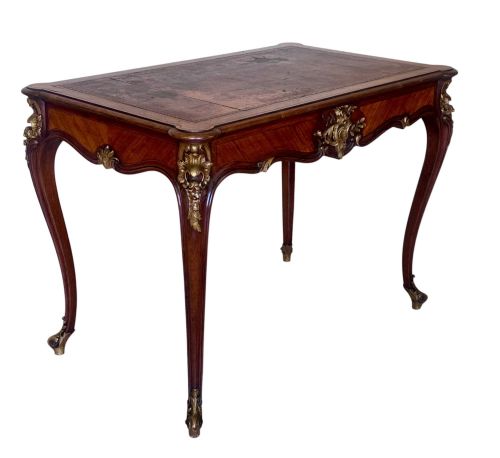
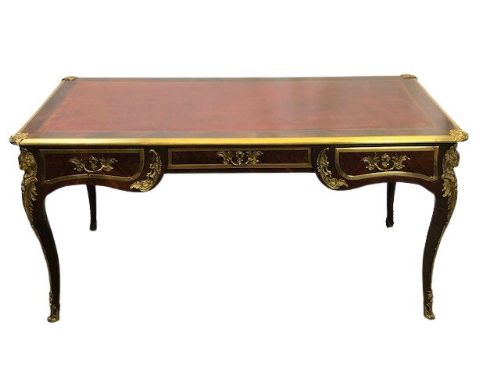
The dominant aesthetic draws heavily on Louis XV and Louis XVI revivals, accompanied by Napoleon III and French Rococo revival influences. Makers shaped these desks with curved cabriole legs or slender tapered supports, fitted with one or more drawers across the frieze. Many examples incorporate a leather-lined writing surface bordered by intricate marquetry or plain rosewood veneers.
Origins are consistently French, whether made in Parisian workshops or interpreted by English firms such as Gillows of Lancaster using continental idioms. The materials extend beyond rosewood to include kingwood, walnut, tulipwood, and fruitwood, often accented with porcelain panels or cartonnuer additions.
How They Were Made
Cabinetmakers built the carcass using native and exotic timbers, laying precious veneers like rosewood and kingwood over sturdy secondary woods. Marquetry patterns were hand-cut and pieced together in floral or geometric designs, creating elaborate surfaces across the top and sides of the desk.
Metal ornament played a defining structural and decorative role, with ormolu and gilt bronze mounts cast, chased, and secured to the corners, legs, and drawer edges. Brass stringing and details further highlighted the contours of the writing table, while leather was typically glued and tooled for the writing insert.
French Rosewood Bureau Plat Retail Price Guide 2026
Typical asking prices for french rosewood bureau plat among the pieces listed under this phrase on Sellingantiques today, from the lower quarter to the upper quarter. They describe what is for sale here now, not the wider market.
Some desks include a matching cartonnuer on top, proving that desk clutter is a centuries-old tradition.
What Varies in Quality
The standard of a french rosewood bureau plat rests largely on the crispness of its bronze mounts and the precision of its marquetry work. Finer examples display deeply chased ormolu with sharp definition, whereas simpler pieces rely on plain veneers and modest cast brass accents.
Construction methods also distinguish the workshop origin, seen in the smoothness of drawer linings, the thickness of the timber veneers, and the integrity of the structural joints. Pieces bearing the stamp of known makers often reflect superior hand-finishing across every visible and hidden surface.
Francois Linke·CH. Jeanselme & Co·Gillows Of Lancaster
The French Rosewood Bureau Plat Glossary
- Ormolu
- Gilded bronze used extensively for decorative mounts, corners, and feet on continental furniture. The technique involves applying a mercury and gold amalgam to cast bronze before firing.
- Marquetry
- The art of applying small pieces of veneer to a structure to form decorative patterns and pictorial scenes. Makers utilised woods like rosewood, kingwood, and tulipwood for tonal contrast.
- Cartonnuer
- A set of pigeonholes or document drawers built to sit on top of a desk. These additions helped organise correspondence and paperwork.
- Frieze
- The central horizontal band of the desk located directly beneath the top surface, which typically houses the pull-out drawers.
French Rosewood Bureau Plat: Frequently Asked Questions
What is a bureau plat?
A bureau plat is a freestanding writing desk designed to be viewed from all sides, featuring a finished back and a wide top.
These tables typically include drawers set into the frieze and often rest on curved cabriole legs with metal mounts.
Where should I place it?
Because the back of a bureau plat is finished with the same care as the front, it sits comfortably in the middle of a room.
Many people use them as statement writing desks or large console tables in studies, libraries, and drawing rooms.
How do I identify a revival piece?
Nineteenth-century revival pieces emulate earlier eighteenth-century designs, often incorporating Louis XV or Louis XVI decorative vocabulary.
Examining the construction methods, secondary timbers, and wear patterns helps distinguish nineteenth-century interpretations from earlier originals.
What woods were used?
Cabinetmakers relied heavily on exotic imported timbers such as rosewood and kingwood for their striking grain patterns and rich natural colours.
Secondary woods like walnut, tulipwood, and fruitwood frequently appeared alongside marquetry inlay and gilt bronze accents.