








Etched Crystal Stemware
Etched crystal stemware brings period grace to the table, combining clear glass and lead crystal with delicate surface work.
Etched Crystal Stemware
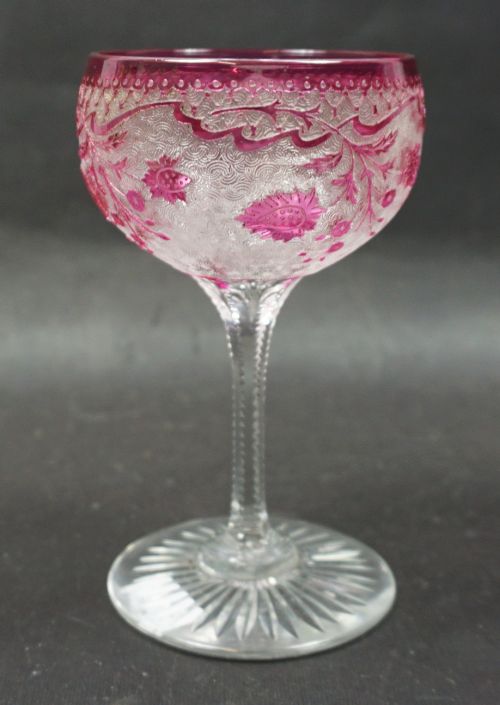
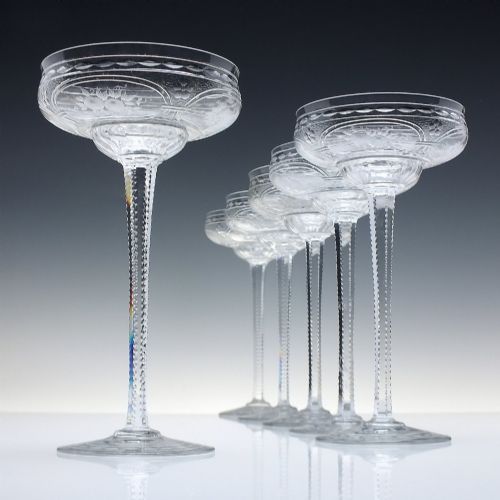
Etched crystal stemware comprises drinking vessels, wine glasses, champagne glasses, and champagne coupes created across periods spanning the Georgian era, the Victorian decades, and the early twentieth century. These pieces serve functional drinking purposes while displaying decorative patterns on clear glass, lead glass, and ruby glass bowls.
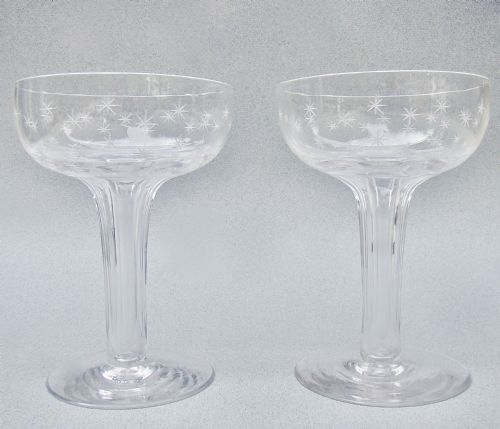
The version most frequently encountered on this page is the Victorian wine glass or champagne coupe, typically featuring star-etched or floral motifs upon a hollow or faceted stem. Alongside these, French suites, Art Deco services, and Georgian faceted stemmed drinking glasses appear regularly.
Forms extend from single rummers and gin glasses to large dining suites comprising dozens of matched or harlequin elements. Buyers select these items to furnish traditional dining settings or to mix historical periods within a modern interior.
How they were made
The manufacture of these drinking vessels begins at the furnace, where artisans shape lead crystal, clear glass, and ruby glass using hand-blown techniques. Molten material is gathered on an iron blowpipe and manipulated into bowls, stems, and wide foot bases.
Decoration relies on surface modification, utilising engraving, wheel-cutting, acid-cutting, and etching techniques to create intricate patterns such as fruiting vines and star motifs. Chemical treatments or rotating abrasive wheels cut directly into the lead glass to produce the characteristic tactile finish.
Etched Crystal Stemware Retail Price Guide 2026
Typical asking prices for etched crystal stemware among the pieces listed under this phrase on Sellingantiques today, from the lower quarter to the upper quarter. They describe what is for sale here now, not the wider market.
One set includes thirty-four matching French glasses, ensuring nobody runs out of champagne.
What varies in quality
Quality in these drinking glasses rests upon the clarity of the material and the precision of the surface decoration. Heavier lead crystal exhibits greater brilliance and depth than standard clear glass, while crispness in the wheel-cut or etched lines defines superior craftsmanship.
The integrity of the form - such as the balance between the bowl, the stem, and the wide foot base - distinguishes standard production from finer services. Larger suites maintaining uniform pattern application across every piece demand higher skill levels than isolated individual vessels.
Baccarat·Stevens & Williams
The Etched Crystal Stemware Glossary
- Lead crystal
- Glass containing metallic oxide to increase refractive index and weight. This material provides the brilliant clarity and resonant ring expected in finer drinking vessels.
- Champagne coupe
- A shallow, broad-bowled glass designed originally for sparkling wine. The wide rim allows the bubbles to dissipate quickly while showcasing the engraved bowl and foot.
- Rummer
- A large, heavy drinking glass popular in the eighteenth and nineteenth centuries. These vessels typically feature a short stem and a capacious bowl suitable for ale or wine.
- Acid cut cameo
- A decorative technique using acid to eat away layers of coloured glass over a contrasting ground. This process produces raised, multi-layered designs on the surface.
- Harlequin set
- A collection of individual glasses sharing similar forms or periods but varying in minor decorative details. Such sets offer a mismatched yet complementary aesthetic for the table.
Etched Crystal Stemware: Frequently Asked Questions
How do I clean antique crystal stemware?
Wash these drinking vessels by hand in warm water using a mild detergent, avoiding sudden temperature changes to protect the glass.
Dry each piece immediately with a lint-free cloth to maintain the clarity of the etched and cut decoration.
Can I use these glasses for daily dining?
Many people incorporate period stemware into everyday meals, provided they handle the lead crystal and hand-blown glass with care.
Hand washing remains essential to preserve the delicate engraved surfaces of Victorian and Georgian pieces.
What is the difference between a wine glass and a rummer?
Wine glasses generally feature taller stems and smaller bowls proportioned for table service during dinner.
Rummers possess a shorter stem and a larger, heavier bowl designed for heartier beverages.
How do I identify Victorian stemware?
Victorian examples often display deep star-etching, heavy lead crystal construction, and characteristic hollow or faceted stems.
Comparing the weight and the style of the engraving against documented nineteenth-century forms helps confirm the period.