
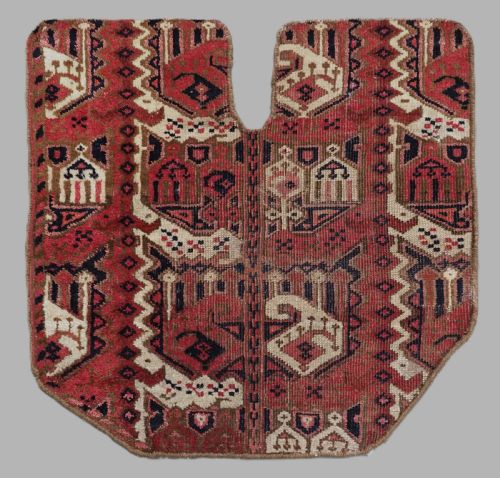


Ersari Rug Circa 1880
An ersari rug circa 1880 brings central asian tribal weaving into a room through rich wool and natural dyes.
Ersari Rug Circa 1880
An ersari rug circa 1880 represents traditional central asian tribal weaving from the late nineteenth century. These textiles include main carpets, saddle rugs, door hangings known as ensis, and storage bags such as torbas and chuvals.
The version most commonly met on this page is the torba or bag face, often featuring distinctive motifs like ikat designs, chodor ertum guls, star in octagon patterns, and rams horn motifs. Beshir subgroup pieces also appear alongside standard tribal formats.
Makers utilised wool foundations, occasionally incorporating goat hair or horsehair for durability within tribal trappings and bags. Small dowry rugs like the dip khali also occur within this group.
How they were made
Weavers constructed these pieces using hand-spun wool for the pile, dyed with natural colourants to achieve deep tones. Foundations combined wool with goat hair and horsehair to provide structural strength for utilitarian objects.
The execution relies on traditional Turkmen tribal knotting techniques specific to Central Asia. These methods produced dense, durable surfaces capable of withstanding heavy daily use in nomadic or village settings.
What varies in quality
The standard of an ersari rug circa 1880 rests upon the clarity of the natural dyes and the depth of the hand-spun wool pile. Strong, vibrant colour separation enhances the visual impact of complex patterns like ikat designs and guls.
Structural integrity also dictates quality, particularly the tightness of the weave and the condition of the wool, goat hair, or horsehair foundation. Pieces retaining complete original borders and sound side-cords represent the higher end of the range.
The Ersari Rug Circa 1880 Glossary
- Torba
- A small Turkmen storage bag used inside a tent. These pieces often feature wide main borders and refined guls.
- Ensi
- A tribal door hanging placed at the entrance of a yurt. They typically display a cruciform design dividing the field into four panels.
- Chuval
- A large storage bag face produced by Turkmen tribes for household belongings. They frequently showcase major guls aligned in rows.
- Gul
- A repeating medallion pattern used in Turkmen carpet design. Each tribal group utilised distinct botanical or geometric variations.
- Beshir
- A subgroup of Ersari Turkmen weaving known for larger formats and borrowable elements from ikat textiles. These pieces often display unique layouts.
Ersari Rug Circa 1880: Frequently Asked Questions
How do I use an ensi?
An ensi functions traditionally as a tent door hanging to demarcate the domestic interior from the outside space. In modern settings, collectors usually hang them on walls as textile art.
Their specific layout, featuring a central cross division, makes them well-suited for vertical display where the full design remains visible.
How do I care for wool pile?
Maintenance requires gentle vacuuming without a rotating beater bar to protect the hand-spun wool pile and natural dyes. Keeping the textile out of direct sunlight prevents the fading of traditional colourants.
Professional cleaning by a specialist in antique oriental carpets ensures the goat hair and horsehair foundations remain stable over time.
What are ikat designs?
Ikat designs found on Beshir torbas mimic the blurred resist-dye patterns characteristic of Central Asian silk garments. Weavers translated these fluid textile motifs into wool carpet pile.
This stylistic borrowing demonstrates the cultural exchange between nomadic carpet weavers and urban sedentary populations in the region.