

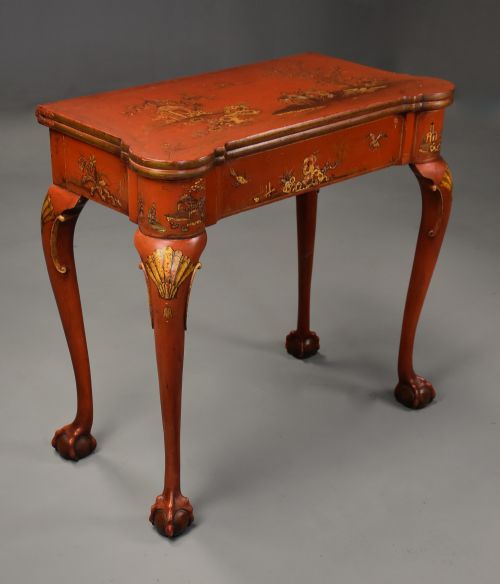


Envelope Tea Table
An envelope tea table is a clever folding top piece designed for games and tea, combining compact elegance with mechanical ingenuity.
Envelope Tea Table
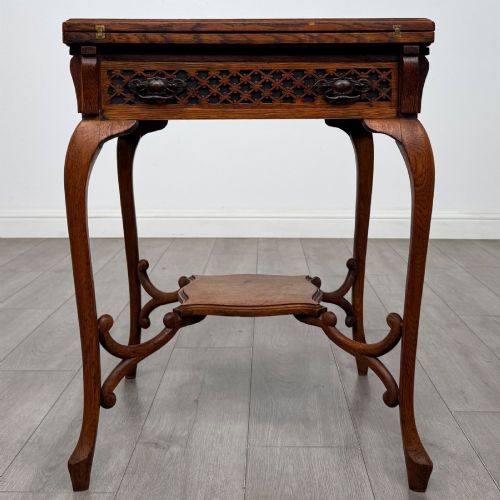
An envelope tea table is a specialist piece of furniture created to serve both as a display surface and a practical gaming or tea table. When you search for an envelope tea table, you encounter inventive designs where the top is formed of four triangular flaps that fold inward like an envelope.
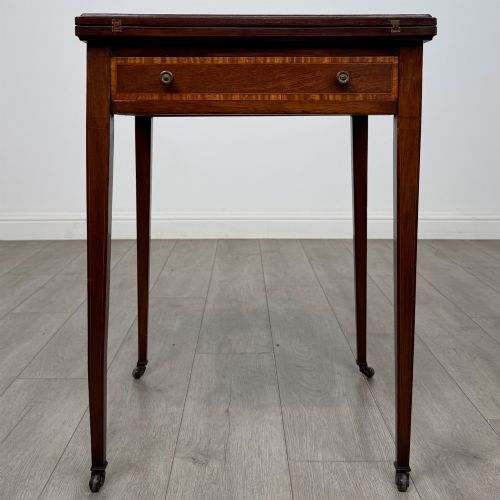
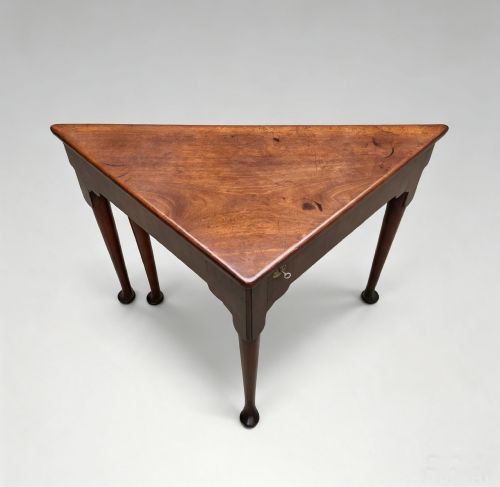
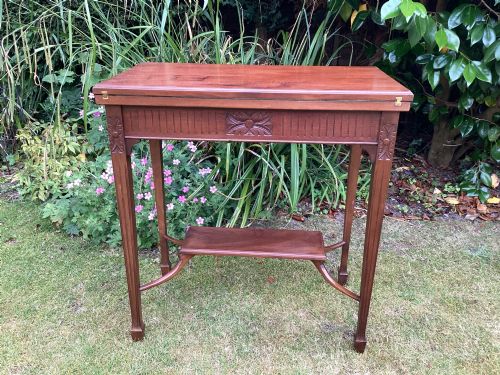
The pieces appearing on this page span several distinct eras, with Edwardian and Victorian examples forming the bulk of the selection alongside earlier Georgian and Regency roots. Makers utilised woods such as mahogany, rosewood, and walnut, often enhanced with satinwood inlay, brass fittings, and marquetry.
Most entries function dually as card tables or occasional tables, pivoting or folding out to reveal baize-lined playing surfaces with clever internal wells for counters. This combination of compact closed dimensions and generous open utility makes them enduringly popular for drawing rooms.
How they were made
Cabinetmakers constructed these tables using solid timber frames veneered with rich woods like mahogany, rosewood, and burr walnut. Boxwood and satinwood inlay added crisp geometric detailing or floral motifs across the folding leaves.
The defining mechanism relies on a clever pivot action where turning the top causes all four triangular leaves to open or close in unison. Brass hinges and internal wooden linkages ensure the flaps meet precisely at the centre when closed.
The selection spans several distinct eras, incorporating Edwardian, Victorian, Regency, and 18th Century styles.
What varies in quality
The sophistication of the timber selection dictates much of the distinction, with figured burr walnut or finely chosen rosewood sitting above plain mahogany. Fineness of inlay and the crispness of marquetry work show the artisan's skill.
The smoothness of the mechanical action separates ordinary pieces from superior examples. A well-made table operates with synchronized precision, where turning the surface lifts and spreads the flaps without binding or sagging.
Howard & Sons Ltd
The Envelope Tea Table Glossary
- Envelope table
- A table with a square top composed of four triangular folding flaps that pivot open to reveal a baize-lined surface. This mechanism was particularly favoured in the Edwardian and Victorian periods for games rooms.
- Marquetry
- The art of applying pieces of veneer to a structure to form decorative patterns and pictures. Craftsmen used contrasting timbers like boxwood and satinwood to create detailed floral or geometric motifs.
- Baize
- A coarse woolen material resembling felt, traditionally used to line the playing surfaces of card and games tables. It provides a soft, non-slip texture for playing cards and counters.
- Occasional table
- A small, versatile piece of furniture designed for specific, intermittent use rather than permanent placement. These tables are easily moved around a room as needed for tea or cards.
Envelope Tea Table: Frequently Asked Questions
How does the envelope mechanism work?
The mechanism relies on a central pivot connected to internal wooden levers. When you rotate the top table surface, all four triangular leaves are drawn inward or pushed outward simultaneously.
This synchronized movement allows the table to transform swiftly from a compact square surface into an expanded table with a lined interior.
Were these tables used for tea or games?
They were designed to accommodate both pursuits depending on the arrangement of the room. The enclosed top served as a stable surface for tea or display when folded.
Opening the flaps revealed a baize-lined interior complete with small corner wells intended for holding card counters and gaming pieces.
What woods were commonly used?
Mahogany and rosewood form the foundation of many surviving examples, particularly from the Victorian and Edwardian periods. Cabinetmakers also utilised walnut and satinwood to provide richer grain patterns and lighter contrasting tones.
Inlay work frequently incorporated boxwood and various dyed veneers to create geometric borders or central floral medallions.
How do I identify an Edwardian piece?
Edwardian examples often feature lighter timbers, delicate satinwood inlay, and slender tapered legs rather than the heavier proportions of earlier eras. They frequently display refined Edwardian Chippendale revival influences or simpler classical stringing.
The construction techniques and standardised hardware of the early twentieth century also help distinguish these later interpretations from genuine Georgian precursors.