







Engraved Brass Mantle Clock
An engraved brass mantle clock brings nineteenth-century mechanical precision and finely worked metal into a room.
Engraved Brass Mantle Clock
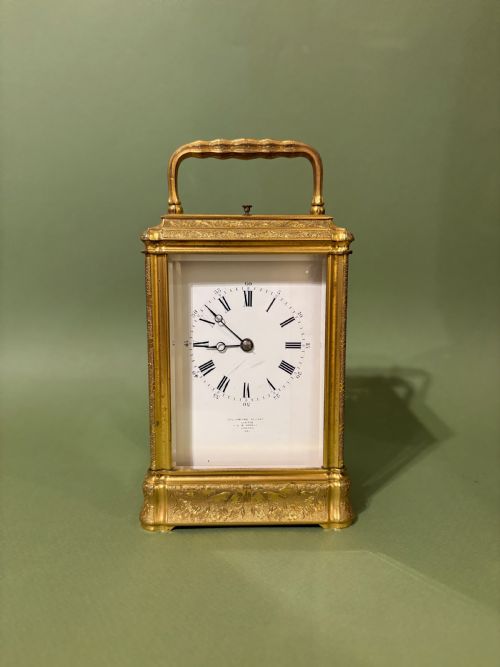
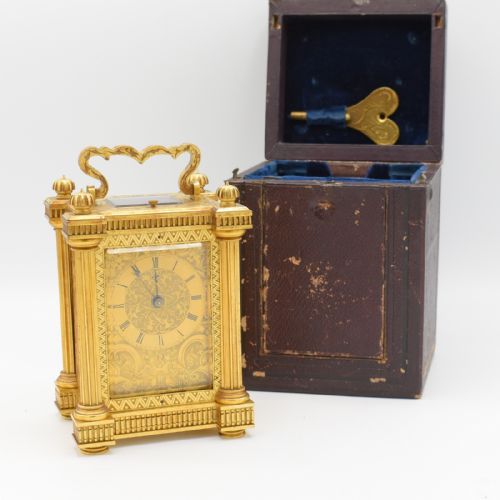
An engraved brass mantle clock represents a category defined by polished metal housings decorated with line work, scrolls, and floral motifs. Buyers searching for an engraved brass mantle clock encounter French carriage clocks, repeating timepieces, and bracket forms originating from the Victorian era up to the early twentieth century.
The pieces appearing on this page span several decades of production from the mid-nineteenth century through the 1920s. Workshop output from French makers dominates the selection alongside British firms, utilising heavy cast housings designed to sit stably on a shelf or mantle.
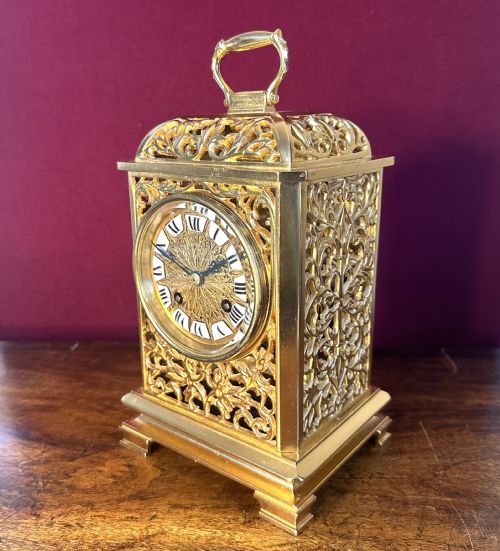
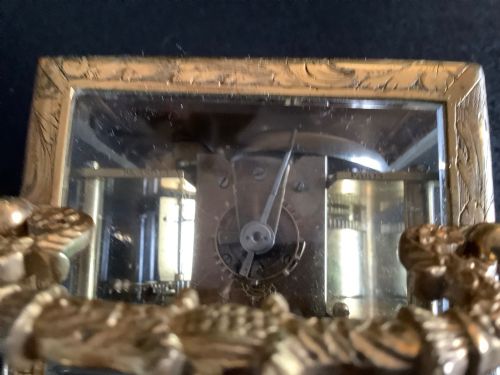
Forms vary from miniature carriage models to giant repeating clocks and lantern clocks. Many examples feature glass panels that reveal the escapement and train of wheels inside, framed by richly chased or engraved brass surfaces.
Materials and Construction
Makers constructed these clocks primarily from brass and gilt brass, frequently casting heavy frames to house intricate spring-driven or fusee movements. Enamel dials provide a crisp, contrasting surface for Roman or Arabic numerals, while bevelled glass panels protect the delicate gear trains from dust.
Engraving was executed by hand using gravers to cut fine lines and patterns directly into the brass or gilt bronze surfaces. Workshops often combined polished flat planes with recessed, matted, or engraved borders to create depth and catch the ambient light.
Engraved Brass Mantle Clock Retail Price Guide 2026
Typical asking prices for engraved brass mantle clock among the pieces listed under this phrase on Sellingantiques today, from the lower quarter to the upper quarter. They describe what is for sale here now, not the wider market.
Recorded periods span from the mid-nineteenth century Victorian era through the Edwardian period and into the nineteen-twenties.
Markers of Quality
Quality in these clocks rests upon the crispness of the hand engraving and the robustness of the movement. Superior examples display deep, sharply defined cutting on the brass case rather than shallow machine stamping, alongside complex mechanisms such as quarter striking and repeater functions.
The thickness of the brass casting and the clarity of the enamel dial further separate standard production from high-end workshop output. Signed backplates and movements by recognised makers indicate a higher tier of horological craftsmanship.
HENRI JACOT·Howell & James London·Mappin & Webb·Margaine Of France·Charles Frodsham·Drocourt·Peerless Mathias Bauerle
The Engraved Brass Mantle Clock Glossary
- Carriage clock
- A portable spring-driven timepiece designed during the nineteenth century for travel. These clocks typically feature a rectangular brass case with glass panels and a folding handle on top.
- Repeater
- A mechanical complication that strikes the hours and quarters on demand when a pendant or lever is pressed. This feature allowed owners to tell the time in the dark without lighting a candle.
- Fusee
- A conical pulley used in better quality clocks to maintain an even pull on the movement as the mainspring unwinds. This mechanism ensures more consistent timekeeping throughout the running period.
- Escapement
- The internal mechanism that controls the release of power from the gear train and gives an impulse to the balance wheel or pendulum. Common types in these clocks include the lever and cylinder platforms.
Engraved Brass Mantle Clock: Frequently Asked Questions
How do repeating carriage clocks work?
A repeating carriage clock contains an additional train of gears powered by its own spring. Pressing the button on top releases this train to sound the last hour and quarters on a bell or gong.
This complication required precise fitting within a compact brass case, making these models more expensive to produce originally.
What is a fusee movement?
The fusee is a cone-shaped grooved pulley connected to the mainspring by a fine chain or cord. As the spring loses tension, the chain moves to a wider part of the cone to maintain equal torque.
This system provides superior timekeeping accuracy compared to standard barrel-driven spring clocks.
How should I clean the brass case?
Dust the engraved brass surfaces gently with a soft, dry cloth to prevent the accumulation of grit in the recesses. Avoid abrasive polishes that can wear away gilding or soften the sharp edges of the hand engraving.
Professional horological cleaning is recommended for the internal movement every few years to keep the gear train operating smoothly.
Are these clocks suitable for daily winding?
Most of these timepieces require winding every eight days using a dedicated key fitted to the arbors on the backplate. Handle the key carefully and stop winding the moment resistance is felt to avoid over-tensioning the mainspring.
Setting the time should be done by moving the minute hand forward rather than backward to protect the escapement.