


English Village Watercolours
English village watercolours capture the quiet charm of rural life through delicate pigments on paper.
English Village Watercolours
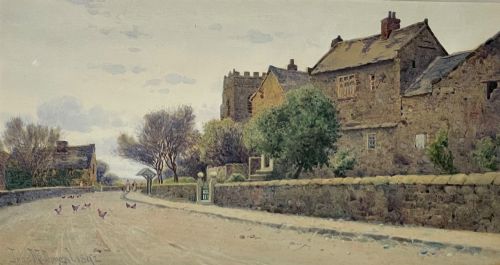
English village watercolours represent rural settlements, country streets, and coastal hamlets across various British locations. These original artworks record specific places such as Yorkshire, Devon, Suffolk, and Warwickshire through the eyes of artists working from the Victorian era into the mid-twentieth century.
Buyers encounter landscape studies, architectural views of historic inns and stone houses, and coastal scenes associated with regional groups like the Staithes School. The selections span Victorian pastoral depictions, Edwardian views, British Impressionism, and mid-century realism.
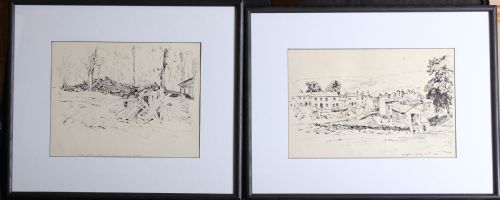
The works take the form of individual paintings, drawings, and pairs executed on paper support, often mounted within traditional wood and glass framing. These pieces offer a direct visual record of changing British rural architecture and topography.
How they were made
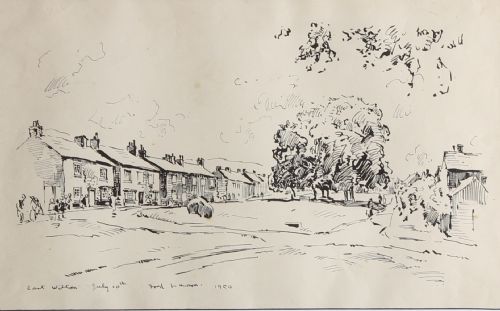
Artists created these works using watercolour pigment and ink applied directly onto paper supports. The technique relied on fluid washes of colour combined with precise ink linework to define architectural details, stonework, and figures.
Finished paintings were commonly protected behind glass and housed within wooden frames suited to domestic display. The combination of water-soluble pigments and paper required careful handling by the artists to build translucent layers of tone and atmosphere.
Several watercolours preserve the exact names of obscure village inns long after the ale has stopped flowing.
What varies in quality
Quality rests upon the artist's ability to capture light, topographical atmosphere, and architectural proportion within the fluid medium of watercolour. Works by established named painters demonstrate superior control over pigment density and spatial depth compared to anonymous topographical sketches.
The strength of composition and the clarity of regional detail separate routine topographical records from accomplished examples of British Impressionism and regional school painting. Condition of the paper support and preservation of original pigment vibrancy also influence the visual impact of each piece.
John McDougal·Fred Lawson·Arthur Tucker·Louie Stanley Maurice Prince·Frederick G. Coulridge·John Smith Atherton·John Edward Bale·Robert Hollands Walker·Frederick Mayor·Percy Brooke·David Woodlock·Walter Henry Sweet·John J. Hamer·Stanley Orchart·Alfred Rimmer·David Heward·Joseph Hughes Clayton·Alfred Leyman
The English Village Watercolours Glossary
- Watercolour
- A painting method in which the paints are made of pigments suspended in a water-based solution. This medium allows for translucent washes and delicate colour layering.
- Staithes School
- A group of northern artists associated with the Yorkshire coastal fishing village of Staithes. They adopted Impressionist techniques to capture local scenes and maritime life.
- Victorian Pastoral
- An artistic style celebrating idealized rural life and agrarian landscapes during the nineteenth century. These scenes typically emphasise quiet country cottages and agricultural routines.
- British Impressionism
- A painting approach focusing on light, fleeting moments, and everyday subjects using loose brushwork. This style influenced many landscape painters working across Britain in the late nineteenth and early twentieth centuries.
English Village Watercolours: Frequently Asked Questions
What periods do these watercolours cover?
The selections span from the nineteenth century through the Victorian and Edwardian periods into the mid-twentieth century, including works from the 1900s, 1910s, 1920s, 1930s, 1940s, and 1950s.
Individual pieces reflect the shifting stylistic approaches of these decades, ranging from traditional pastoral views to mid-century realism and British Impressionism.
How were these paintings originally displayed?
These watercolours were typically mounted behind glass within wooden frames to protect the delicate paper and pigment from dust and moisture.
Many retain their period framing, which provides context regarding how domestic interiors showcased rural art during the Victorian and Edwardian eras.
How can I identify specific locations?
Many works include titles inscribed directly by the artist or recorded on the mount, naming specific villages, counties, or landmarks such as Bolton Castle, Staithes, or Dedham High Street.
Comparing the architectural styles and regional topography helps verify the depicted English and Welsh locations recorded in the artwork titles.
What is the Staithes School?
The Staithes School represents a notable collective of artists who worked in the Yorkshire fishing village, applying Impressionist methods to coastal and rural subjects.
Watercolours by these painters capture the atmospheric light and daily activities of northern maritime and village communities.