
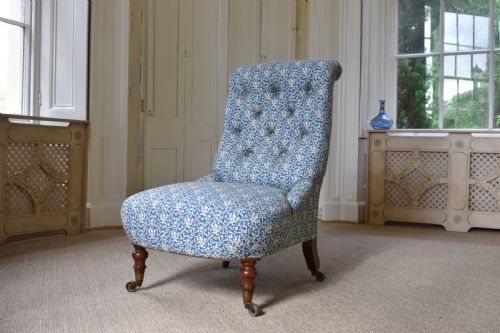

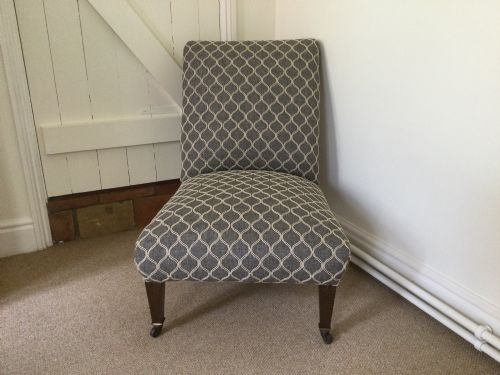


English Victorian Slipper Chair
An English Victorian slipper chair offers a low seat designed for the bedroom or boudoir, combining deep upholstery with neat proportions.
English Victorian Slipper Chair
When you search for an English Victorian slipper chair, you find low-slung seats designed originally for bedrooms and dressing rooms to allow comfortable dressing. These low profiles sit close to the floor, often supported by turned wooden legs on castors.
The selections here span the nineteenth century, including pieces from the eighteen-forties up to eighteen-sixty. Alongside dedicated slipper chairs, you encounter related bedroom chairs, nursing chairs, and low drawing room seats.
Makers and workshops of the period such as Howard and Sons, Gillows, and Maple and Co produced these seating forms in walnut, mahogany, and rosewood. Upholstery choices vary from button-backed designs in damask and cotton to vintage linen and tapestry.
Construction and Materials
Frames are constructed from solid hardwoods like walnut, mahogany, and rosewood, providing a sturdy skeleton for the low seat. Woodwork often appears on turned front legs and exposed frame edges, while brass castors enable easy movement.
Upholstery techniques rely on traditional stuffing and springing, finished with tight fabric covers, button tufting, and applied braids. Materials include cotton, linen, damask, and tapestry, reflecting both aesthetic movement tastes and mid-nineteenth-century conventions.
Low bedroom seats earned their name because Victorian ladies found it vastly easier to lace their boots while sitting close to the floor.
Judging Quality and Execution
The refinement of the timber frame dictates the baseline quality, with finely turned legs and rich grain in the walnut or rosewood marking superior examples. Workshops associated with known makers display a sharper attention to proportion and carved detail.
Upholstery execution separates standard output from exceptional pieces, particularly in the precision of button tufting and the choice of textile. Intricate details such as hand-woven tapestry or heavy damask elevate the presence of a drawing room or bedroom chair.
Howard and Sons·Maple and Co·Gillows
The English Victorian Slipper Chair Glossary
- Slipper chair
- A low-framed upholstered seat without arms, traditionally used in nineteenth-century bedrooms for changing shoes. The height keeps the sitter close to the floor.
- Nursing chair
- A low bedroom chair designed to support a woman while nursing children, sharing similar proportions with slipper chairs. These often feature slightly higher backs for added comfort.
- Button-backed
- An upholstery method where deep buttons are pulled through the padding to create a quilted, patterned diamond effect. This technique secures the internal stuffing while adding visual texture.
- Aesthetic Movement
- A late nineteenth-century design style focusing on visual beauty rather than narrative or moral function. Pieces from this movement display clean lines and refined decorative schemes.
- Castor
- A small swivelling wheel attached to the base of furniture legs to ease movement across carpets and floorboards. Brass fittings are common on mid-nineteenth-century seating.
English Victorian Slipper Chair: Frequently Asked Questions
What makes a slipper chair different from other Victorian chairs?
A slipper chair stands much lower to the ground than standard dining or drawing room seating, and traditionally lacks arms to accommodate bulky nineteenth-century petticoats and dresses.
This low profile allows the piece to fit neatly into bedrooms, dressing rooms, and smaller parlours without dominating the floor space.
How are these chairs used in modern rooms?
These low seats function well as accent chairs in living rooms, bedrooms, or reading corners where standard armchairs feel too bulky. Their compact footprint provides extra seating without crowding the room.
They also serve effectively beside dressing tables or as decorative pieces in hallways.
How do I identify a Victorian piece?
Victorian seating generally relies on solid hardwoods like walnut, mahogany, and rosewood, paired with traditional joinery and turned wooden legs fitted with brass castors. Stylistic details often include button upholstery and low-slung proportions.
Mid-nineteenth-century examples also reflect design shifts towards aesthetic movement influences or traditional button-backed salon styles.
Did these chairs always have castors?
Many nineteenth-century examples feature small brass castors on the front legs to allow easy repositioning across heavy carpets. These fittings protect the wooden legs and facilitate movement around the bedroom.
Some lighter bedroom chairs omit them depending on the specific maker and design.