




English Travel Clock
An english travel clock is a portable timepiece built for movement, offering precision and horological craft across Victorian, Edwardian, and later periods.
English Travel Clock
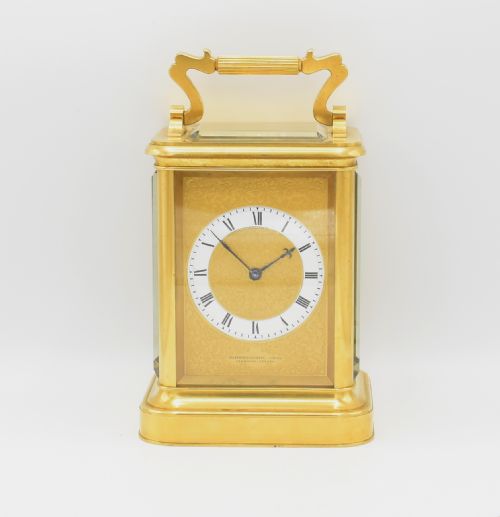
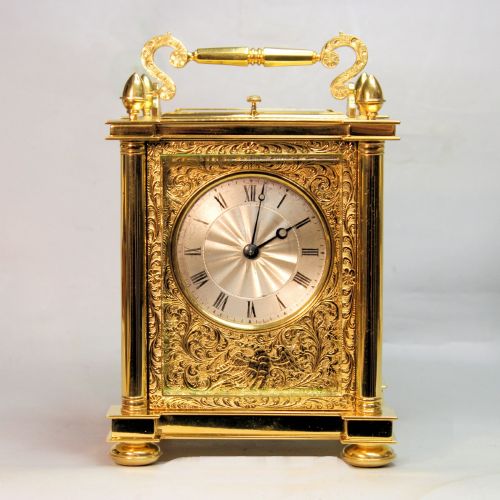
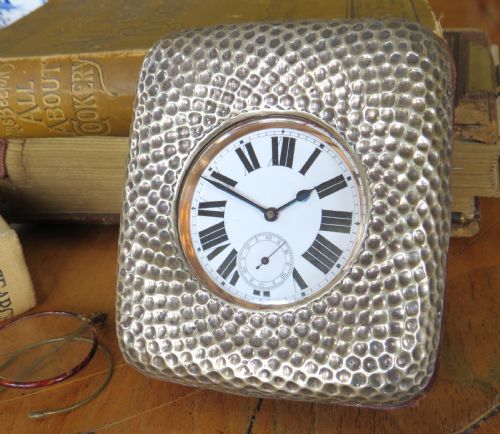
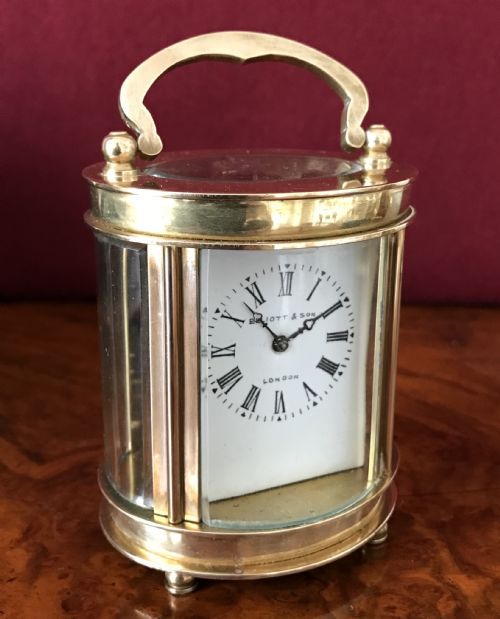
An english travel clock primarily takes the form of a carriage clock or a silver-cased timepiece designed for portability during journeys. These pieces emerge across the nineteenth century, the Victorian era, and into the twentieth century.
The most frequent examples encountered on this page are brass and gilt brass carriage clocks featuring glass panels and enamel dials. Alongside these, silver-cased travel clocks and miniature variants appear from periods spanning 1860 to 1960.
Makers and retailers of these portable clocks range from historic London firms to provincial specialists. The styles represented cover Victorian, Edwardian, Art Deco, and mid-century traditional designs.
Materials and Construction
The construction of an english travel clock relies heavily on brass, gilt brass, and silver for the structural cases, paired with glass to protect the delicate internal movements. Enamel is frequently utilised for the clock faces, providing a clean surface for Roman or Arabic numerals.
Internal mechanisms employ steel for springs and gears, with fusee movements and repeating complications incorporated by skilled horologists. Tortoiseshell and silvered metal also appear as casing materials in specific pieces.
English Travel Clock Retail Price Guide 2026
Typical asking prices for english travel clock among the pieces listed under this phrase on Sellingantiques today, from the lower quarter to the upper quarter. They describe what is for sale here now, not the wider market.
Listings feature carriage clocks and silver travel clocks spanning the Victorian period, 1860, 1880, 1900, 1930, and 1960.
Elements of Quality
Quality in an english travel clock rests upon the complexity and reputation of the movement inside, such as fusee or grande-sonnerie striking mechanisms. Pieces bearing the signatures of notable London makers command attention for their superior mechanical execution.
The choice of exterior housing materials, from solid silver and tortoiseshell to heavy gilt brass with flawless glass panels, dictates the refinement of the object. Miniature formats and giant carriage clocks represent distinct tiers of scale and horological ambition.
Cousens & Whiteside·Goldsmiths Alliance Ltd·Pickford of London·J Batson & Son·Thomas Cole and James Cole·Hunt And Roskell·Delépine·Henry Matthews·Dent·Folkard & Son Brighton
The English Travel Clock Glossary
- Carriage clock
- A portable spring-driven clock designed for travellers, typically housed in a brass case with glass panels. These clocks often feature a carrying handle on top.
- Fusee
- A conical pulley used in mechanical clocks to maintain an even pull on the movement as the mainspring unwinds. This mechanism ensures consistent timekeeping.
- Grande-sonnerie
- A striking clock complication that sounds both the hours and the quarters automatically on every quarter-hour. It represents a high level of watchmaking skill.
- Enamel dial
- A clock face created by fusing powdered glass to a metal substrate at high heat. This technique produces a smooth, durable, and lustrous white surface.
English Travel Clock: Frequently Asked Questions
How do I wind an english travel clock?
Most models use a dedicated key inserted into the backplate to tension the mainspring barrels. Care must be taken not to over-wind the mechanism.
Some fusee movements require specific handling depending on whether they feature a chain or gutline setup. Consulting the individual movement type ensures proper maintenance.
Were these clocks meant for actual travel?
Yes, these portable timepieces were engineered to withstand the vibrations of nineteenth-century transit by carriage and rail. Their robust brass cases and fitted leather cases protected the delicate gear trains.
Over time, many transitioned from functional travel gear to decorative mantelpieces. Their sturdy construction, however, remains a testament to their mobile origins.
How do I identify a Victorian example?
Victorian pieces often exhibit heavy gilt brass framing, classical architectural proportions, and white enamel dials with blued steel hands. Maker signatures engraved on the backplate help confirm the era.
Stylistic shifts across the reign move from restrained mid-century forms to more ornate Edwardian and Art Deco interpretations later on.
What is a gorge case?
A gorge case is a specific rectangular brass carriage clock housing featuring stepped mouldings at the top and bottom. This architectural style is typical of high-quality nineteenth-century production.
The clean lines of the gorge case allow the bevelled glass panels to showcase the internal escapement clearly.