
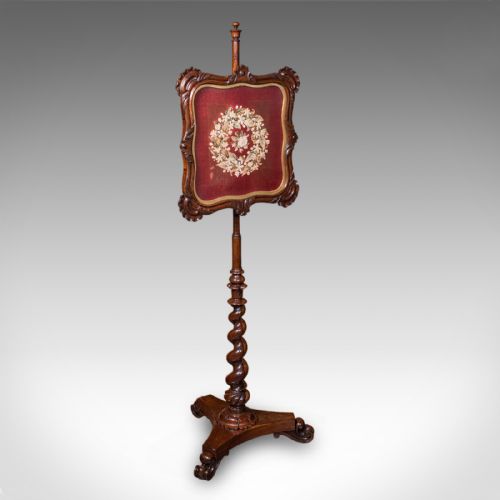


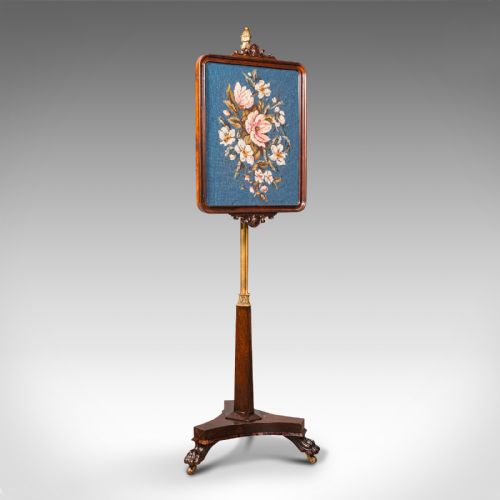
English Tapestry Screen
An English tapestry screen brings warmth and historical needlework to a room, serving as a functional fireside shield or a decorative divider.
English Tapestry Screen
When you search for an english tapestry screen, you encounter pieces designed to block hearth heat or divide a room with textiles. The selection ranges from tall multi-panel folding room dividers to adjustable tripod pole screens and freestanding cheval panels.
Most examples date from the Georgian, Regency, and Victorian eras, alongside occasional 1930 metamorphic occasional tables. Woods such as mahogany, rosewood, walnut, and giltwood frame wool, silk, and needlepoint panels.
Materials and construction methods
Cabinetmakers utilised dense timbers like mahogany, rosewood, and walnut to turn slender tripod bases, support frames, and tall folding panels. Brass hardware frequently secures hinges and adjustable pole mechanisms.
Textile panels display hand-worked wool needlepoint, tapestry, and silkwork embroidered onto canvas. These fabrics are mounted tightly into timber frames or hung from adjustable wooden poles.
Some screens cleverly double as tables, proving that Regency and Victorian inventors wanted their heat shields to hold a teacup too.
Distinguishing quality across the range
The sophistication of the needlework panel dictates much of the visual distinction, from simple floral motifs to intricate pictorial scenes worked in fine wool and silk. Crispness in the timber turning and carving, particularly on tripod bases and giltwood frames, separates standard workshop production from finer cabinetmaking.
Structural integrity relies on the tightness of frame joints and the smooth operation of adjustable brass mechanisms or folding hinges. Original textiles preserved in stable condition hold greater aesthetic continuity than later replacements.
The English Tapestry Screen Glossary
- Pole screen
- A fireside screen featuring a vertical wooden shaft and an adjustable panel that slides up and down to deflect hearth heat. The base typically rests on three carved legs.
- Cheval screen
- A large, freestanding framed panel supported by two side uprights and feet, allowing the glass or textile screen to tilt. It functions as both room decor and a movable barrier.
- Needlepoint
- Embroidery stitched onto a stiff open-weave canvas foundation, covering the mesh entirely to form dense pictorial or geometric patterns. Wool is the most common thread material.
- Giltwood
- Timber covered with a thin layer of gold leaf or gesso and gold paint. It appears on decorative frames and high-status furnishings.
- Metamorphic furniture
- An item designed to transform into another functional form, such as a fire screen that converts into an occasional table. This ingenuity combines display with utility.
English Tapestry Screen: Frequently Asked Questions
What is a pole screen used for?
A pole screen was traditionally placed near a fireplace to shield a person's face from the intense radiant heat of an open coal fire. The adjustable panel could be slid up or down the central shaft to block the heat precisely.
Over time, these pieces became decorative furnishings used to display fine needlework and embroidery. Today, they serve as accent pieces in sitting rooms and studies.
How do I date an english tapestry screen?
Dating relies on combining the timber species, joinery methods, and the style of the needlework panel. Georgian and Regency examples often feature mahogany or rosewood with delicate tripod bases, while Victorian pieces lean towards heavier walnut frames and elaborate floral needlepoint.
Looking at the construction of the frame and the wear on the wooden feet provides further clues. Comparative evidence from past sales helps align specific turning styles with precise decades.
Where should I place a room divider?
Room dividers work well in open-plan spaces to create private zones or visually break up a large room. Their height allows them to partition a corner while maintaining an airy feel.
Positioning them away from direct, strong sunlight protects the antique wool and silk needlepoint panels from fading. Placing them against a neutral wall also highlights the detailed textile work.
Are tapestry screens fragile?
The textile panels require gentle care because wool and silk needlework can weaken over long periods. Keeping them out of direct sunlight prevents the coloured threads from fading and becoming brittle.
The wooden frames and brass mechanisms are generally sturdy, but folding panels and adjustable poles should be handled with care. Regular dusting with a soft brush keeps the canvas and timber in good condition.