



English Rosewood Tea Table
An English rosewood tea table and its related card and centre forms bring rich dark timber and formal elegance to a traditional drawing room.
English Rosewood Tea Table
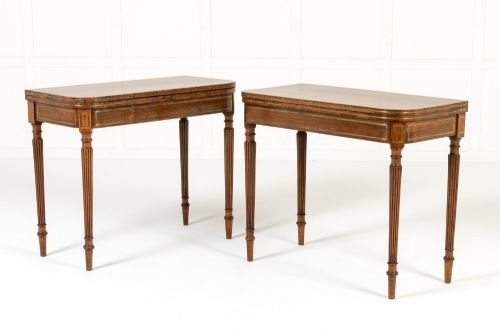
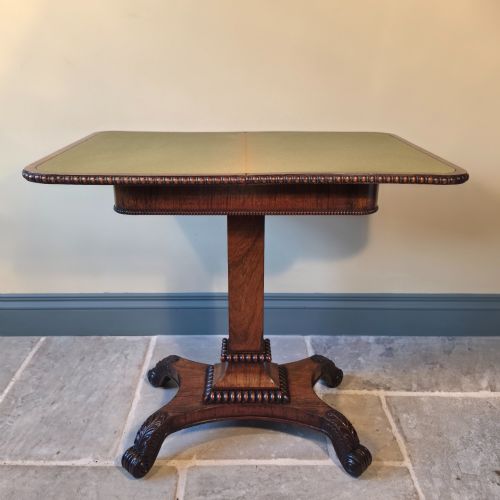
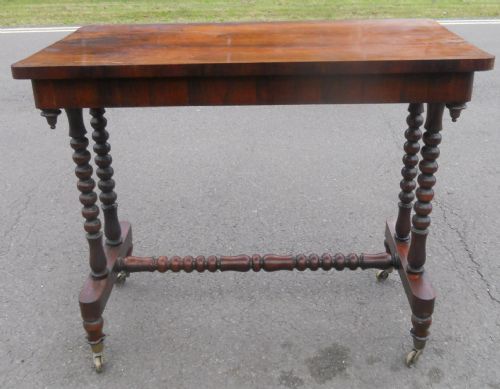
An English rosewood tea table encompasses versatile fold-over card tables, teapoys, and centre tables spanning the Regency, George III, George IV, and William IV periods. Buyers examining this page will most frequently encounter fold-over card tables and occasional tables designed for nineteenth-century entertaining.
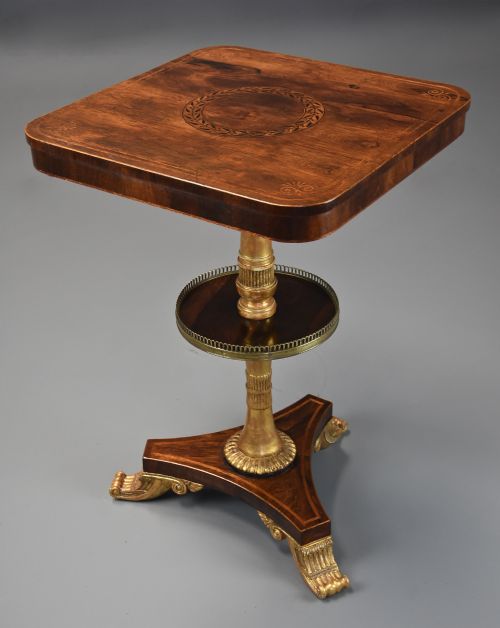
The selection ranges from grand pedestal card tables with swivel tops to compact occasional tables and fitted teapoys functioning as work boxes. Makers of the era utilised rich timber grains to create striking centrepieces for the principal rooms of fine houses.
How they were made
Cabinetmakers selected dense rosewood veneers for their deep colour and pronounced figuring, laying them over secondary timbers such as mahogany to construct stable tabletops and pedestals. Brass inlay was frequently embedded into the timber surfaces to trace geometric and classical motifs.
Interiors and functional elements often incorporated contrasting secondary woods like satinwood, while specialised gaming surfaces utilised baize lining inside fold-over tops. Gilding occasionally accented carved wooden mounts on grander centre tables and pedestals.
A teapoy doubles as a tea caddy and a work box, keeping your loose leaf blend and your sewing needles in harmonious proximity.
What varies in quality
Quality rests upon the selection and matching of the rosewood veneer, where symmetrical grain patterns across a fold-over top distinguish superior cabinet work. The crispness of carved wooden details and the precision of brass inlay reflect the skill invested in the piece.
Structural integrity in the pedestals and swivel mechanisms dictates daily usability, separating workshop productions of high repute from standard commercial output. Attribution to prominent makers like Gillows or T & G Seddon elevates the standing of an individual table.
Gillows·George Bullock·T & G Seddon·Ince & Mayhew
The English Rosewood Tea Table Glossary
- Tea table
- A small table designed for serving tea, often featuring a fold-over top that doubled its surface area when opened against a wall.
- Teapoy
- A small stand or box containing caddies for storing tea, frequently fitted with compartments for sewing and supported on a central pedestal.
- Centre table
- A freestanding table finished on all sides, intended to stand in the middle of a room rather than against a wall.
- Baize
- A coarse woolen material resembling felt, traditionally used to line the playing surfaces of card and gaming tables.
- Regency
- An English design period spanning the early nineteenth century, characterised by classical revival motifs and architectural restraint.
English Rosewood Tea Table: Frequently Asked Questions
How were card tables used?
Card tables served as multi-purpose furniture in the drawing room, remaining folded against a wall when not in use.
During evening gatherings, the top unfolded to reveal a baize-lined playing surface supported by a pivoting leaf or gateleg action.
How do I identify a Regency table?
Regency tables date from the early nineteenth century and typically display classical architectural influences, such as pillar-and-base pedestals.
Cabinetmakers of this era favoured dark rosewood veneers, occasionally enhanced with precise brass stringing or inlaid brass motifs.
Where should I place a centre table?
A centre table is designed to stand free in the middle of a room, finished with decorative timber grain on all sides.
It functions well as a focal point in a large hallway or drawing room, providing a surface for lamps or decorative objects.