
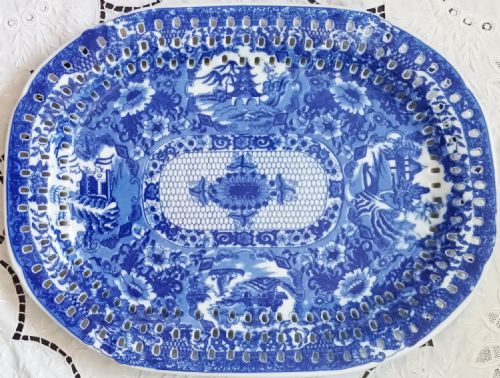


English Pearlware Platter
An english pearlware platter brings deep cobalt blue scenes and refined earthenware body to the table, prized for its crisp decoration and unmistakable blueish glaze pool.
English Pearlware Platter
An english pearlware platter sits firmly in the ceramic lineage bridging creamware and later ironstone, characterised by a distinctive glaze formulation containing a small amount of cobalt. When searching for an english pearlware platter, collectors encounter large serving vessels spanning the Georgian and early Victorian periods, often decorated in deep blue and white transfer print.
The forms range from substantial meat drainers and serving dishes with reservoirs to generous platters bearing chinoiserie and topographical scenes. Most examples belong to the nineteenth century, reflecting the peak of Staffordshire pottery production and transfer printing techniques.
Production materials and methods
Potters built an english pearlware platter using refined earthenware clay bodies, which fired to a pale cream or white colour before receiving a thin lead glaze. Adding cobalt oxide to this glaze neutralised the natural yellowish tint of the earthenware, creating the characteristic bluish pooling visible in recessed areas and foot rims.
Makers applied intricate patterns through transfer printing using cobalt pigment transferred from engraved copper plates onto the biscuit ceramic. This allowed workshops to produce complex topographical and pictorial designs with remarkable consistency across large serving vessels.
Listings for this phrase feature nineteenth century earthenware and pearlware forms, spanning Georgian and Victorian periods with notable Staffordshire pottery origins.
Factors of quality and distinction
Quality in an english pearlware platter rests upon the clarity of the cobalt transfer print and the smoothness of the ceramic surface. Crisp lines in complex patterns like chinoiserie or classical ruins separate superior Staffordshire output from simpler commercial wares.
The depth and uniformity of the bluish glaze pool also dictate worth, alongside specialised forms such as pierced rims or integrated reservoirs for carving joints of meat. Early examples with sharp potting and well-defined borders command greater attention from serious ceramic collectors.
Thomas Lakin·Brameld and Co·John Rogers and Son
The English Pearlware Platter Glossary
- Transfer printing
- A decoration method where an engraved copper plate transfers a design onto tissue paper, which is then applied to the unglazed or biscuit ceramic surface. This technique revolutionised pottery production in the Georgian era.
- Chinoiserie
- A European decorative style influenced by Chinese artistic traditions, frequently appearing on blue and white earthenware. It depicts imaginary pavilions, bridges and figures.
- Staffordshire
- The historic industrial area in the English Midlands that served as the primary centre for pottery and ceramic manufacturing during the eighteenth and nineteenth centuries.
English Pearlware Platter: Frequently Asked Questions
What is an english pearlware platter?
An english pearlware platter is a ceramic serving dish produced primarily during the Georgian and early Victorian periods, made from refined earthenware and finished with a bluish-tinted glaze.
These large vessels typically feature intricate blue and white transfer-printed designs depicting landscapes, ruins, or architectural scenes from Staffordshire potteries.
How do I care for an english pearlware platter?
Wash an english pearlware platter gently by hand using warm water and mild soap, avoiding modern dishwashers and harsh abrasive sponges that can damage the antique glaze.
Store the platter securely on a stable surface or display it safely in a plate rack to protect the edges from chips and structural strain.
How were serving platters used originally?
Large serving platters served as the centrepiece for presenting roasted meats, fowl, and large courses at dining tables during the Georgian and Victorian eras.
Specialised versions included built-in reservoirs and drainer inserts designed to collect juices during carving at the table.