


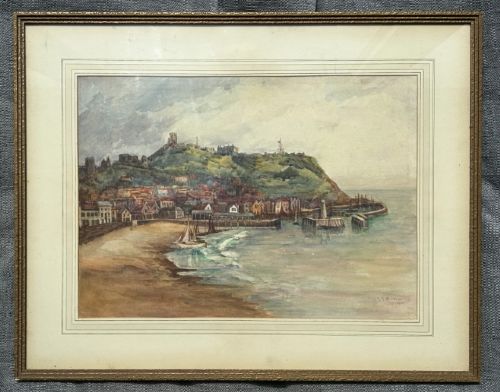


English Maritime Watercolour
An english maritime watercolour captures coastal light and harbour life through the delicate application of pigment on paper.
English Maritime Watercolour
When you search for an english maritime watercolour, you encounter historic depictions of harbours, coastal villages, and fishing vessels rendered on paper. The works on this page span from the nineteenth century into the mid twentieth century, featuring scenes from locations such as Whitby, St Ives, and Scarborough.
The most common formats on this page are framed paintings and works on paper executed by named artists working within Victorian, Edwardian, and British Impressionist traditions. These pieces record maritime activity, from trawling luggers to boats resting on shores.
The subjects focus heavily on coastal topography, capturing specific stretches of the Yorkshire, Norfolk, Devon, and Cornwall coasts. Collectors find works depicting local vessels like cobles alongside broader views of tidal rivers and estuaries.
Materials and Techniques
These works rely fundamentally upon watercolour pigment applied to paper, occasionally utilising glass and wood for framing. Artists used washes of watercolour paint to create atmospheric effects of sky, sea, and coastal light.
The physical support consists primarily of paper housed behind glass within wooden frames. Pigments were brushed onto the paper surface to build depth, capturing the movement of water and the texture of cliffs and boats.
Several works capture the exact moment local fleets await the tide.
Distinctions in Quality
The strength of a composition rests on the artist's ability to handle atmospheric light and maritime detail using fluid washes. Stronger examples demonstrate confident brushwork in rendering rigging, hulls, and coastal architecture without overworking the paper.
Provenance and documentation also separate the range, as signed works and pieces with clear regional attributions carry greater clarity. The handling of the medium distinguishes standard topographical recording from more accomplished artistic interpretations of marine subjects.
James Orrock·William Banks Fortescue·Arthur Tucker·Thomas Bush Hardy·Henry Bright
The English Maritime Watercolour Glossary
- Watercolour paint
- A medium consisting of colour pigments suspended in a water-soluble vehicle, applied to paper surfaces. It allows for transparent washes and delicate tonal gradations.
- Coble
- A traditional type of open fishing boat native to the north-east coast of England. These vessels are frequently depicted in Yorkshire coastal scenes.
- Lugger
- A small sailing vessel rigged with lugsails, commonly seen in historical fishing fleets off the south-west and east coasts.
- Framed artwork
- A painting on paper protected behind glass and enclosed within a wooden moulding for display and preservation.
- British Impressionism
- An artistic style characterised by visible brushstrokes and an emphasis on accurate depiction of light in natural settings.
English Maritime Watercolour: Frequently Asked Questions
What periods do these watercolours date from?
The listings span from the nineteenth century through the Edwardian era up to the mid twentieth century.
They reflect Victorian fine art traditions as well as later regional British painting styles.
Which coastal locations appear most often?
Harbours and coastal towns in Yorkshire, Norfolk, Devon, and Cornwall feature prominently in the titles.
Specific places include Whitby, St Ives, Scarborough, and Lynmouth.
How should I frame and display them?
Works on paper require protection behind glass to prevent atmospheric damage from dust and moisture.
Keep them away from direct sunlight to preserve the watercolour pigments over time.
Are these watercolours original pieces?
The inventory consists of original hand-painted works executed by individual artists rather than mechanical reproductions.
Many bear artist signatures or historical attribution details on the mount or frame.