


English Landscape Ink Drawing
These English landscape ink drawing works capture countryside scenes in ink, paper, watercolour and wash, offering immediate historical atmosphere for any room.
English Landscape Ink Drawing
An English landscape ink drawing brings together precise linework and washes on paper to record topography, rural architecture and natural views. These works range from loose field sketches to finished compositions created across the eighteenth and twentieth centuries.
The selections span Georgian and George III sheets alongside mid-twentieth-century British interpretations. Works from artists such as Fred Lawson appear frequently alongside anonymous sketches of village streets, castles and northern dales.
Buyers encounter framed artworks executed on paper, sometimes augmented with watercolour and pencil. The subjects stretch from the Lake District to Yorkshire, capturing specific locations with notable immediacy.
Materials and technique
Draftsmen built these images using iron gall or carbon ink applied with quill or steel nibs upon handmade or machine-made paper. Many sheets incorporate subtle washes of grey, brown or sepia ink to suggest shadow and depth behind the primary lines.
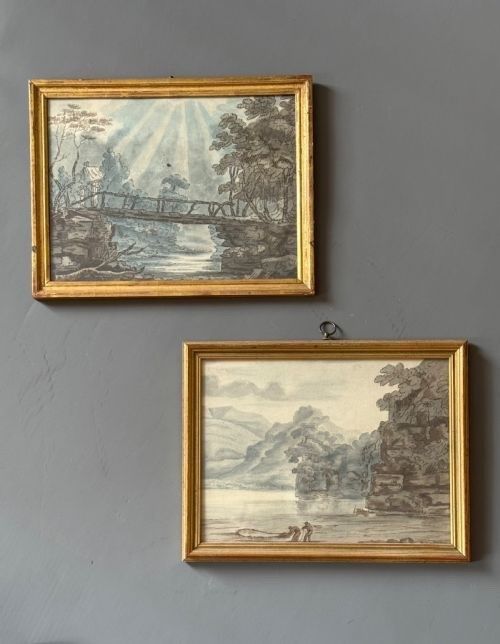
Watercolour and pencil frequently accompany the ink to define skies, foliage and architectural elements. Finished pieces often reside beneath glass within wooden or gilt wood frames that protect the fragile paper support from environmental moisture.
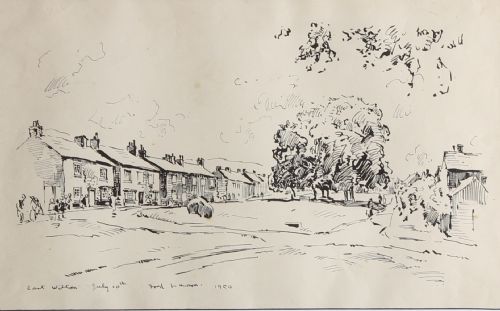
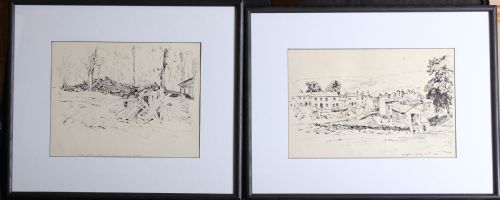
Fred Lawson walked the Yorkshire dales with pen and paper, capturing village corners and ruined castles through changing northern weather.
Evaluating quality
Quality rests upon the confidence of the hand and the economy of line used to define space. A superior drawing shows direct observation and decisive penwork rather than hesitant corrections or overworked details.
The preservation of the paper support and the clarity of the ink pigments dictate the visual impact of the work. Strong compositions make effective use of unworked paper to create natural light across the landscape.
Fred Lawson·Stanley Orchart·Edward Dayes·Richard Leech·Thomas Rowlandson·John Thistle·Dr Thomas Monro
The English Landscape Ink Drawing Glossary
- Wash
- A diluted application of ink or watercolour applied with a brush to create tonal depth and shadow. It provides atmospheric contrast behind the sharper pen lines.
- Georgian
- The period spanning the reigns of the four King Georges, characterised by classical elegance in art and architecture. Works from this era often display refined topographical accuracy.
- Watercolour
- Pigment bound in a water-soluble vehicle, frequently combined with ink drawings to add colour and tone. It allows for transparent layers that complement linear work.
- Gilt wood
- Wood coated with a thin layer of gold leaf or metallic paint, commonly used for traditional picture framing. This finish adds warm reflectivity to framed works on paper.
English Landscape Ink Drawing: Frequently Asked Questions
How should I hang an ink drawing?
Keep works on paper away from direct sunlight to prevent the ink and paper from fading over time. Constant indoor humidity levels help preserve the integrity of the antique paper supports.
Ensure frames are securely hung using appropriate wall fixings suited to the weight of the wood and glass. Professional framing with conservation-grade backing provides essential long-term protection.
How do I identify a Georgian landscape drawing?
Georgian sheets often display characteristic laid paper with visible chain lines when viewed against the light. The subject matter typically reflects picturesque traditions of the eighteenth century.
Inscriptions in contemporary ink on the reverse or mount frequently name the depicted location or date the sheet. Stylistic comparisons with known topographical artists of the period confirm attribution.
What is the difference between a sketch and a finished drawing?
A field sketch captures immediate visual notes on location with rapid pen strokes and minimal wash. These pieces reveal the artist's working process and direct observation of nature.
Finished drawings are composed for exhibition or collection, featuring deliberate washes and considered perspective. They offer complete pictorial narratives of specific English countryside views.
Can I mix twentieth-century drawings with Georgian pieces?
Pairing works across different centuries creates a dynamic wall display united by common subjects and monochrome tones. Twentieth-century British views share a direct linework tradition with earlier Georgian topography.
Consistent framing using similar wood or gilt mouldings ties disparate periods together into a cohesive arrangement. The shared medium of ink on paper bridges stylistic shifts over time.