


English Georgian Wall Barometer
An english georgian wall barometer measures atmospheric pressure with precision and brings period timber and silvered metal into a hallway or study.
English Georgian Wall Barometer
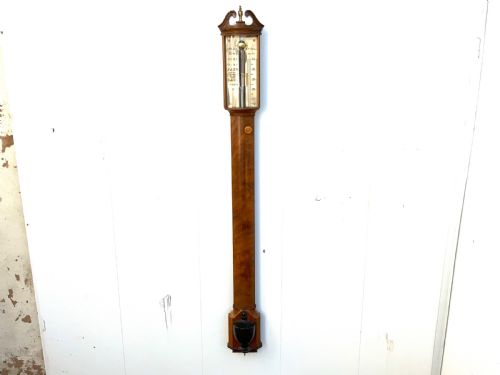
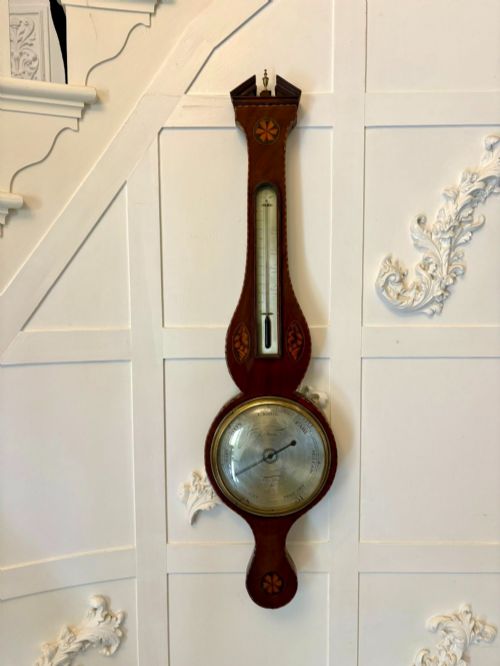
An english georgian wall barometer is a domestic scientific instrument designed to hang on a wall, housed in timber cases from the eighteenth and nineteenth centuries. The selection on this page centres on stick barometers and wheel barometers, alongside angle and clock combinations.
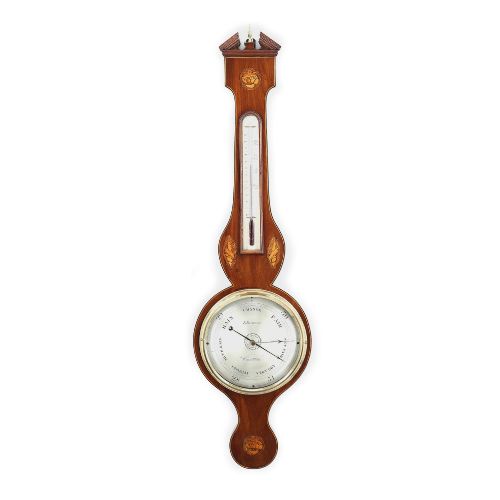
Most examples originate from the Georgian, Regency, and early Victorian periods, drawing on makers from London, provincial towns, and coastal cities. Walnut, mahogany, and satinwood dominate the housing, often detailed with shell inlay, boxwood strings, and brass fittings.
How they were made
Cabinet makers built the cases using solid and veneered timbers such as mahogany, walnut, and satinwood, frequently shaping them into bow-fronts or expanding wheel frames. Inlays of boxwood and shell ornamentation were set directly into the wood surfaces.
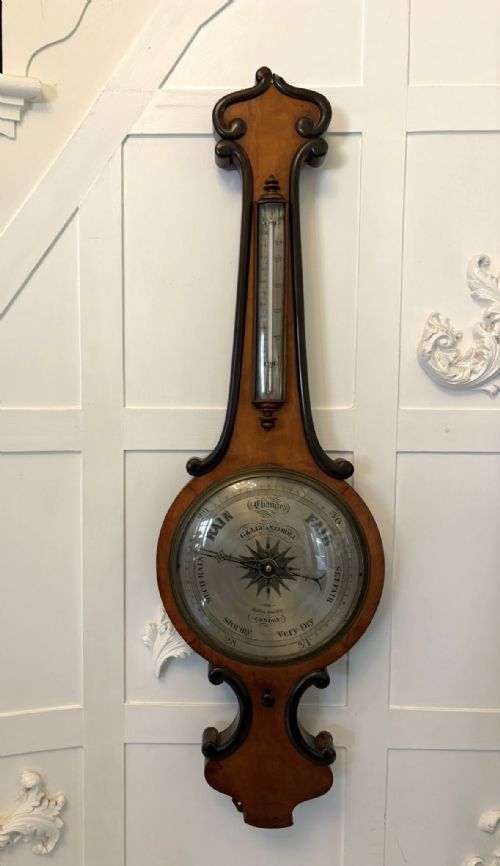
Dials and indicators rely on silvered metal plates, brass bezels, and glass covers to protect the mercury tubes and indices. Instrument makers inscribed scales, maker names, and locations directly onto the silvered brass or metal faces.
Some makers added dampness indicators alongside barometric scales to help households predict incoming rain before the clouds even gathered.
What varies in quality
The distinction between standard and superior pieces rests on the crispness of the cabinet work, the complexity of the wood figures, and the refinement of the dial engraving. Finely executed shell inlay and well-balanced proportions separate provincial output from the finest London workshops.
Originality of the mercury tube, brass fittings, and backboards dictates the historical integrity of an instrument. Cases retaining their untouched patination and clear maker signatures command greater interest than those with replaced components.
B. Besozzi of Weymouth·G & L Guanziroli London·Prada of High Wycombe·Molton of Norwich·Luisetti of London·Sandrino of Liverpool·Hayward of Ashford·Gilbert London·Bianchi Ipswich·James Gatty London·Charles Aiano London·Gowland London·A Pinchetti and Co London·Dominic Gatty·Russell of Liverpool·L Malacrida London·George Dollond of London
The English Georgian Wall Barometer Glossary
- Stick barometer
- A vertical instrument where the mercury column moves inside a long exposed or glazed wooden trunk. This form represents the earlier design tradition in domestic weather recording.
- Wheel barometer
- A circular dial instrument connected to a siphon tube by a float and pulley mechanism. It displays pressure changes via a turning hand on a silvered metal face.
- Silvered metal
- A brass or copper plate treated with a silver preparation to create a matte white reading surface. Maker details and weather scales are engraved into this layer.
- Boxwood inlay
- Light-coloured wood strips inserted into darker cabinet timber to form geometric borders and lines. It provides decorative contrast on mahogany and walnut cases.
English Georgian Wall Barometer: Frequently Asked Questions
How do stick and wheel barometers differ?
A stick barometer shows the mercury level directly in a vertical tube against a graduated scale. A wheel barometer uses a concealed float and cord to turn a pointer around a circular dial.
Stick models tend to follow earlier eighteenth-century forms, while wheel versions became popular toward the end of the Georgian era and into the nineteenth century.
Where were these barometers originally placed?
These instruments hung in the halls, libraries, and principal reception rooms of town houses and country estates. Their dual role combined domestic science with formal interior decoration.
Owners consulted them daily to anticipate weather changes before travelling or managing agricultural estates.
How can I date an instrument?
Dating relies on the architectural style of the wooden case, the shape of the dial, and the lettering used for the maker's signature. Straight trunks and vernier scales often point to the eighteenth century, while bow-fronts and decorated wheel frames suggest Regency or Victorian periods.
Comparing the recorded maker against known working dates refines the timeline further.
Are these barometers still accurate?
Many retain their functional glass tubes and mercury columns, though they are primarily acquired as historic works of art and craftsmanship. Atmospheric readings can still be taken if the internal siphon remains intact and sealed.
Specialist handling is required if the instrument needs relocation or recalibration.