

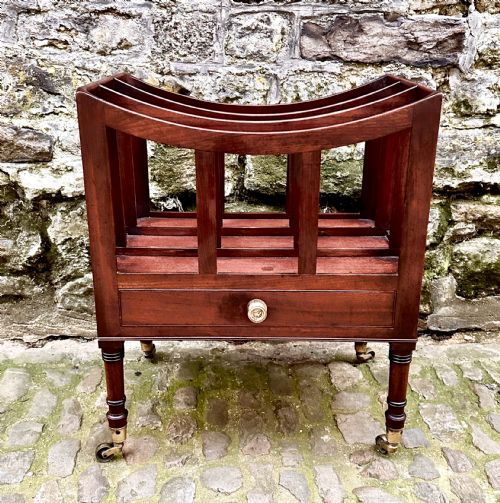


English Georgian Canterbury
An English Georgian canterbury is a practical stand for holding newspapers, magazines, and sheets of music, designed to sit neatly beside a chair or table.
English Georgian Canterbury
An English Georgian canterbury is a low stand equipped with partitioned sections for holding periodicals, folios, or music sheets. The pieces appearing here span the Georgian and Regency periods, stretching from around the turn of the nineteenth century into the William IV era.
Most examples you encounter take the form of open racks with distinct vertical divisions, occasionally incorporating a small drawer beneath the slatted base. While primarily designed as movable tidies for newspapers and magazines, variations include dwarf bookcase hybrids with graduated shelves.
Materials and construction
Makers relied heavily on dense hardwoods such as mahogany and rosewood to provide the necessary strength for slender uprights and dividers. These timbers were selected for their rich grain and ability to take a smooth polish, suiting the refined interiors of country houses.
Brass fittings frequently appear in the form of castors or structural accents, allowing these portable stands to be easily moved across carpets and floors. Joinery was kept neat and functional to support the compartmented partitions without adding unnecessary weight.
English Georgian Canterbury Retail Price Guide 2026
Typical asking prices for english georgian canterbury among the pieces listed under this phrase on Sellingantiques today, from the lower quarter to the upper quarter. They describe what is for sale here now, not the wider market.
Named after the Archbishop of Canterbury who supposedly commissioned the first music stand of this type.
Assessing quality
Quality rests upon the crispness of the turned spindle supports, the stability of the divisions, and the depth of figure in the mahogany or rosewood. Finer pieces demonstrate careful attention to the joinery where the slats meet the base and frame.
The presence of integrated drawers, thoughtful carving on the legs, and original brass castors elevate an example above standard utility stands. Fustian craftsmanship shows in heavy, clumsy divisions and plain secondary woods without careful finishing.
J C Loudon
The English Georgian Canterbury Glossary
- Folio stand
- A piece of furniture designed for holding large sheets of paper, prints, or folios. These share a similar open partition structure with standard canterburys.
- Regency
- A style period spanning the early nineteenth century characterised by classical influences and rich dark timbers. Pieces from this era often feature refined brass mounts and elegant turned legs.
- George III
- The period of British design covering the later eighteenth and early nineteenth century. Furniture from this era emphasises balanced proportions and quality mahogany construction.
English Georgian Canterbury: Frequently Asked Questions
What was a canterbury used for originally?
These stands served to keep newspapers, sheet music, and unbound literary folios tidy and close to hand in a parlour or drawing room.
They allowed households to organise daily reading materials neatly beside seating areas without cluttering tabletops.
How do I tell a Georgian canterbury from a later one?
Examine the timber density, construction methods, and the turnings on the upright supports. Earlier pieces utilise solid mahogany or rosewood with hand-cut joinery.
Hardware such as castors and small drawer pulls also offer clues to the period through their casting and mounting style.
Can I use an antique canterbury for modern magazines?
Yes, the divided sections accommodate contemporary periodicals and large books quite effectively. Their sturdy wooden partitions are well suited for daily use.
Care should be taken not to overload fragile antique divisions with excessively heavy volumes.
Where should I place a canterbury in a room?
They sit best beside a sofa, armchair, or desk where their compartments remain easily accessible. Their finished appearance on all sides allows them to stand away from walls.
Keep them away from direct sunlight and heat sources to protect the polished mahogany or rosewood surfaces.