

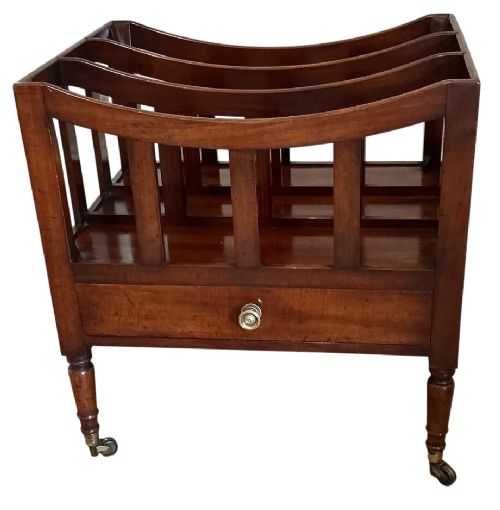
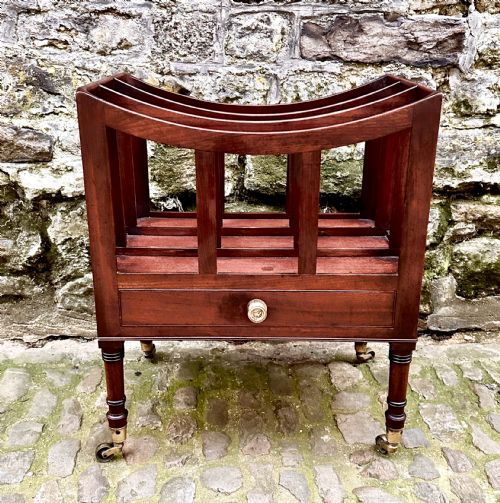


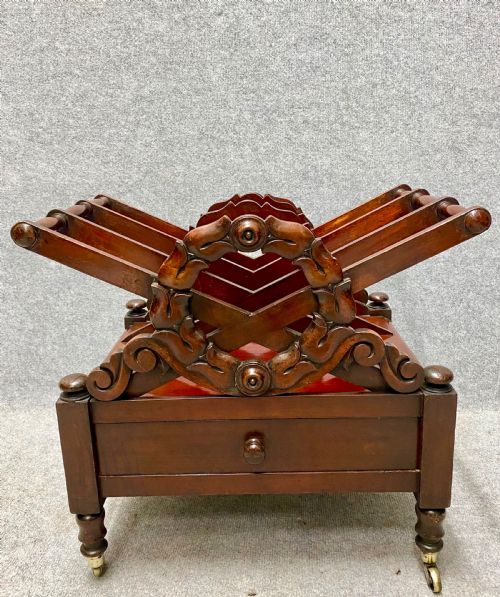


Mahogany Canterbury Brass Castors
These mahogany canterbury brass castors bring classic timber warmth and easy mobility to any room as elegant tiered stands for books and papers.
Mahogany Canterbury Brass Castors
A mahogany canterbury brass castors search brings up low stand furniture designed to hold books, sheets of music, newspapers and magazines. These pieces commonly date from the Georgian, Regency and Victorian periods.
Buyers also encounter related formats including music stands and combined what-not shelving units in ebonised mahogany. These items serve equally well beside a sofa or desk for daily reading storage.
How they were made
Cabinet makers constructed these stands using rich mahogany timber, occasionally ebonising the wood for dramatic effect. The rich grain is finished to a smooth polish that highlights the natural figuring of the material.
Metalworkers cast the brass fittings separately, attaching them securely to the legs to allow the heavy timber stands to move smoothly across carpets and floors. Fine turned pillars and slender upright slats form the characteristic compartments.
Mahogany Canterbury Brass Castors Retail Price Guide 2026
Typical asking prices for mahogany canterbury brass castors among the pieces listed under this phrase on Sellingantiques today, from the lower quarter to the upper quarter. They describe what is for sale here now, not the wider market.
Materials across the selection focus primarily on solid and veneered mahogany, complemented by polished brass castors and occasional ebonised finishes.
What varies in quality
The sophistication of the timber turning and the crispness of the joinery set the better examples apart from standard work. Finer pieces show thoughtful proportioning in the slatted divisions and careful matching of mahogany veneers.
Original hardware, including well-cast brass castors and neat drawer pulls, adds significantly to the integrity of an antique canterbury. The presence of attributed cabinet maker design further elevates the standing of an individual piece.
Gillows of Lancaster·J.C.Loudon
The Mahogany Canterbury Brass Castors Glossary
- Canterbury
- A low multi-compartmented stand used for holding sheet music, newspapers or books. The form dates back to the late eighteenth century and often includes a base drawer.
- Castor
- A small swivelling wheel fitted to the base of furniture legs for easy movement. These are typically cast in brass on better period pieces.
- Regency
- An English design style spanning the early nineteenth century. Furniture from this period draws inspiration from classical antiquity with clean lines and restrained ornament.
- Ebonised
- Timber treated with a dark stain or finish to imitate ebony. This technique appears on specific Victorian interpretations of the form.
- George III
- The stylistic period covering the reign of the third king of that name. Pieces from this era display balanced proportions and quality mahogany construction.
Mahogany Canterbury Brass Castors: Frequently Asked Questions
What is a canterbury used for?
These stands were originally designed to hold folios of sheet music near a piano or music room. They quickly evolved to store daily newspapers, books and magazines in the parlour.
Today they function just as well beside a living room sofa or study armchair for keeping reading materials tidy and close at hand.
How do I identify a Regency canterbury?
Regency examples often feature distinctive boat-shaped frames with sweeping curved rails and slender turned uprights. They commonly date from around eighteen hundred to eighteen twenty.
Look for refined proportions, rich mahogany grain, and neat brass castors supporting the low frame.
Did these pieces always have castors?
Most traditional canterburys were built with small metal wheels beneath the legs to let servants move the loaded stand easily around a room. Brass was the standard metal used for these functional fittings.
Their presence allows the heavy timber furniture to glide smoothly across floorboards and carpets.
How do I care for mahogany furniture?
Keep mahogany timber away from direct heat sources and strong sunlight to prevent the polish from fading or drying out. Regular dusting with a soft, dry cloth preserves the natural lustre of the wood.
Occasional application of quality wax feeds the grain without building up a heavy, dull film.