


English Country Farm Art
English country farm art captures rural life through oil paintings and watercolours that bring the historic landscape directly into your home.
English Country Farm Art
English country farm art encompasses works created during the nineteenth and twentieth centuries that portray rural scenes, agricultural landscapes, and farmyard animals. These pieces reflect the working countryside through depictions of livestock, cottages, harvest scenes, and farmworkers.
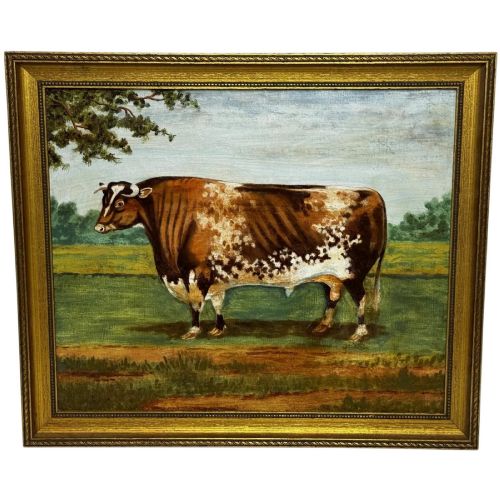
Buyers will most frequently encounter nineteenth-century oil paintings and early twentieth-century watercolours on this page. Subjects range from detailed studies of prize bulls and poultry to expansive views of Yorkshire dales and Surrey farmsteads.
Materials and Technique
Artists primarily utilised oil paint on canvas or board, alongside delicate watercolours on paper enhanced with ink. Canvas grounds provide depth for rich oil pigments in rural landscapes, while paper supports fluid washes in smaller studies.
Makers also produced tactile items connected to rural labour, such as handmade wooden scale models of farm carts and carved beech shoulder yokes. These three-dimensional pieces demonstrate traditional woodworking techniques alongside flat picture creation.
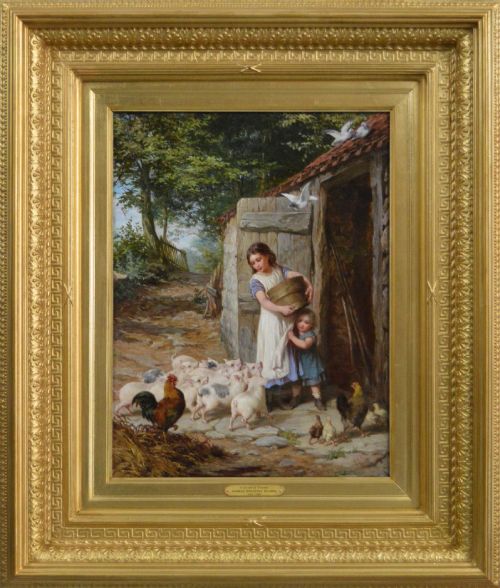
A guinea pig and a rabbit occasionally share cottage floor space with poultry and piglets in Victorian genre paintings.
Judgments of Quality
Quality rests on the artist's ability to render light, form, and accurate anatomical detail in animals and human figures. Works by named nineteenth and twentieth-century painters exhibit superior brushwork and compositional balance compared to anonymous student pieces.
The handling of atmospheric perspective and local colour distinguishes accomplished regional depictions from generic rural scenes. Condition also plays a role, with clean canvases and well-preserved watercolours commanding greater attention.
George Augustus Holmes·Samuel Joseph Clark·Herbert Royle·Owen Bowen·Ernest Higgins Rigg
The English Country Farm Art Glossary
- Genre painting
- A style depicting scenes from everyday life, often featuring farmworkers, cottages, and domestic animals. These works offer a narrative window into rural society.
- British Impressionism
- A painting approach focusing on natural light and loose brushwork, visible in many twentieth-century landscape works. Artists captured transient weather effects over farmyards.
- Shoulder yoke
- A curved wooden device carved from beech, historically used by dairy maids to carry heavy water or milk pails evenly. They display practical rural craftsmanship.
- Watercolour painting
- A technique using water-soluble pigments on paper to create luminous landscapes and preparatory sketches. It requires swift precision from the artist.
English Country Farm Art: Frequently Asked Questions
What subjects appear in english country farm art?
These works typically display farmyards, livestock such as shorthorn bulls and poultry, harvest activities, and rural cottages. Scenes often include working horses, milkmaids, and local Yorkshire or Surrey landscapes.
Such subjects document the daily realities of agricultural life across the nineteenth and twentieth centuries.
How do I care for antique oil paintings?
Keep oil paintings away from direct sunlight and fluctuating humidity to protect the canvas and paint layers. Dust them gently with a soft, dry brush without using water or cleaning solutions.
Professional conservation is recommended if tears or heavy grime accumulate over decades.
Where were these rural scenes painted?
Many pieces depict specific northern English locations, including Yorkshire dales, Swaledale, Wharfedale, and Leeds. Other works capture southern rural settings in Surrey and Merseyside.
Artists frequently worked plein air or within local studio spaces set up near rural farms.
Are watercolours as durable as oil paintings?
Watercolours on paper are more sensitive to light and moisture than oil paintings on canvas or board. Framing them behind UV-protective glass safeguards the pigments from fading over time.
Properly framed watercolours remain stable for generations in domestic environments.