


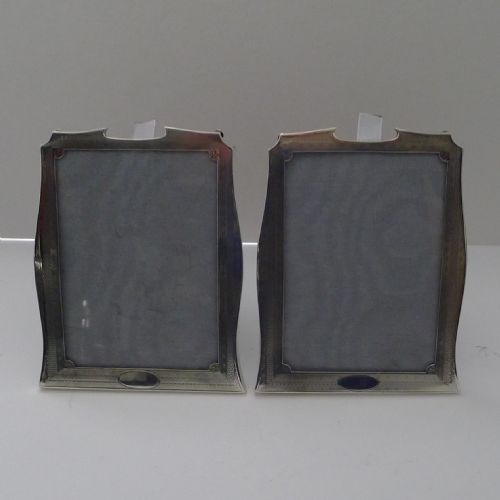


Engine Turned Silver Frame
An engine turned silver frame holds a treasured photograph with precision-carved geometric patterns that catch the light.
Understanding the engine turned silver frame
An engine turned silver frame is designed to display portrait and landscape photographs in domestic interiors. These decorative accessories appear across the early twentieth century, spanning the George V, Belle Epoque and Art Deco periods.
The most common form on this page is the picture or photograph frame, shaped in rectangular, oval or large formats. Pieces originate from English and French makers, utilising sturdy wooden backs and glass fronts to protect the enclosed image.
Materials and construction methods
Silversmiths constructed these pieces using solid silver or sterling silver sheet over structural wooden inner frames. Glass protects the photograph on the front, while fabric or wood lines the reverse alongside easel supports.
Makers applied mechanical engraving using rose engine lathes to cut precise, repetitive geometric patterns across the metal surface. This technique produces regular chevrons, waves and lines across borders and panels.
Retail Price Guide 2026
Typical UK retail prices for engine turned silver frame, calculated from the Sellingantiques database of over a million retail prices indexed since 2003. This retail price guide relies exclusively on Sellingantiques data; no external sources or auction records are used, so the figures do not describe the wider market.
Listings feature sterling silver and standard silver frames paired with glass, fabric and wood elements across three distinct decades.
Factors that distinguish individual examples
The crispness and depth of the mechanical engraving determine the refinement of the border decoration. Sharply defined geometric cuts retain their geometric complexity without blurring across corners.
Substantial gauge silver plate and well-fitted wooden or fabric backings indicate superior manufacturing standards. Maker attribution and original hallmarking also distinguish standard production from notable silversmith output.
Emile Langlois·William Comyns·Green & Cadbury Ltd·William Haseler·Walker and Hall·Mappin & Webb
The Engine Turned Silver Frame Glossary
- Engine turning
- A decorative technique where a geometric pattern is mechanically engraved into metal using a specialised lathe. This method creates uniform, repeating textures across the silver surface.
- Sterling silver
- A silver alloy containing a specific proportion of pure silver and other metals to increase durability. Items made to this standard frequently display official assay office hallmarks.
- George V
- A British historical period spanning the early decades of the twentieth century. Frames from this era often display restrained neoclassical or traditional decorative motifs.
- Art Deco
- A design style characterised by sleek geometric shapes, stylized motifs and streamlined symmetry. Pieces from this movement frequently employ sharp chevrons and sunburst patterns.
Frequently Asked Questions
How do I clean an engine turned silver frame?
Use a soft microfiber cloth and a mild silver polish designed to protect delicate engraved recesses. Avoid harsh abrasive brushes that might flatten the precise mechanical patterns.
Take care around original glass and fabric backings during the cleaning process. Gentle maintenance preserves the crisp lines of the metalwork.
Can these frames stand both vertically and horizontally?
Many examples feature two-way easel backs that accommodate both portrait and landscape photographs. The hinged struts attached to the wooden reverse support positioning in either orientation.
Check the rear fittings to confirm whether the easel mechanism permits multi-directional display. Single-direction stands appear frequently on older models.
How do I identify the period of a silver frame?
Examine the hallmarks stamped into the silver border for assay office symbols and date letters. These official marks record the exact year and location of manufacture.
Stylistic indicators such as Art Deco geometry or Belle Epoque curves also help narrow down the date of production. Hallmarks remain the most reliable guide to age.
What glass is normally found in these frames?
Most pieces retain their original transparent window glass held securely behind the bezel or inner rebate. Replacement glass appears occasionally in frames that have undergone restoration.
Original glass sometimes exhibits minor surface bubbles or slight variations consistent with early twentieth-century manufacture.