
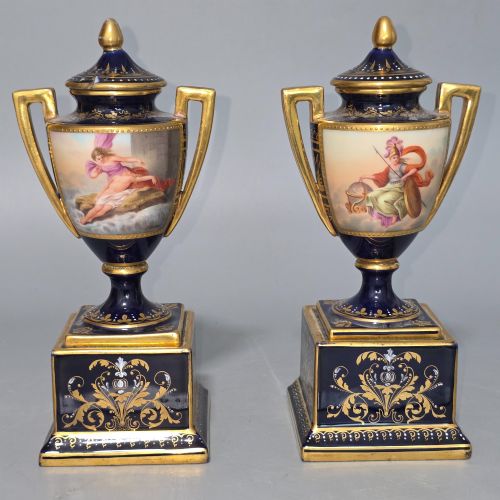


Empire Style Porcelain Vases
Empire style porcelain vases bring neoclassical grandeur to a room, offering classical forms and hand-painted detail from the nineteenth century.

Empire Style Porcelain Vases
When you search for empire style porcelain vases, you encounter nineteenth-century French and Viennese works shaped as urns, amphorae, goblets, and Medici vessels. These pieces draw directly on neoclassical design, often featuring classical handles, pedestal bases, and distinct lidded forms.
The versions you meet most frequently on this page are pairs of French porcelain vases originating from Paris workshops, alongside specific pieces from Sèvres and Vienna. They frequently combine hand-painted scenes with gilded highlights, presenting a formal presence suited to period interiors.
How they were made
These items rely on hard-paste porcelain shaped into classical vessel forms, fired at high temperatures to achieve a durable and smooth ceramic body. Artisans then applied detailed hand-painted scenes and enamel work directly onto the glazed surface.
Gilding forms a central part of the manufacturing technique, utilising gold leaf and gold leaf highlights to accentuate handles, rims, and borders. Certain pieces incorporate cast gilt bronze or ormolu mounts fitted tightly around the porcelain body.
Napoleon Bonaparte occasionally required porcelain factories to commemorate his campaigns so grandly that the vases barely fit through standard dining room doors.
What varies in quality
The standard of painting marks the principal distinction between everyday production and exhibition pieces, with superior examples displaying finely detailed figural scenes and intricate brushwork. Artisans who painted commemorative or signed works achieved a level of depth that elevates the entire vessel.
The integration of metalwork also dictates quality, distinguishing between simple porcelain bodies and those enhanced with cast ormolu mounts and gilt bronze fittings. Heavier gilding and precise handling of hard-paste porcelain separate standard nineteenth-century output from works created for international exhibitions.
Vienna Porcelain·Sèvres
The Empire Style Porcelain Vases Glossary
- Hard-Paste Porcelain
- A durable ceramic composition made from kaolin and petuntse fired at high temperatures. This material provides the dense white body characteristic of nineteenth-century decorative urns.
- Ormolu
- Finely ground high-carat gold applied to a bronze base in a mercury amalgamation process. This technique produces the bright metallic mounts seen on nineteenth-century French vases.
- Amphora
- A classical two-handled vessel with a narrow neck, used in antiquity and revived during the nineteenth century. These forms often feature painted classical scenes.
- Medici Vase
- A bell-shaped urn with a footed base and flared rim, named after the Renaissance collection of antique marble vessels. Nineteenth-century ceramicists translated this classical shape into porcelain.
- Gilding
- The application of gold leaf or powdered gold to the surface of porcelain or bronze. It defines the decorative borders and handles of neoclassical vessels.
Empire Style Porcelain Vases: Frequently Asked Questions
How were empire style porcelain vases used?
These vessels functioned primarily as decorative items on mantelpieces, side tables, and pedestals within formal nineteenth-century interiors. Lidded urns and amphorae added classical symmetry and visual weight to grand rooms.
Certain pieces were also produced or adapted later to serve as table lamps while retaining their original porcelain bodies and painted scenes.
What defines the neoclassical style in these vases?
Neoclassical design draws inspiration from ancient Greek and Roman art, translated here into clean architectural lines, urn shapes, and symmetrical handles. Motifs often include classical figures, laurel wreaths, and palmettes.
This aesthetic rejected excessive rococo curves in favour of dignified proportions, straight columns, and balanced compositions.
How do you identify a Sèvres porcelain vase?
Sèvres pieces typically display fine hard-paste porcelain bodies combined with meticulous hand-painted scenes and heavy gilding. Many bear factory marks or commemorate specific historical figures like Napoleon Bonaparte.
The inclusion of pink ground colours and finely chased ormolu mounts further points to the French imperial manufacture.