
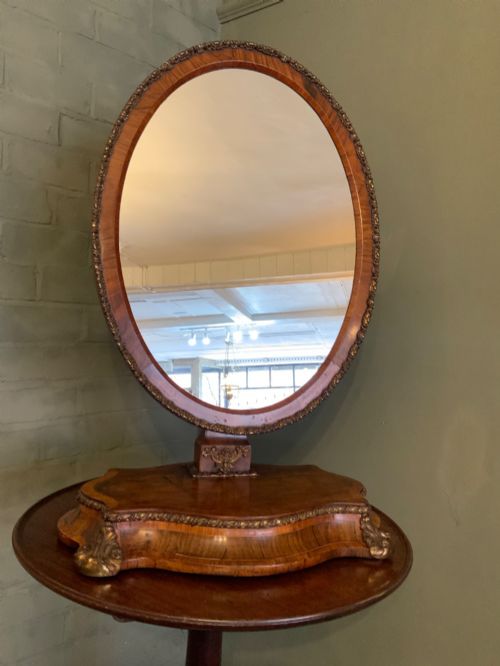
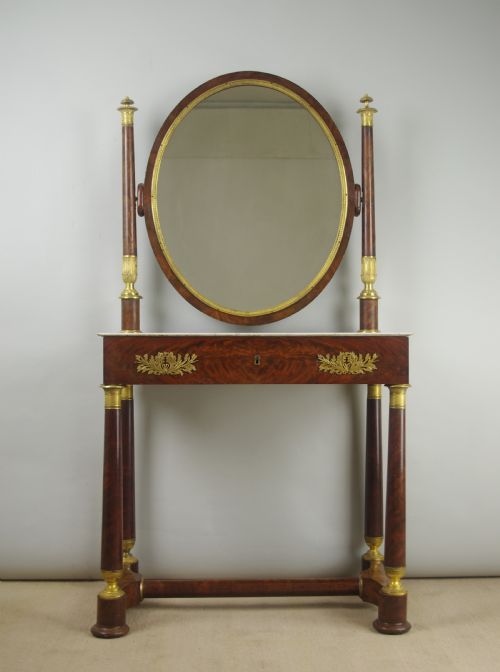
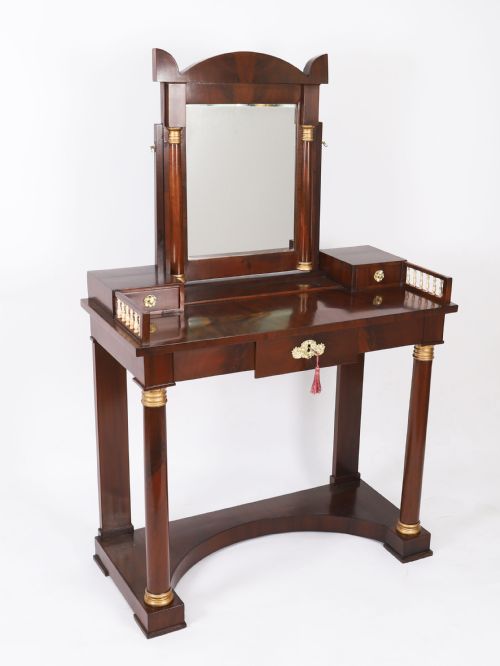


Empire Style Dressing Table
An empire style dressing table brings striking classical presence to a bedroom through rich timbers and gleaming metal mounts.

Empire Style Dressing Table
An empire style dressing table combines substantial timber construction with classical metal mounts to create a commanding centrepiece for the bedroom. These pieces draw on French design traditions, often appearing alongside related furnishings like dressing table mirrors and bedroom furniture suites.
The versions most commonly met on this page date from the nineteenth century, spanning foundational pieces from the eighteen-hundreds through to later revival work. They take the form of dedicated dressing tables or dressing chests, frequently accompanied by matching mirrors.
Makers working within this idiom utilised distinct stylistic variations, ranging from strict French Empire execution to later French Empire Revival and French Chateau interpretations. Each variation maintains a focus on architectural form and decorative metal detailing.
Materials and construction
Mahogany and walnut form the primary timber bodies of these pieces, providing a rich, dark ground that supports elaborate decorative schemes. Cabinet makers shaped these woods into substantial furniture forms designed to showcase the natural grain alongside applied metal elements.
Ormolu, gilt bronze, brass, and silver gilt provide the characteristic metallic highlights found across the mounts and fittings. These metal components are cast and chased with classical motifs, then fixed to the timber surfaces to frame the structure.
Marble elements and glass components appear alongside the woodwork, particularly in the construction of inset surfaces and associated dressing table mirrors. These contrasting textures complete the material vocabulary of the pieces.
The inventory spans individual toilet mirrors, full dressing tables, and complete five-piece bedroom furniture suites.
Distinctions in quality
The refinement of the cast metal mounts separates standard examples from exceptional pieces, as finely chased ormolu and gilt bronze display crisp detail and deep relief. Lesser examples rely on simpler brass fittings with softer definition.
The choice and handling of timber dictate the visual weight of the furniture, with beautifully figured mahogany or walnut veneers elevating the overall presence. Construction integrity in the drawers and framing further distinguishes superior cabinet work.
The Empire Style Dressing Table Glossary
- Ormolu
- Gilded bronze or brass applied as decorative mounts to furniture. This technique imparts a rich golden finish that contrasts sharply with dark timbers.
- French Empire Revival
- A later nineteenth-century aesthetic that reinterprets earlier Napoleonic design motifs. It captures the grand proportions and classical vocabulary of the original period.
- Dressing Chest
- A multi-drawer storage unit adapted for personal grooming. These items often incorporate integrated mirror elements within bedroom furniture suites.
- Triptych Mirror
- A three-panel folding mirror designed to stand on a dressing surface. The hinged side wings allow the user to view angles from multiple directions.
Empire Style Dressing Table: Frequently Asked Questions
How do I care for the timber and metal mounts?
Regular dusting with a soft, dry cloth protects the polished mahogany or walnut surfaces from abrasive particles. Avoid commercial silicone polishes, which can build up and dull the timber over time.
Metal mounts require gentle cleaning without harsh chemical agents to preserve the original gilding on the ormolu and brass components.
Are these dressing tables strictly French in origin?
While the design vocabulary originates in France, the style spread widely and inspired subsequent revival movements across Europe. Many pieces retain strong connections to French cabinet making traditions through specific stylistic markers and construction methods.
Revival pieces from later in the nineteenth century often reinterpreted these French aesthetic standards for contemporary homes.
How do original pieces differ from revival pieces?
Original nineteenth-century pieces date from the height of the Empire period or close to its direct influence, displaying authentic period construction methods. Revival examples, often produced later in the century or into the twentieth century, adopt the same classical vocabulary while reflecting the manufacturing techniques of their own era.
Both categories share a commitment to grand proportions and rich material combinations.