



Empire Style Carvers
Empire style carvers are substantial seating defined by neoclassical restraint, offering heavy classical presence and solid mahogany or giltwood frames for a formal interior.
Empire Style Carvers
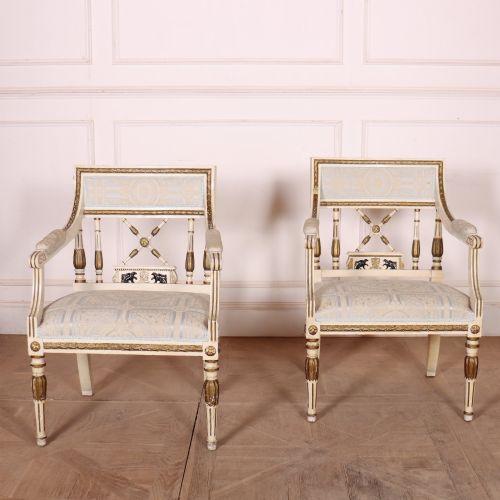
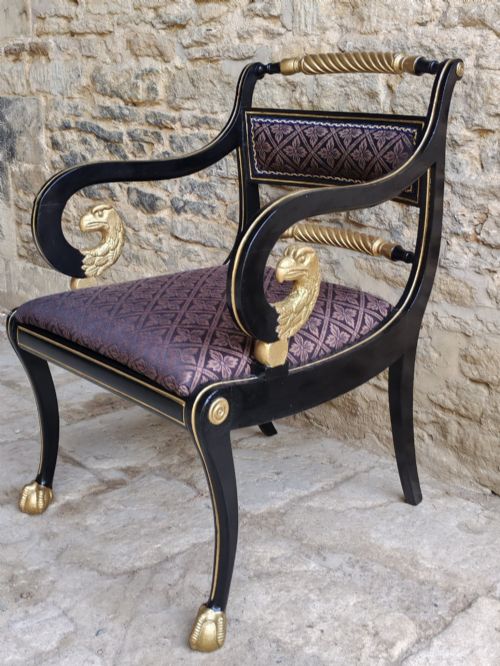
Empire style carvers are formal armchairs shaped by neoclassical design, appearing here across nineteenth century and revival forms. These seating pieces draw on French Consulate, Swedish Neoclassical, and Regency idioms to create strong architectural lines within a room.
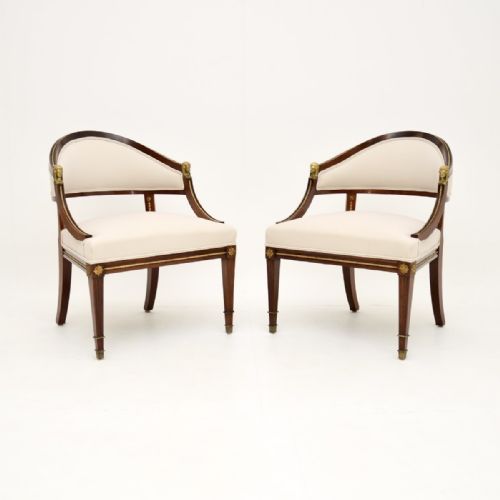
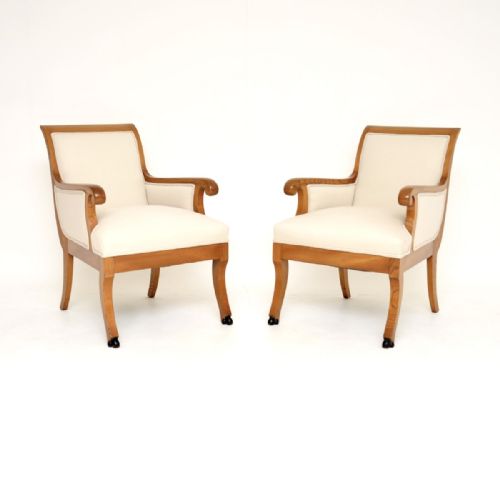
A buyer examining this selection will frequently encounter mahogany and giltwood armchairs alongside painted finishes and elm variants. The selection spans true nineteenth century examples from England, Italy, Denmark, and France, alongside later revival pieces from the early twentieth century.
The primary forms on this page are salon armchairs, library chairs, and pairs of carvers featuring carved decoration. These seating choices suit formal drawing rooms or studies where classical symmetry and substantial timber frames are required.
Materials and construction
Makers constructed these carvers primarily using solid mahogany, elm, and beech, frequently employing ebonised wood or giltwood finishes for decorative effect. Brass mounts and velvet or plain fabric upholstery complete the construction details recorded across the pieces.
The structural technique relies on substantial timber framing combined with finely carved decoration. Workshops applied gilding and painted schemes over wood bases to achieve the desired neoclassical appearance.
Empire Style Carvers Retail Price Guide 2026
Typical asking prices for empire style carvers among the pieces listed under this phrase on Sellingantiques today, from the lower quarter to the upper quarter. They describe what is for sale here now, not the wider market.
Listings for this phrase include pieces from the nineteenth century alongside twentieth century revivals, utilising mahogany, giltwood, fabric, and velvet.
Distinctions in quality
Quality in these carvers rests upon the crispness of the carved decoration and the selection of the timber. Dense mahogany and meticulously layered giltwood or painted surfaces separate standard production from finer cabinet work.
Proportion and decorative restraint dictate the standing of a piece. Pieces with balanced classical proportions and refined carving demonstrate superior workshop execution.
Henry Thomas Peters
The Empire Style Carvers Glossary
- Carver
- An armchair, usually designed with arms to match a set of dining or salon chairs. These seats typically occupy the head of a table or sit as individual accent pieces.
- Giltwood
- Timber coated with gold leaf or gold paint to simulate solid gold enrichment. This finish appears frequently on neoclassical and revival seating frames.
- Neoclassical
- A style drawing inspiration from the classical art and architecture of ancient Greece and Rome. It emphasises symmetry, straight lines, and restrained ornamentation.
- Regency
- A British design period spanning the early nineteenth century. It is characterised by a strong archaeological interest in classical antiquity.
- Ebonised
- Wood treated with a dark stain or finish to imitate ebony. This dark surface creates a high contrast against gilded details or light upholstery.
Empire Style Carvers: Frequently Asked Questions
What defines an empire style carver?
An empire style carver is a formal armchair influenced by classical antiquity and neoclassical design principles. These pieces usually feature substantial timber frames, prominent armrests, and carved or gilded details.
They serve as focal seating in traditional reception rooms, libraries, and formal dining settings.
How do I identify a revival piece from the original period?
Identifying revival pieces from original nineteenth century items involves examining the timber ageing, construction joints, and finishing techniques. Revival pieces often date from the early twentieth century and reflect historical styles with slightly different joinery methods. nConsulting the specific date attribution helps clarify the exact period of manufacture.
Where should I place these carvers in a modern home?
These carvers work well as single statement pieces in a hallway, bedroom, or study. They also function effectively as end chairs in a formal dining arrangement.
Their strong architectural lines provide a visual anchor in minimalist or eclectic interiors.
What timber types are most common in these chairs?
Mahogany is the predominant timber found across these listings, alongside elm, beech, and ebonised wood. Giltwood and painted finishes also appear frequently on the frames.
These materials provide the necessary structural strength for substantial carved armchairs.