


Empire Style Carver Chair
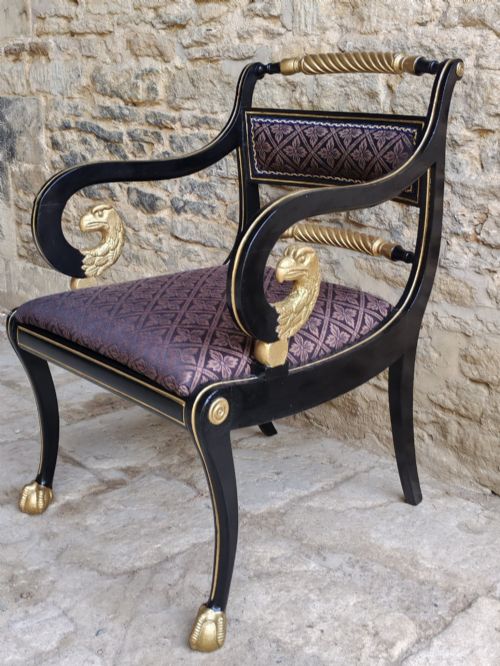
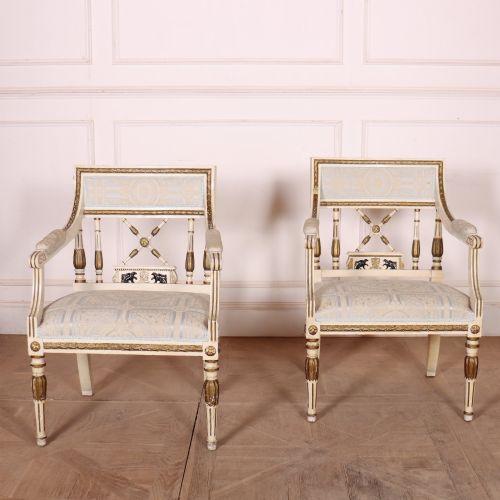
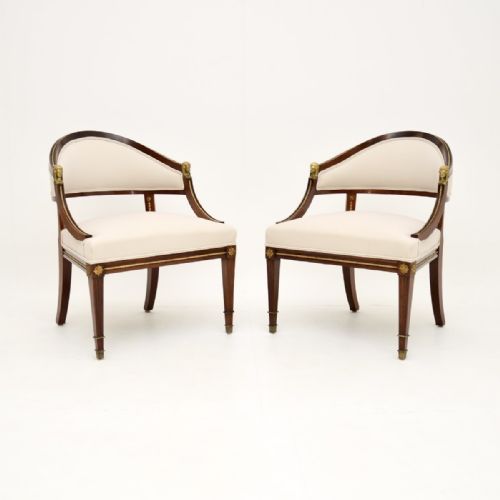
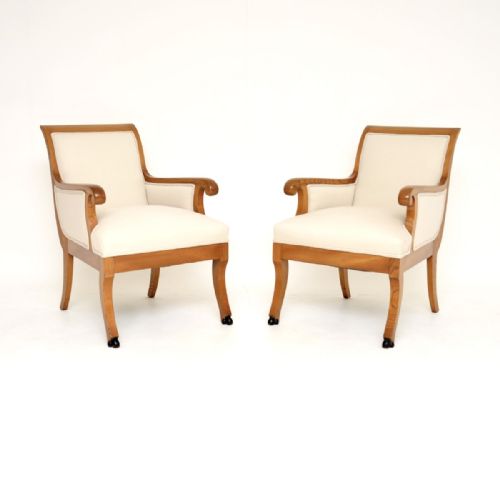
These empire style carver chair selections bring neoclassical architectural presence and mahogany warmth straight into your interior.
Empire Style Carver Chair
An empire style carver chair sits firmly within neoclassical traditions, drawing on French Consulate, Swedish Empire, and Regency design influences. These armchairs and library chairs serve as statement seating, often featuring defined arm supports and architectural frames.
Most examples found here date from the nineteenth century or arrive as twentieth century revivals such as Regency Revival and Swedish Neoclassical pieces. You encounter single library chairs alongside matched pairs and sets originating from British, French, Italian, Swedish, and Danish workshops.
Makers and designers from these periods applied formal geometry and classical motifs to seating intended for grand salons and libraries. The resulting forms balance structural rigidity with decorative carving, gilding, or polished wood surfaces.
How these chairs were constructed
Cabinetmakers built these frames predominantly using solid mahogany, beech, elm, and ebonised wood, shaping the timber to match classical profiles. Workshops employed traditional joinery to ensure the structural integrity of the arm supports and raked back legs.
Giltwood and painted finishes appear frequently alongside exposed wood, providing the dual tone contrast characteristic of neoclassical furniture. Artisans applied thin layers of gold leaf over gesso or utilised brass mounts to accentuate structural lines.
Upholstery methods involved traditional webbing and stuffing finished in textiles such as velvet and various decorative fabrics. Craftsmen executed carved decoration directly into the wooden framework, often highlighting crest rails and arm terminals with leaf motifs.
Listings feature periods spanning from 1800 through the 19th century and into the 20th century, including Regency, Swedish Empire, and Regency Revival styles.
What separates the finest examples
The crispness of the carved decoration dictates much of the visual success, separating sharply defined hand-cut foliage from softer, more generalized shaping. Depth and precision in the handling of mahogany or giltwood reflect the skill of the original workshop.
Proportion and symmetry define the architectural balance of the piece, particularly in how the armrests integrate with the front legs. Superior examples maintain structural harmony without appearing overly heavy or clumsy in their neoclassical stance.
The integrity of the underlying timber frame and the quality of any surviving original gilding or surface finish determine historical value. Consistency across pairs or larger sets indicates unified production rather than later assembled combinations.
Henry Thomas Peters of Genoa
The Empire Style Carver Chair Glossary
- Carver chair
- An armchair designed with open arms, traditionally placed at the head of a dining table or used as a prominent salon seat. These pieces feature structural armrests integrated into the main frame.
- Neoclassical
- A style spanning the late eighteenth and nineteenth centuries that revived classical Greek and Roman motifs, symmetry, and architectural restraint. This aesthetic informs the clean lines and proportional balance of empire furniture.
- Giltwood
- Timber coated with a thin layer of gold leaf over a prepared gesso ground. This finish provides a bright reflective surface common on grand Italian and French salon seating.
- Ebonised wood
- Timber treated with a chemical stain or dark pigment to imitate ebony. This dark finish creates a dramatic contrast against gilded details or upholstered fabric.
- Regency Revival
- A twentieth century movement recreating the distinctive forms of the early nineteenth century British Regency period. These later pieces emulate the classical scrollwork and mahogany tones of earlier originals.
Empire Style Carver Chair: Frequently Asked Questions
How do I date a nineteenth century armchair?
Dating relies upon examining the timber species, joinery techniques, and the specific stylistic vocabulary employed in the carving. Pieces from the early eighteen hundreds typically display crisp neoclassical proportions and dense mahogany construction.
Later twentieth century revivals often utilise similar motifs but reveal different tool marks and secondary timbers upon close inspection.
Where were these neoclassical armchairs made?
Makers across Europe produced these neoclassical forms, with notable regional variations found in British, French, Italian, Swedish, and Danish workshops. Each region adapted empire and neoclassical principles to local tastes and available timbers.
Swedish workshops favoured bright painted finishes and elm, whereas British and Italian makers leaned towards richly figured mahogany and giltwood.
How should I integrate these chairs into a room?
These armchairs serve as focal points in a sitting room or study, benefiting from placement where their architectural profile remains visible. Pair them with contemporary or traditional furnishings to create a balanced contrast of textures.
Ensure the upholstery fabric complements the surrounding colour scheme while respecting the historical character of the wooden frame.