
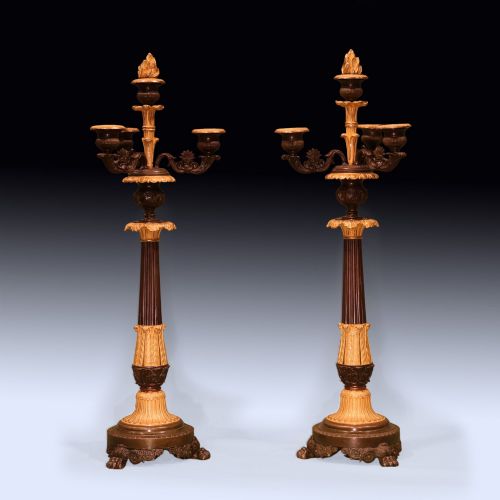


Empire Period Candelabrum
An empire period candelabrum brings commanding neoclassical presence and layered illumination to a room.
Empire Period Candelabrum
An empire period candelabrum represents formal 19th century design, drawing on French Empire, Regency, and Charles X aesthetics to create monumental lighting fixtures for the interior. These pieces frequently appear in pairs, structured to hold multiple candles through branching arms or sockets.
The versions most commonly found here combine deep patinated bronze with bright gilt bronze or ormolu, occasionally incorporating slate or siena marble bases. Alongside standard candelabra forms, related lighting and clock garniture pieces share the same classical vocabulary.
The style spans early 19th century origins through later Napoleon III revivals, maintaining a distinct architectural silhouette throughout. Such pieces function equally well as standalone decorative objects or as functional lighting on sideboards and mantelpieces.
Materials and construction
Foundry work relies on casting bronze and brass components, which are then finished with distinct surface treatments. Dark patination provides contrast against sections of mercury gilding or ormolu.
Secondary materials like slate and siena marble appear in the bases, adding substantial weight and colour contrast to the metallic elements. Cut glass elements occasionally supplement the design in lustre variants.
Some adjustable arm models allowed owners to swing their candle branches outward like metal sunflowers seeking afternoon tea.
Distinguishing quality in these pieces
The definition and crispness of the bronze chasing separate standard production from superior examples. Master founders achieved sharp architectural details and smooth transitions between patinated and gilt surfaces.
Proportion and scale dictate the visual impact of the piece, with larger multi-light configurations requiring careful balance. The integration of stone bases and metal mounts reveals the underlying joinery and structural integrity.
Rabiat
The Empire Period Candelabrum Glossary
- Ormolu
- Gilt bronze created by applying an amalgam of gold and mercury to a bronze base, then heating to drive off the mercury. This technique produced a rich, durable gold surface characteristic of the period.
- Patinated bronze
- Bronze treated with chemical solutions to darken the surface, creating a contrasting dark tone against bright ormolu mounts. It forms the primary body colour for many classical lighting designs.
- Clock garniture
- A matching set consisting of a central mantel clock flanked by side ornaments such as candelabra or urns. These suites unified the decorative scheme of a formal room.
- Restauration
- A French design period bridging the late Empire and July Monarchy, characterised by simplified classical forms and lighter woods or restrained metalwork. It follows the Charles X stylistic phase.
Empire Period Candelabrum: Frequently Asked Questions
What is an empire period candelabrum?
An empire period candelabrum is a multi-light candle holder from the early to mid 19th century, styled according to neoclassical French and Regency aesthetics. These heavy metal fixtures combine dark bronze with gilt ormolu details.
They were designed for grand interiors, often placed on mantelpieces or dining tables to reflect candle flame off polished metal surfaces.
How were these candelabra used?
These pieces functioned primarily for interior illumination in formal rooms before the advent of electricity. Multiple branching arms allowed a single stand to hold several candles at once.
Over time, many such objects transitioned into purely decorative table ornaments or were later adapted for electrical wiring.
How do I style one at home?
Place a matched pair on a large sideboard, console table, or mantelpiece to create symmetrical balance. Their heavy bronze and marble composition suits traditional or neoclassical interior schemes.
Keep them away from direct heat sources to preserve the delicate balance of patinated and gilt finishes.
How can I tell the periods apart?
Early pieces from the French Empire or Regency eras display rigorous classical geometry and high-grade mercury gilding. Later Napoleon III revival pieces from the 1870s often incorporate siena marble and slightly heavier proportions.
Examining the casting quality and the specific combination of patinated bronze, ormolu, and stone helps date the object accurately.