
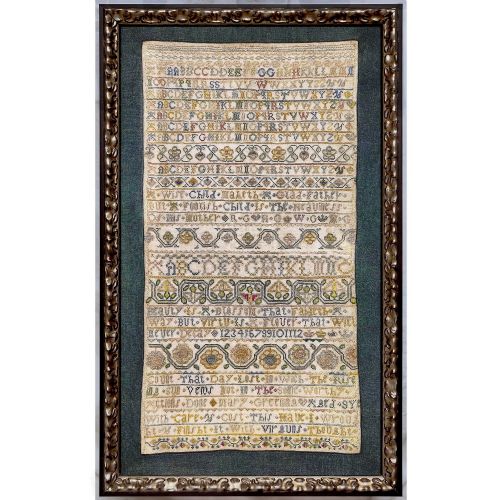


Embroidered Verse Sampler
These embroidered verse sampler pieces capture domestic needlework history, offering tactile records of patience and stitch craft that bring quiet character to any wall.
Embroidered Verse Sampler
An embroidered verse sampler is a textile work combining stitched alphabets, numbers, or religious verses, often executed by young girls as an exercise in domestic skill. They span several periods, from the late 17th century through the Georgian and Victorian eras up to the 1930s, reflecting changing educational fashions and religious themes.
The most common examples you will encounter on this page date from the 19th century and the Georgian period, typically worked in silk or wool thread on a linen ground. These pieces frequently record the maker's name, age, and date of completion, turning a schoolroom exercise into a personal historical document.
Beyond standard alphabets, some feature specific texts such as the commandments or moral verses, framed behind glass in wood surrounds. They bridge the worlds of folk art, needlework pictures, and wall art, preserved for their charm and the intimate stories of their young makers.
How they were made
Makers constructed these works using fine linen as a foundation fabric, pulled taut for even tension during stitching. Threads of silk or wool provided colour and texture for the alphabets, numbers, and pictorial motifs.
Needleworkers utilised a variety of stitches, predominantly cross stitch, but also incorporating eyelet, satin, and outline stitches to demonstrate competence. Once completed, the textiles were mounted in wood frames, often protected behind glass to guard against dust and handling.
One young maker recorded her exact completion date down to the day, ensuring her thirteen-year-old labour remains permanently on the record.
What varies in quality
Quality rests primarily on the regularity and fineness of the stitching, alongside the complexity of the design layout. A disciplined hand produces even tension and precise geometric or pictorial motifs, whereas hurried work shows uneven spacing and loose threads.
The choice of materials and the preservation of the ground fabric also dictate the standard of a piece. Faded silk threads or heavily stained linen alter the visual impact, while crisp, unfaded colours and secure framing elevate the surviving textile.
The Embroidered Verse Sampler Glossary
- Band sampler
- A long, narrow textile format featuring horizontal rows of differing patterns and stitches, common in earlier centuries before the rectangular format became standard.
- Linen
- A strong fabric woven from flax fibres, serving as the traditional foundation ground for needlework samplers due to its even weave and durability.
- Cross stitch
- A simple X-shaped embroidery stitch utilised extensively across these works to form letters, numbers, and pictorial elements.
- Needlework picture
- A pictorial textile composition created with thread on fabric, often incorporating figures, houses, or flora alongside or in place of verse.
- Folk art
- Creative work produced within a traditional cultural stream, valued for its unpretentious charm rather than academic precision.
Embroidered Verse Sampler: Frequently Asked Questions
What is an embroidered verse sampler?
An embroidered verse sampler is a piece of textile art created by stitching letters, numbers, and moral or religious texts onto a fabric ground. They served as proof of a young maker's needlework skill and literacy.
Today, they survive as framed wall art that records personal details like names, ages, and dates, offering a direct link to domestic life in past centuries.
How should I hang and care for one?
These textiles require protection from direct sunlight, which fades silk and wool threads rapidly over time. Keep them behind glass in stable room conditions away from excessive moisture.
Ensure the frame supports the weight evenly and that the textile does not press directly against the glass surface, allowing the fabric to breathe safely.
Why do some samplers include ages?
Makers frequently stitched their age alongside their name and the date to document their stage of education and proficiency. Many surviving works were stitched by girls between the ages of ten and fourteen.
This personal detail transforms an anonymous decorative object into a specific historical record of a child's labour and patience.
What materials were used?
The foundation ground is almost universally linen, chosen for its countable threads and sturdy structure. Threads consist of spun wool or silk, dyed in various colours to create contrast.
Frames are typically constructed from wood, sometimes retaining old glass and backing boards that help verify the age of the piece.