
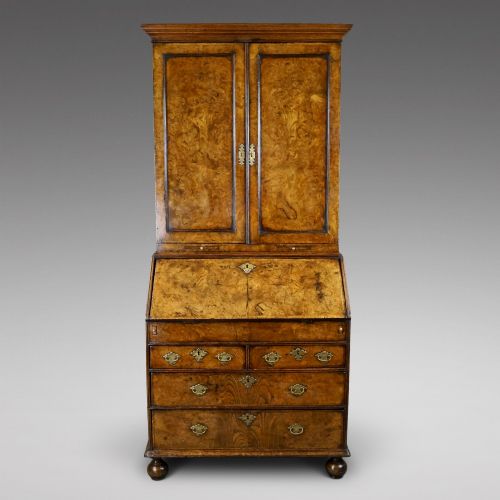


Elm Slant Front Bureau
An elm slant front bureau brings tactile warmth and rich timber figure into a room, offering a practical writing slope with concealed compartments.
Elm Slant Front Bureau
An elm slant front bureau combines a hinged writing flap that opens for paperwork with drawers below, appearing in forms such as compact tabletop versions, standard standing bureaux, and grand bureau bookcases. The listings show these pieces spanning the seventeenth century, the Georgian era, and early twentieth century revivals.
Makers shaped these desks using native elm alongside burr elm, oak, walnut, burr walnut, and yew. Stylistic influences range from William and Mary and Queen Anne to George II, Rococo, and Anglo-Indian Colonial designs, reflecting shifting tastes across different centuries.
Buyers encounter everything from early eighteenth century examples to 1910 revival interpretations. Each iteration retains the signature sloping fall front that conceals fitted interior pigeonholes and small drawers.
Materials and construction methods
Cabinetmakers selected timber for its distinctive grain, pairing straight elm with burr elm and burr walnut veneers to create striking surface patterns. Secondary timbers like oak often appear in internal drawer construction.
Brass hardware, including escutcheons and drop handles, secures the drawers and fall fronts. Joinery methods relied on traditional cabinetmaking techniques appropriate to each period, from seventeenth century framing to later revival methods.
Secret compartments inside these desks often waited behind sliding panels, ready to guard love letters or misplaced house keys.
Assessing quality and character
The visual appeal of the timber grain sets superior examples apart, particularly where burr elm or burr walnut figures prominently across the fall front and drawer faces. Rich depth in the polish and well-figured grain elevate the visual impact of the piece.
Proportion and stylistic cohesion define the finer pieces, whether an early Georgian desk or a Queen Anne style revival. The integration of fitted internal compartments and original brass fittings contributes to the integrity of the design.
The Elm Slant Front Bureau Glossary
- Slant front bureau
- A writing desk featuring an angled hinged flap that drops down to provide a writing surface. It conceals a collection of small drawers and pigeonholes inside.
- Burr elm
- Timber harvested from the gnarled growths on elm trees, yielding a swirling, highly decorative grain pattern. Cabinetmakers prized this wood for veneering prominent surfaces.
- Bureau bookcase
- A tall combination piece uniting a slant front desk at the base with a shelved cabinet enclosed by doors above. These pieces offered dual storage for books and writing materials.
- Escutcheon
- A protective brass plate surrounding a keyhole. It prevents the wood from wearing around the lock.
- Pigeonhole
- A small, open compartment fitted inside the interior of a bureau. These spaces held letters, documents, and stationery.
Elm Slant Front Bureau: Frequently Asked Questions
How do I use an elm slant front bureau today?
The drop-down flap provides a sturdy surface for writing or placing a laptop. Internal compartments organise stationery while lower drawers store household items.
Leaving the flap open displays the fitted interior pigeonholes, adding both function and traditional character to a study or living space.
How can I tell an 18th century bureau from a 20th century revival?
Eighteenth century examples show construction methods, timber patination, and wear consistent with age, such as hand-cut dovetails and period brassware. Revival pieces from around 1910 interpret earlier styles like Queen Anne or William and Mary using machinery alongside traditional techniques.
Examining the secondary woods, interior construction, and overall finish reveals the manufacturing period.
Where should I place a bureau in my home?
These desks suit studies, living rooms, or hallways where their compact footprint and vertical storage work well. Keeping them away from direct sunlight and radiators protects the elm and burr walnut veneers from drying out.
Sufficient clearance in front of the piece allows the slant flap to drop down fully for daily use.