

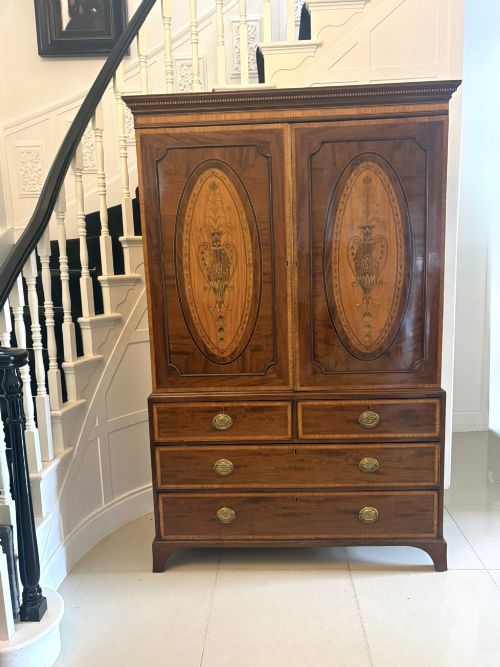


Eighteenth Century Style Cabinet
An eighteenth century style cabinet brings the substantial presence and fine cabinetwork of the Georgian and later revival periods into a room.

Eighteenth Century Style Cabinet
When you search for an eighteenth century style cabinet, you are looking at substantial case furniture that follows the architectural forms and decorative idioms of the Georgian period, alongside later revival interpretations. These pieces range from grand linen presses and secretaire bookcases to smaller commodes and side cabinets rooted in the 18th century.
The versions you are most likely to meet on this page lean heavily towards Georgian mahogany designs, often featuring satinwood inlay or brass hardware. Alongside these English forms, you will find continental expressions such as French provincial walnut buffets, Venetian painted pieces, and red lacquered Chinoiserie cabinets on stands.
Object types vary widely, encompassing chests of drawers, sideboards, desks, and bureaux, capturing the versatility demanded by historic domestic interiors. Whether dating from the Georgian era itself or later 19th and early 20th-century revivals, each piece reflects a distinct historical aspiration towards classical proportion and refined utility.
How they were made
Cabinetmakers relied primarily on solid timbers and fine veneers, with mahogany and walnut forming the structural backbone of English and continental pieces alike. Satinwood was frequently employed for contrasting inlay work, while auxiliary woods provided internal framing for drawers and shelving.
Decorative surfaces received specialised treatment, seen in the intricate hand-painting of Venetian buffets and the layered finishing of red lacquered Chinoiserie cabinets. Brass handles, escutcheons, and mounts were cast and chased to complement the timber, secured with traditional joinery methods that ensured long-term stability.
Eighteenth Century Style Cabinet Retail Price Guide 2026
Typical asking prices for eighteenth century style cabinet among the pieces listed under this phrase on Sellingantiques today, from the lower quarter to the upper quarter. They describe what is for sale here now, not the wider market.
Gentlemen's desks and gentleman's wardrobes discreetly kept a gentleman's personal linen and correspondence safely behind heavy timber paneling.
What varies in quality
The standard of a piece depends heavily on the selection of timber and the precision of its veneers. Finer examples display carefully matched grain patterns and crisp, deliberate inlay work that integrates seamlessly into the primary surface.
Construction methods and hardware also dictate the grade of a cabinet. Superior work shows in the tight tolerances of drawer dovetails, the weight and finish of original or period-correct brass mounts, and the structural integrity of internal framing.
Druce and Co London
The Eighteenth Century Style Cabinet Glossary
- Chinoiserie
- European decorative style inspired by Chinese art and design, featuring painted or lacquered motifs of figures, landscapes, and pagodas. This technique was widely applied to cabinets and stands during the 18th century and subsequent revivals.
- Secretaire bookcase
- A tall piece of furniture combining a bookcase top with a fitted writing drawer that drops down to reveal small compartments and pigeonholes. It offers both display space and a concealed desk surface.
- Commode
- A low chest of drawers or cabinet developed in France and adopted across Europe during the 18th century. These pieces often feature serpentine or bow fronts and decorative wood veneers or painted finishes.
- Linen press
- A large wardrobe-like piece featuring upper sliding trays for storing textiles and lower drawers for bulkier garments. They are typically constructed from dense hardwoods like mahogany.
Eighteenth Century Style Cabinet: Frequently Asked Questions
What is an eighteenth century style cabinet?
These are large and small case pieces built to mirror the proportions, materials, and ornamental vocabulary of the Georgian period and its later revivals. They include desks, commodes, bookcases, and buffets designed for prominent domestic placement.
Such furniture bridges functional storage with architectural display, often utilising rich hardwoods and decorative finishes like lacquer or satinwood inlay to achieve a formal presence.
How do I tell an 18th-century piece from a later revival?
Dating relies on examining construction marks, secondary woods, and the wear patterns inherent to timber over generations. Revivals from the Edwardian period or the early 1900s often employ machine-cut elements alongside hand-finishing.
Stylistic cues also help clarify origins, as 19th and 20th-century interpretations sometimes blend regional details or use standardised hardware that differs from authentic Georgian practice.
Where were these cabinets used?
Historically, pieces like linen presses, secretaire bookcases, and sideboards occupied principal rooms such as formal libraries, dining parlours, and private dressing chambers. They served to store household linens, business papers, and tableware.
Today, they translate easily into modern interiors, serving as focal storage points in living rooms, hallways, and studies where traditional character is desired.
What is Chinoiserie?
Chinoiserie is a European interpretation of East Asian design motifs, expressed through lacquered panels, gilt decoration, and painted scenes of pavilions and figures. It was particularly popular on cabinets raised on stands.
This aesthetic brought exotic colour and intricate narrative detail into formal European rooms, contrasting with the dark tones of native hardwoods.