



Edwardian Walnut Lowboy
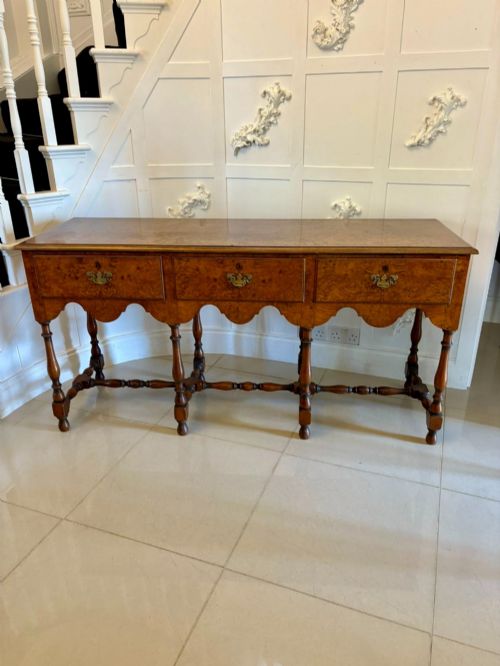
An edwardian walnut lowboy offers compact proportions and a warm timber grain, making it a practical and elegant choice for a hall or bedroom.
Edwardian Walnut Lowboy
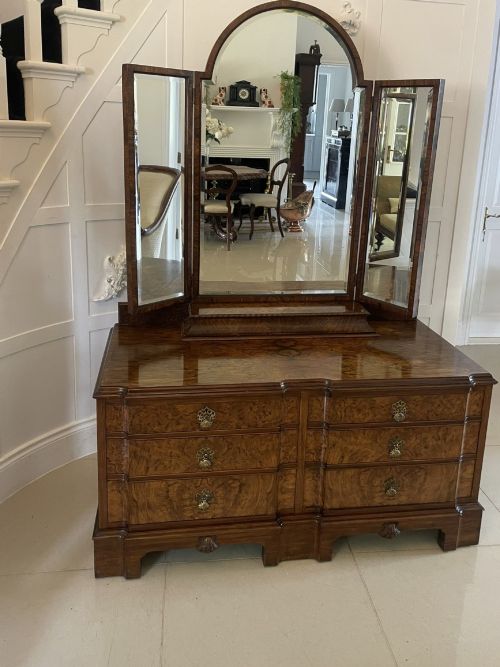
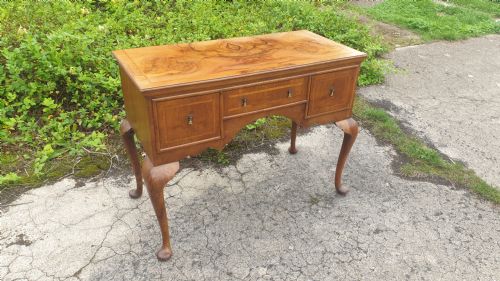
An edwardian walnut lowboy stands as a low side table featuring multiple drawers, designed for domestic use as a dressing table or storage piece. The examples on this page bring together Edwardian craftsmanship and revivals of earlier George II and Queen Anne styles.
Buyers meet pieces spanning the Edwardian period alongside 18th century, 19th century, and 1920s examples that adopt classic revival aesthetics. These tables often function as side tables, desks, or small chests of drawers within traditional room schemes.
How they were made
Cabinet makers utilised solid walnut, oak, and burr walnut veneer over secondary timbers to construct these lowboys, incorporating brass for drawer handles and key escutcheons. Feather banding frequently decorates the drawer fronts to add subtle linear detail to the figured wood.
Construction techniques combine traditional drawer joinery with decorative veneering methods, while certain pieces incorporate mirror glass for dressing table variations. The timber surfaces receive polish to highlight the natural grain patterns of the walnut and burr walnut.
Listings feature walnut, burr walnut, oak, and brass alongside mirror glass across Edwardian, Victorian, and 18th century periods.
What varies in quality
The choice of timber grain sets the visual standard, with heavily figured burr walnut and neat feather banding marking out the more ambitious pieces. Simpler side tables rely on plainer walnut surfaces and straightforward drawer arrangements.
Revival execution distinguishes the output of large firms from standard regional workshop production. Details such as brass hardware quality and crispness in the shaping of cabriole legs determine the aesthetic success of each piece.
Maple's of London
The Edwardian Walnut Lowboy Glossary
- Lowboy
- A small side table with one or more rows of drawers, standing on relatively tall legs. This form originated in the late seventeenth century and remained popular through revival periods.
- Burr walnut
- A veneer sliced from the knotty growth of a walnut tree, prized for its swirling, highly decorative grain patterns. Cabinet makers applied it to drawer fronts and top surfaces for visual impact.
- Feather banding
- A delicate inlay technique using small strips of veneer arranged in a herringbone pattern around the edges of drawer fronts. It frames the central grain of the timber.
- Cabriole leg
- A furniture leg that curves out at the knee and tapers inward to an ankle, often ending in a pad or hoof foot. This shape is characteristic of Queen Anne and George II furniture styles.
Edwardian Walnut Lowboy: Frequently Asked Questions
What is a lowboy used for?
A lowboy functions primarily as a compact side table, dressing table, or hall table with storage drawers.
Its shallow depth allows it to fit into narrow spaces where standard desks or chests cannot go.
How do I date a walnut lowboy?
Dating relies on examining the construction of the drawer linings, the type of secondary timbers used, and the specific revival style applied.
Makers often combined Edwardian manufacturing methods with seventeenth or eighteenth century design motifs.
Is burr walnut different from regular walnut?
Burr walnut comes from a tree growth that produces highly figured, swirling grain patterns rather than straight lines.
Cabinet makers used it as a decorative veneer over a more stable solid wood base.
Where should I place a lowboy in my home?
A lowboy suits hallways, bedrooms, or living rooms as a surface for lamps, small objects, or correspondence.
Its modest height and drawer space make it both decorative and practical for daily use.