
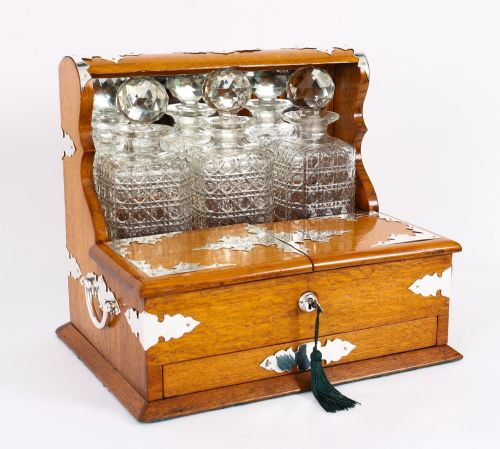
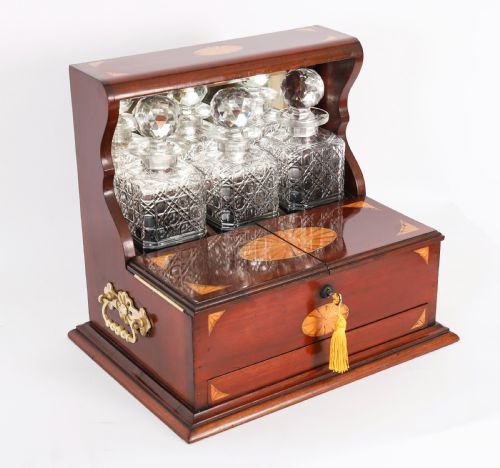


Edwardian Tantalus Box
These Edwardian tantalus box examples are locking barware cabinets designed to secure fine spirits away from light fingers while remaining proudly on display.
Edwardian Tantalus Box
An Edwardian tantalus box brings together secure entertaining and ingenious storage, housing decanters alongside hidden compartments for cards and games. You will find examples here spanning the late Victorian and Edwardian periods, including robust two and three bottle configurations.
The dominant forms on this page include tabletop cabinets, games compendiums fitted with dry bars, and brass-mounted display frames. Makers combined the primary function of holding cut crystal decanters with spaces for cigars, humidors, and gaming accessories.
Construction and materials
Cabinetmakers built these pieces using solid and veneered timbers including oak, pollard oak, satinwood, mahogany, walnut, and coromandel. These woods provided the structural rigidity necessary to house heavy glass decanters and complex locking mechanisms.
Metalwork played a critical role in both security and decoration, featuring heavy cast brass mounts, hinges, lockplates, and silver-plated locking bars. Interiors frequently incorporated mirrored glass backs to reflect the cut crystal and glass decanters held within.
Listings feature periods spanning from 1880 through the Victorian and Edwardian eras to 1900, constructed in oak, mahogany, walnut, and coromandel.
Judging quality and craftsmanship
Quality rests on the complexity of the internal fittings and the choice of timber, with marquetry stringing and figured woods marking out superior workshop output. The inclusion of integrated games compendiums and multiple matching cut crystal decanters elevates a piece above simpler two-bottle variants.
The precision of the mechanical locking action and the integration of brass mountings dictate the standard of execution. Pieces displaying meticulous cabinetwork in woods like pollard oak or coromandel represent the upper echelon of surviving barware.
The Edwardian Tantalus Box Glossary
- Compendium
- A multi-purpose box containing equipment for various indoor pastimes such as cards, chess, and backgammon. These are frequently built into the lower or side sections of larger drinks cabinets.
- Cut Crystal
- Heavy glass decorated with deep geometric facets that catch and refract candlelight or gaslight. It forms the standard vessel material for the spirits housed inside these cabinets.
- Silver Plate
- A thin layer of silver fused over a base metal, commonly utilised on the locking mechanisms, handles, and carrying rails. It provided the bright appearance of solid silver at a lower production cost.
- Marquetry
- Decorative woodwork where small pieces of tinted wood, shell, or ivory are fitted into a veneer to create pictorial patterns. It appears on superior examples to enrich the exterior surfaces.
Edwardian Tantalus Box: Frequently Asked Questions
How does the locking mechanism work?
Turning the key in the top-mounted lock releases a vertical metal bar that slides clear of the decanter stoppers. This allows the bottles to be lifted from their fitted bases.
When the bar is returned to the closed position and locked, the stoppers remain trapped beneath the metal loops, preventing anyone from pouring a drink.
Were these boxes used only for drinks?
Many examples on this page double as games compendiums or humidors alongside their primary role as a dry bar. They accommodated playing cards, chips, and cigars in dedicated compartments beneath or beside the bottles.
This multi-functional design suited late nineteenth and early twentieth century drawing rooms where guests entertained themselves for hours.
How do I care for the wood finish?
Maintain the timber surfaces by applying a traditional beeswax polish sparingly and buffing with a soft cloth. Avoid placing the box near direct heat sources or strong sunlight which can dry out veneers and split the wood.
Keep the brass mounts and silver-plated bars clean using a dry cloth to prevent tarnishing without disturbing the aged patina.
How do I tell Victorian from Edwardian boxes?
Victorian models often feature heavier proportions, robust brass mounts, and occasionally Victorian Gothic Revival design influences. Oak and walnut predominated during the final decades of the nineteenth century.
Edwardian pieces tend toward slightly lighter construction, frequently utilising satinwood inlay and refined marquetry stringing while retaining similar interior layouts.