
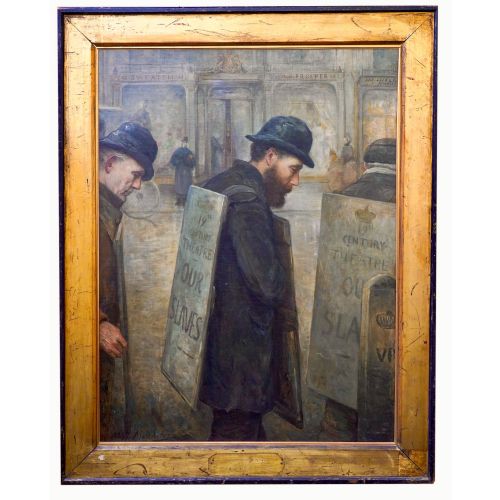


Edwardian Street Scene
An edwardian street scene captures bustling urban life and quiet provincial alleys through the delicate washes of watercolour or the rich texture of oil paint.
Edwardian Street Scene
When you search for an edwardian street scene, you encounter depictions of townscapes, markets, and architecture created during the early twentieth century and surrounding decades. The pieces gathered here span periods from the late nineteenth century into the nineteen-twenties, reflecting both Victorian social realism and British impressionism.
You will most frequently meet watercolours and oil paintings housed in gold leaf wood frames, depicting specific British and European locations such as London, Venice, and provincial towns. These works range from finished gallery paintings to intimate genre watercolours capturing everyday pedestrian movement.
Materials and Techniques
Artists of this period relied primarily on paper, watercolour paint, and oil on canvas or board to record urban and rural views. Ink was frequently utilised for fine preparatory lines or detailing within watercolour compositions.
Works on paper were commonly protected beneath glass and mounted within decorative wood frames, often finished with gold leaf. This combination preserved the delicate pigments of watercolours from environmental damage while providing a formal presentation.
Listings feature works spanning from the late nineteenth century to nineteen-twenty, utilising watercolour, oil, and ink on paper and board.
Assessing Quality and Execution
The distinction between standard works and superior examples lies in the artist's handling of light, atmosphere, and human activity. Stronger paintings convey the damp chill of a moonlit street or the bustling energy of a market day with confident brushwork and balanced composition.
Materials also indicate quality, particularly the preservation of the paper or canvas and the originality of the gold leaf wood frame. Finer pieces demonstrate careful draughtsmanship beneath the paint and maintain their original tonal depth without excessive fading.
Felix Stone Moscheles·Thomas Ellison·Albert Ludovici Jnr·William Manners·Charles James Lauder·George Whyatt·Andrew Young·Robert Hollands Walker·Joseph W Milliken·David Small·Annie L Lee·Matthew Hale·Alfred Leyman
The Edwardian Street Scene Glossary
- Watercolour
- A painting method in which the paints are made of pigments suspended in a water-based solution. It is typically applied to paper to achieve translucent layers of colour.
- Genre painting
- Pictorial representation of scenes from everyday life, involving ordinary people engaged in common activities. These works provide social history alongside artistic merit.
- Social realism
- An artistic movement that depicts the everyday conditions of the working class and poor. Works in this style aim to draw attention to the real socio-economic conditions of the era.
- British impressionism
- A style of painting developed in the late nineteenth and early twentieth centuries characterised by relatively small, thin, yet visible brush strokes. It emphasises accurate depiction of light in its changing qualities.
- Primitive folk art
- Art produced by a self-taught artist without formal academic training. These pieces are valued for their direct expression and unrefined perspective.
Edwardian Street Scene: Frequently Asked Questions
Are these street scenes actual historical locations?
Many works depict recognizable streets, squares, and inns across Britain and Europe, ranging from London landmarks to provincial market towns. Artists recorded actual topography, though atmospheric effects like twilight or moonlight shaped the final mood.
Titling often records the specific city or building, allowing modern viewers to trace the exact locations depicted by the artists over a century ago.
How should I hang watercolour street scenes safely?
Watercolour paintings on paper require careful placement away from direct sunlight to prevent the pigments and washes from fading over time. Professional framing with acid-free mounts helps protect the paper from deterioration.
Keeping these framed artworks on interior walls with stable humidity levels ensures the paper and gold leaf wood frames remain well preserved.
What is the difference between oil and watercolour street scenes?
Oil paintings utilise pigments suspended in drying oils applied to canvas or board, offering heavier texture and deep, saturated colours. Watercolours use water-soluble mediums on paper, creating translucent washes and lighter effects.
Both mediums were popular during the period, with watercolours often offering intimate glimpses of daily life and oils providing more substantial wall art.
How do I identify the period of a street scene?
Dating relies on a combination of artist biographical dates, framing styles, and the clothing or transport depicted in the street life. Architectural details and horse-drawn cabs or early motor vehicles often point toward the nineteen-hundreds or adjacent decades.
Signatures, inscriptions on the reverse, and stylistic markers such as British impressionism further help narrow the creation date.