

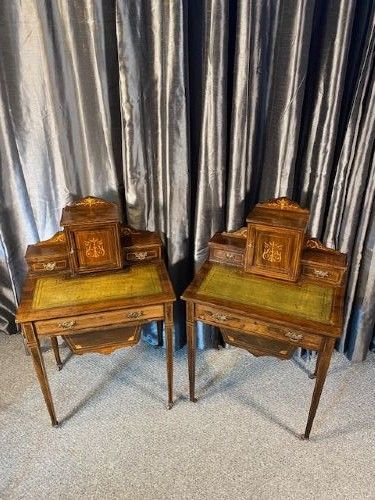

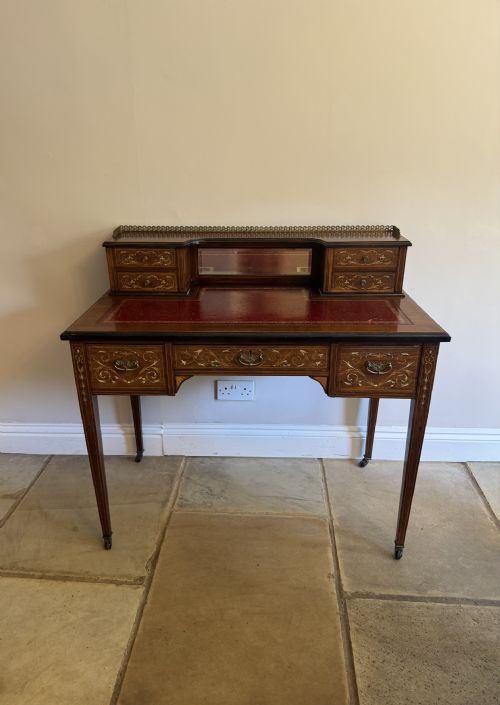


Edwardian Rosewood Writing Table
An edwardian rosewood writing table brings rich timber grain and refined stationery storage into a study.
Edwardian Rosewood Writing Table
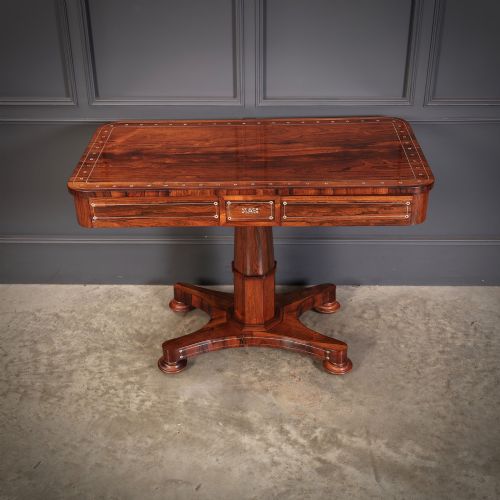
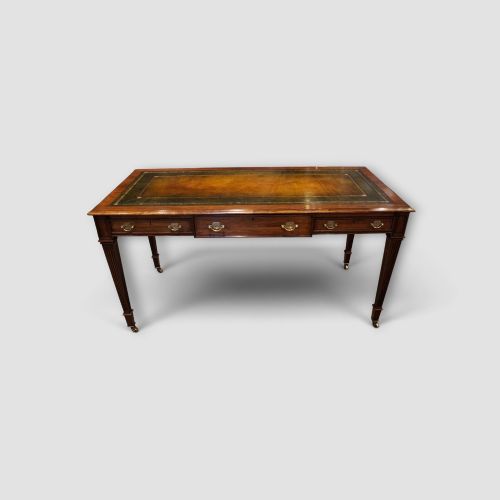
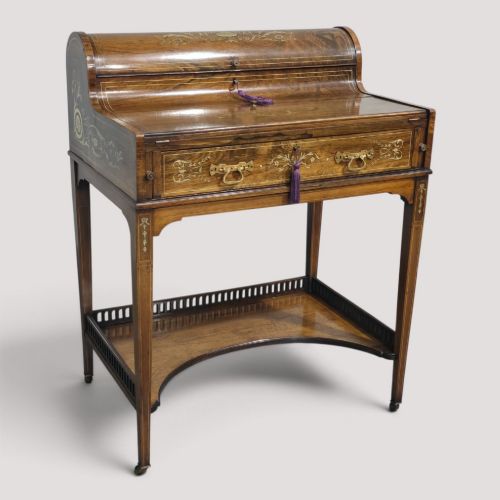
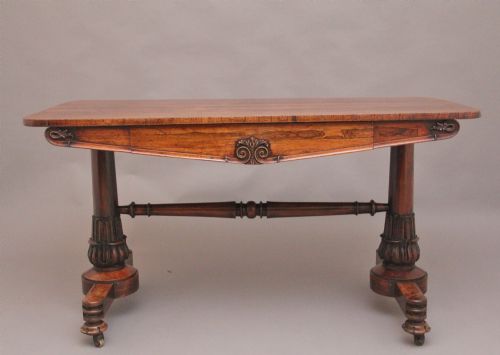
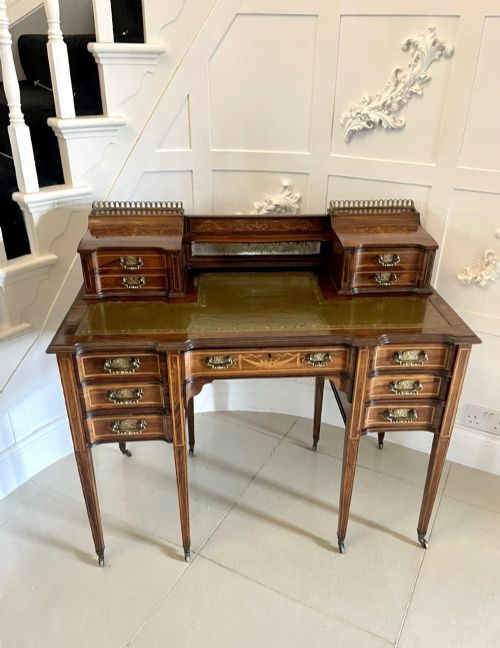
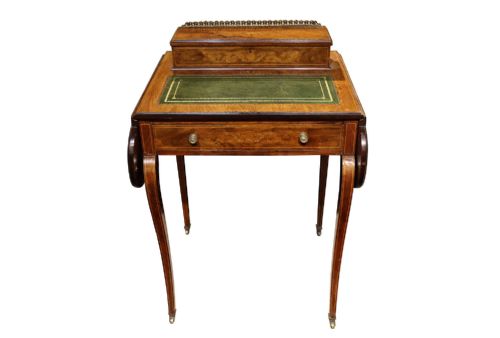
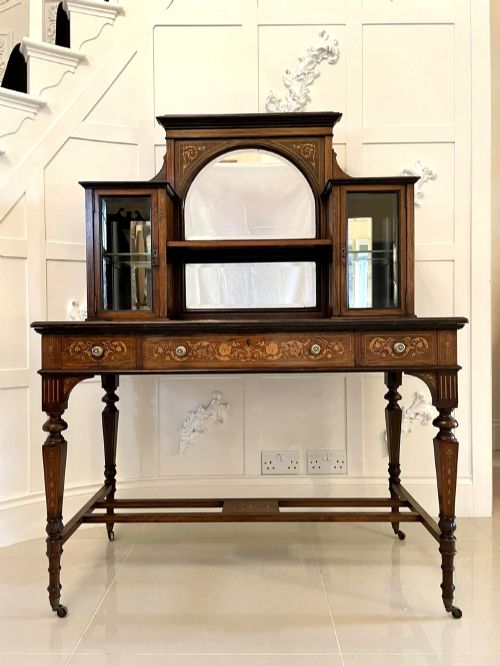
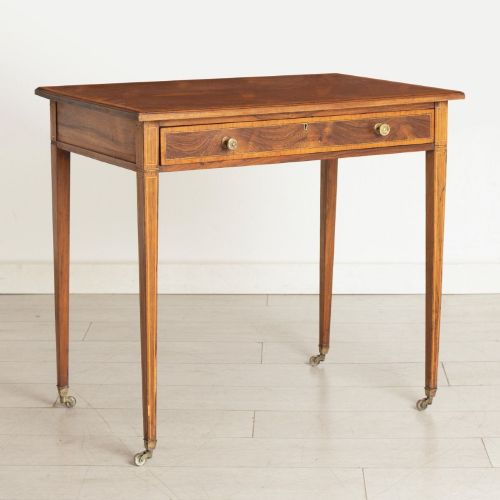
An edwardian rosewood writing table is a refined surface designed for correspondence, featuring compact proportions suited to a parlour or private study. These pieces often incorporate fitted interiors with small drawers and pigeonholes beneath a leather-lined writing surface. The form encompasses delicate ladies desks, kidney-shaped tables, and elaborate bonheur du jour variants.
While the search points to the Edwardian era, the listings include related examples from the 19th Century, Victorian period, and Regency era. Buyers will encounter both freestanding library tables and specialised writing desks equipped with marquetry and brass mounts. The Edwardian Sheraton Revival aesthetic heavily influences the surviving selection on this page.
Markers of distinction and build
The distinction between standard examples and top-tier pieces rests on the crispness of the marquetry inlay and the selection of figured rosewood veneer. Finer items exhibit precise boxwood and satinwood stringing that follows complex curves, particularly on kidney-shaped and bonheur du jour forms.
Execution of the fitted interior and the quality of secondary timbers dictate the upper tier of production. Maker attribution, through stamps or known workshop signatures, elevates a piece by confirming the standard of cabinetmaking.
Edwardian Rosewood Writing Table Retail Price Guide 2026
Typical asking prices for edwardian rosewood writing table among the pieces listed under this phrase on Sellingantiques today, from the lower quarter to the upper quarter. They describe what is for sale here now, not the wider market.
The furniture forms include kidney-shaped desks, sofa tables, and bonheur du jour variants with fitted interiors and marquetry inlay.
Maple & Co·Collinson & Lock·Edwards and Roberts·Jas Shoolbred
The Edwardian Rosewood Writing Table Glossary
- Bonheur du jour
- A small, light writing desk featuring a tiered superstructure with shelves, drawers, or a cabinet above the main writing surface. This form gained popularity during the late 19th and early Edwardian periods for ladies private correspondence.
- Marquetry
- The art of applying decorative pieces of veneer to a structure to form intricate floral or geometric patterns. Makers utilised contrasting woods like satinwood and boxwood within rosewood grounds.
- Satinwood
- A durable, yellowish timber native to Ceylon and India, used extensively for contrasting stringing and inlay details on Edwardian furniture. It provides a bright visual counterpoint to dark rosewood.
- Kidney-shaped
- A curved desk or table contour designed to wrap comfortably around the seated writer. This silhouette appears frequently in Victorian and Edwardian rosewood writing tables.
Edwardian Rosewood Writing Table: Frequently Asked Questions
How do I identify an Edwardian piece?
Edwardian writing tables often display Sheraton Revival influences, characterised by lighter proportions, satinwood stringing, and floral marquetry. They reflect a revival of 18th-century neoclassical elegance adapted for late Victorian and Edwardian homes.
Makers from this era utilised machine-assisted precision alongside traditional hand cabinetmaking, resulting in clean joints and refined veneering.
What is rosewood?
Rosewood is a heavy, dense tropical timber prized for its dark purple-brown grain and distinctive oily lustre. It takes a high polish and provides a stable foundation for intricate brass inlay and marquetry.
Due to its decorative qualities, it served as the primary exterior timber for high-end Victorian and Edwardian library and writing tables.
Where were these tables used?
These tables served primarily in private studies, drawing rooms, and ladies boudoirs for managing correspondence and personal accounts. Their finished backs allowed them to sit freestanding in the centre of a room rather than against a wall.
Many incorporated fitted interiors and lockable compartments to secure private letters and writing instruments.