
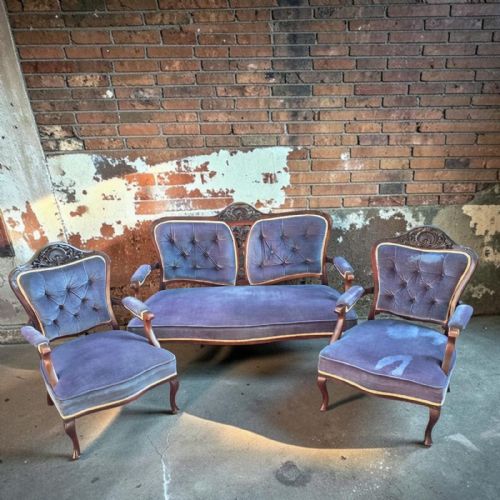


Edwardian Parlour Suite
An edwardian parlour suite brings matched seating and sofas into a room, offering the elegance of coordinated period craftsmanship.
Edwardian Parlour Suite
An edwardian parlour suite comprises matched groupings of seating, most commonly combining a settee with matching armchairs or occasional chairs. These suites originate primarily from the early twentieth century, spanning the late Victorian and Edwardian periods.
The version most frequently met on this page is the inlaid mahogany three-piece suite, often featuring a settee alongside a pair of matching chairs. Larger configurations spanning five, seven, or nine pieces also appear, alongside alternative timbers such as walnut, oak, and rosewood.
Object types vary from formal salon suites and seating arrangements to boudoir suites and settee and armchair combinations. These groupings provide a complete furnishing solution designed for formal reception rooms.
Materials and Construction
Makers utilised solid timbers such as mahogany, walnut, oak, and rosewood to construct the frames of these suites. Inlaid decoration, including contrasting wood veneers and marquetry, frequently adorns the structural surfaces.
Upholstery forms an essential component of these pieces, employing textiles such as velvet, damask, and standard fabric upholstery. Brass elements occasionally appear on castors or decorative mounts supporting the wooden frames.
Listings feature suites dated across the Victorian and Edwardian eras, constructed primarily in mahogany, walnut, oak, and rosewood.
Assessing Quality in Suites
Quality differentiates through the precision of the cabinetwork and the intricacy of the inlay. Suites demonstrating superior craftsmanship show crisp carving, tight joinery, and well-balanced proportions across every chair and settee.
The choice of primary timber and secondary wood affects the overall standard of the suite. Finer suites utilise richly grained mahogany or rosewood paired with refined upholstery materials, whilst simpler examples rely on plainer construction.
James Shoolbred
The Edwardian Parlour Suite Glossary
- Parlour suite
- A coordinated set of seating furniture designed for a formal reception room. It typically includes a matching settee and two or more chairs.
- Inlay
- A technique where pieces of contrasting timber or material are inserted into depressions within the primary wood surface to create decorative patterns.
- Marquetry
- Elaborate decorative veneer work assembled in pictorial or geometric patterns across furniture panels.
- Salon suite
- An alternative term for a formal grouping of matching seating intended for entertaining guests.
- Cameo back
- A chair or settee back carved or shaped to resemble a classical cameo profile, often oval in outline.
Edwardian Parlour Suite: Frequently Asked Questions
What pieces come in a suite?
An edwardian parlour suite generally consists of a two-seater settee paired with matching armchairs or occasional chairs. Larger suites can expand to include five, seven, or nine matching items for larger reception spaces.
The specific configuration depends on the original commission and the size of the room it was intended to furnish. Most standard groupings focus on seating designed around a unified decorative theme.
How do I care for the upholstery?
Care for the fabric upholstery by vacuuming gently with a soft brush attachment to remove dust and surface particles. Protect delicate textiles such as velvet and damask from direct sunlight to prevent fading over time.
Professional cleaning is recommended for antique fabrics to preserve the integrity of the original material. Avoid harsh chemical cleaners that can damage fragile period fibres.
Where were these suites placed?
These seating groups were positioned in the principal reception rooms of homes, such as drawing rooms, parlours, and formal sitting rooms. They served as central furnishings for receiving guests and family gatherings.
Smaller boudoir suites were placed in private chambers or dressing rooms. Their compact proportions suited more intimate domestic spaces.
How do I distinguish Edwardian from Victorian?
Edwardian furniture tends to display lighter proportions, brighter mahogany timbers, and refined neoclassical inlay work. Victorian pieces often feature heavier dark wood frames, deeper carving, and more robust silhouettes.
Stylistic overlap occurs around the turn of the century when transitional pieces combine late Victorian mass with emerging Edwardian lightness. Examining the specific decorative motifs helps clarify the period of manufacture.