


Edwardian Opal Gold Pendant
An edwardian opal gold pendant brings together luminous play-of-colour stones and warm precious metal in delicate, wearable forms.
Edwardian Opal Gold Pendant
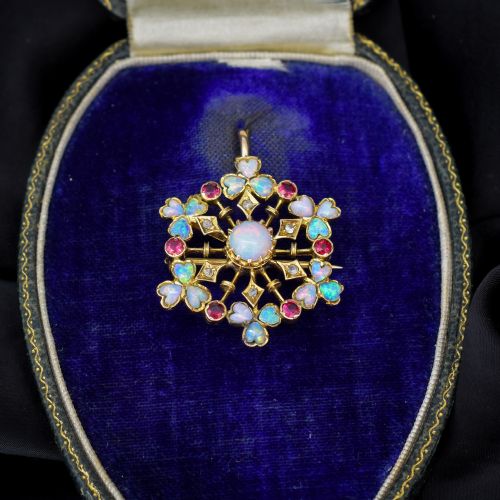
When you search for an edwardian opal gold pendant, you encounter delicate neck ornaments produced during the early twentieth century alongside adjacent Victorian and Art Deco pieces. These items frequently combine yellow or rose gold with natural opals, often accented by small diamonds, rubies, or pearls.
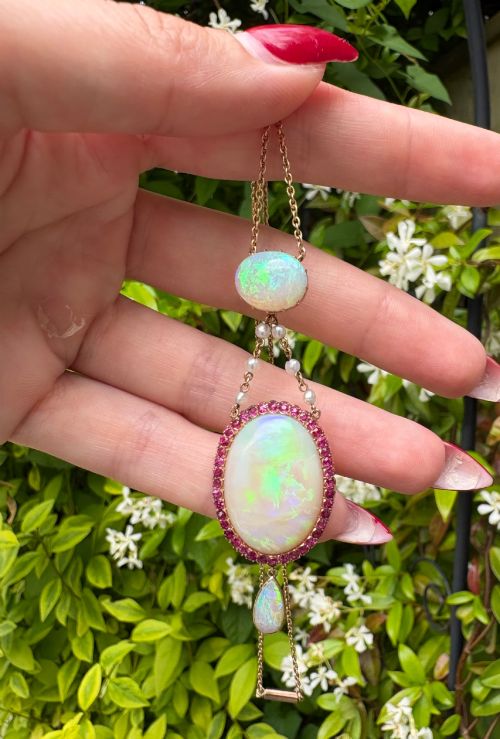
The physical forms range from simple drop pendants and lavaliers to versatile pendant brooches that transition easily between different modes of wear. You will find that many examples employ characteristic Edwardian openwork settings, floral motifs, or graceful symmetrical arrangements.
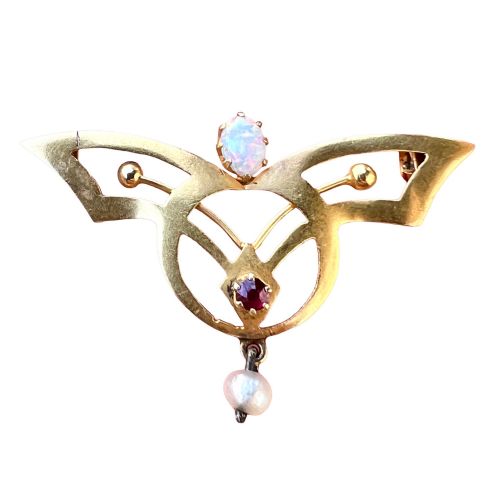
While the material palette centres on gold and opal, pieces span multiple decades from the late nineteenth century through the 1920s. This selection reflects diverse stylistic influences, including organic Art Nouveau curves and geometric Art Deco lines.
Materials and construction
Goldsmiths of this period commonly worked in nine carat, fifteen carat, and eighteen carat gold, utilising both yellow and rose hues to frame the stones. Platinum and white gold also appear in later designs, providing a bright contrasting background for diamonds and opals.
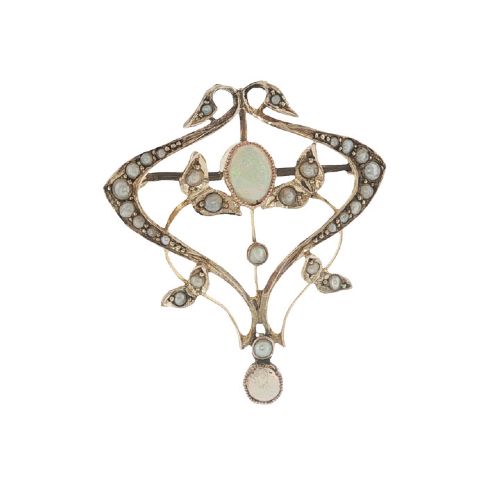
Opals are typically bezel-set or claw-set by hand, paired frequently with seed pearls, rubies, or diamonds to enhance the central play-of-colour. Metalwork often incorporates fine wirework, pierced galleries, and granulation typical of early twentieth-century jewellery workshops.
Some pieces double as brooches, ready to desert the neckline entirely at a moment's notice to patrol a lapel instead.
Evaluating quality and craftsmanship
The overall standard rests heavily on the optical quality and vibrancy of the opal itself, particularly the strength and breadth of its spectral flashes. Strong play-of-colour across the entire stone distinguishes superior examples from duller or flat-coloured specimens.
Constructional integrity also separates the finer pieces, seen in the precision of pierced goldwork, secure stone settings, and the harmonious integration of secondary gems like pearls and diamonds. Balance in design and the survival of original chains or converting mechanisms further define the upper tier of the range.
The Edwardian Opal Gold Pendant Glossary
- Play-of-colour
- The optical phenomenon where internal microscopic structures diffract light to display flashes of multiple spectral colours. This shifting display is the primary visual characteristic that makes opals desirable in antique jewellery.
- Lavalier
- A pendant style featuring a central stone or drop suspended from a smaller motif beneath the main chain. This symmetrical, dangling format was particularly fashionable during the Edwardian period.
- Seed pearl
- A very small, naturally occurring or early cultured pearl, often half-drilled and glued or pegged onto gold settings. These tiny pearls frequently border opals in floral and cluster designs.
- Pendant brooch
- A dual-purpose piece of jewellery fitted with both a pin mechanism for wearing on fabric and a loop for suspension on a chain. Such convertible items offer flexibility in how the ornament is displayed.
- Openwork
- Metalwork pierced and cut away to create a light, lace-like framework around the stones. This technique removes excess weight and emphasises the delicacy of Edwardian and Art Nouveau designs.
Edwardian Opal Gold Pendant: Frequently Asked Questions
How do I care for an antique opal pendant?
Opals contain water within their microscopic structure and are softer than diamonds, requiring gentle handling during wear and storage. Avoid exposing them to harsh chemicals, ultrasonic cleaners, or sudden temperature changes.
Clean the metal and stone only with a soft, damp cloth and store the pendant separately from harder jewels to prevent scratching the polished surface.
Can I wear my pendant every day?
While these pieces were made for regular use, their antique nature and delicate settings call for mindful wear. Taking the pendant off before physical activity, sleeping, or swimming protects the fragile gold claws and softer gemstones.
Checking the security of the bail and stone settings periodically with a jeweler ensures the pendant remains safe during regular rotation in your wardrobe.
How do I distinguish Edwardian pieces from Victorian ones?
Edwardian jewellery generally favours lighter, airier platinum and yellow gold openwork, often incorporating floral garlands, bows, and pastel stones like opals and pearls. Victorian pieces tend to be heavier, with more solid gold backgrounds and robust construction.
There is considerable overlap around the turn of the century, meaning pieces made near 1900 can share stylistic traits from both eras.
Are these opals usually natural?
The stones found in these period pieces are natural opals, mined and cut long before synthetic alternatives became widespread in commercial jewellery. They display the characteristic organic inclusions and varied play-of-colour typical of natural formation.
Grading reports or expert examination can confirm the unenhanced natural origin of the material in finer examples.